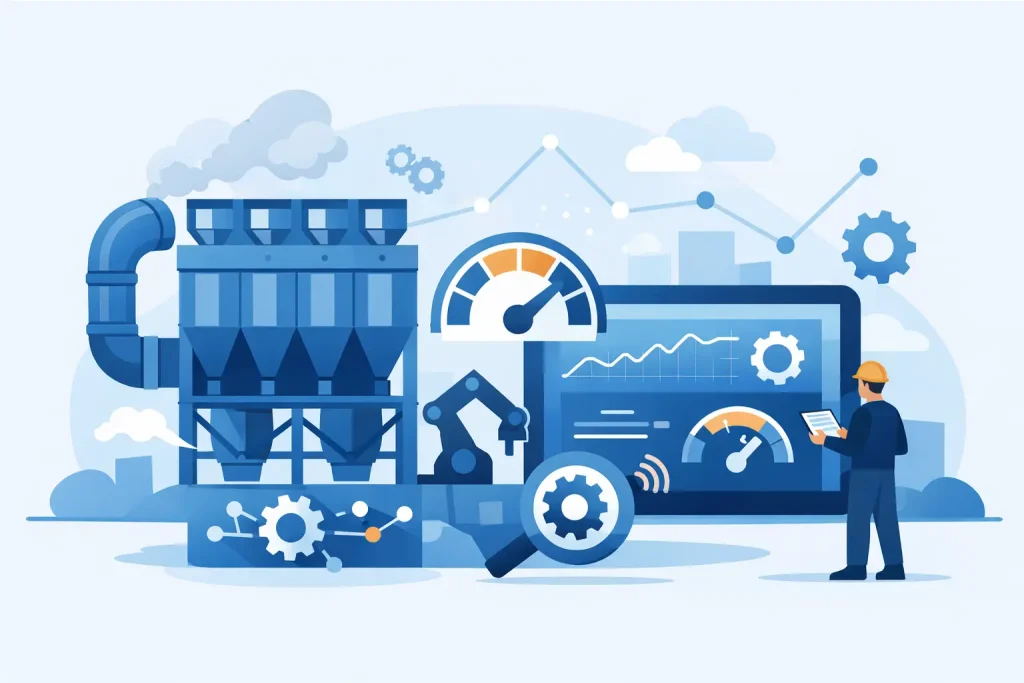
A dust collector rarely fails at a convenient time. It starts with a small pressure shift, an air leak, a weak pulse, or a fan vibration trend that looks minor until production slows, emissions rise, or a baghouse trip forces an unscheduled shutdown. Predictive maintenance for dust collectors is the discipline of catching those changes early enough to act before they become a compliance breach, a safety issue, or a costly outage.
For plant managers, EHS leaders, and maintenance teams, the value is not just mechanical reliability. A poorly performing collector can affect stack results, workplace exposure, housekeeping burden, fire risk, and the quality of compliance records. In facilities operating under strict environmental and occupational requirements, waiting for a visible failure is already too late.
What predictive maintenance for dust collectors actually means
Traditional maintenance models tend to fall into two categories. The first is reactive maintenance, where teams respond after a breakdown, high differential pressure alarm, poor suction complaint, or failed inspection. The second is preventive maintenance, where filters, valves, bearings, and other components are checked or replaced on a fixed schedule.
Predictive maintenance sits between those approaches, but with a different logic. Instead of relying only on calendar intervals, it uses equipment condition and performance trends to determine when intervention is necessary. On a dust collector, that may include differential pressure behavior, compressed air performance, fan vibration, motor current, hopper discharge consistency, pulse-valve response, stack opacity trends, or sensor-driven indications from an IoT monitoring layer.
The objective is straightforward: maintain collection efficiency, airflow stability, and regulatory performance while avoiding unnecessary part replacement. In practice, that means not changing every filter bag too early, but also not waiting until blinded media, broken cages, or leaking seals compromise system performance.
Why fixed schedules are often not enough
A fixed maintenance schedule has value, especially for statutory inspections, housekeeping controls, and routine servicing. The limitation is that dust collection systems do not age uniformly. A pulse-jet baghouse serving a metalworking process behaves differently from a unit handling food powder, feed dust, thermal process fines, or hygroscopic material.
Dust characteristics, operating hours, inlet loading, moisture content, and process upsets all affect wear patterns. One plant may see accelerated filter blinding due to sticky particulate. Another may struggle with compressed air quality that shortens diaphragm valve life. A third may have fan imbalance caused by buildup on the impeller rather than bearing wear.
If all three plants follow the same calendar-based plan, one will replace parts too early, one will miss a developing fault, and one will still face an avoidable shutdown. That is where predictive maintenance becomes commercially and operationally useful. It aligns maintenance timing with actual equipment condition.
The signals that matter most
The best predictive programs do not start with dozens of data points. They start with the few parameters that directly reflect collector health and compliance risk.
Differential pressure tells part of the story
Differential pressure across the filters is often the first trend maintenance teams review, and for good reason. Rising pressure can indicate dust cake buildup, ineffective pulse cleaning, moisture-related blinding, or airflow imbalance. Falling pressure can be just as serious if it suggests torn filter media, bypassing, or leakage.
The important point is context. A high differential pressure reading alone does not confirm a filter replacement decision. It must be read together with airflow performance, pulse frequency, compressed air pressure, hopper evacuation, and process loading. Otherwise, teams may treat the symptom while missing the root cause.
Pulse-cleaning performance affects filter life and airflow
In pulse-jet dust collectors, cleaning efficiency depends on stable compressed air supply, functioning solenoid valves, healthy diaphragms, proper sequencing, and correctly set pressure. A weak pulse may not trigger an immediate alarm, but over time it can drive pressure upward, reduce suction at pickup points, and accelerate media failure.
Monitoring pulse performance can be done through valve cycle counts, pressure trends, and periodic field verification. In facilities with online monitoring, irregular cleaning patterns often become visible before operators notice reduced extraction performance on the floor.
Fan and motor condition should never be separated from filtration performance
A dust collector is not only a filter housing. It is an air movement system. Fan vibration, bearing temperature, motor current, and damper position all influence whether the collector is actually capturing contaminants at the source.
A collector may appear functional while delivering inadequate airflow to hoods, ducts, or LEV points. That is why predictive maintenance for dust collectors should include the fan set, not just the filter section. From a compliance standpoint, acceptable stack appearance does not guarantee acceptable capture performance in the work area.
Hopper discharge and rotary valve behavior are often overlooked
Many dust collector problems begin below the filter section. Bridging, buildup, faulty rotary valves, and inconsistent discharge can push dust back into the system, interfere with cleaning, and raise internal loading. Over time, this can affect pressure stability and increase the risk of re-entrainment.
This is one of the clearest examples of why predictive maintenance must be system-based. A filter issue may actually be a discharge issue.
Compliance is a maintenance outcome, not a separate task
For regulated facilities, predictive maintenance is not just about extending equipment life. It supports defensible compliance. Dust collectors that drift out of specification can affect emission limits, workplace exposure performance, and the reliability of inspection findings. If the system is part of a larger control strategy tied to Clean Air Regulation requirements, DOSH-LEV performance expectations, or documented internal EHS targets, then maintenance quality directly affects regulatory confidence.
This matters during field auditing, testing and commissioning reviews, stack sampling, and root-cause investigations after a performance complaint. Maintenance teams need more than service checklists. They need trend records, alarm histories, inspection findings, and evidence that the system was monitored and corrected before noncompliance escalated.
In that sense, predictive maintenance creates documentation value as well as operating value. It shows that the plant is managing emission-control assets proactively rather than reacting after a deviation is already visible.
Building a practical predictive program
A workable program usually begins with a baseline. That includes collector design data, normal differential pressure range, airflow targets, fan operating conditions, pulse-cleaning settings, and the known behavior of the process it serves. Without a baseline, trend analysis becomes guesswork.
The next step is instrumentation and disciplined observation. Some plants are ready for a full IoT-enabled monitoring layer that captures live performance and alarms across multiple assets. Others begin with manual trend logs and targeted sensors on critical collectors. Either approach can work if the data is reliable and reviewed consistently.
What matters most is choosing action thresholds that are specific enough to trigger maintenance before failure, but not so sensitive that teams learn to ignore alarms. A collector that handles variable dust loading may need wider operating bands than one serving a steady process. This is where engineering judgment matters.
Maintenance response should also be structured by failure mode. A rising pressure trend may lead to inspection of pulse valves, compressed air quality, and hopper discharge before media replacement is approved. Increasing fan vibration may trigger balancing, cleaning, or bearing checks depending on the signature. Predictive maintenance is effective only when data leads to the right intervention, not just faster intervention.
Where plants often get it wrong
One common mistake is treating monitoring as predictive maintenance by itself. Installing gauges, sensors, or dashboards does not improve reliability unless someone reviews the trends and acts on them. Another mistake is focusing only on the collector body while ignoring duct leakage, hood design, or process changes that alter dust loading.
There is also a commercial trade-off to manage. A highly instrumented system offers better visibility, but not every dust collector needs the same level of monitoring. Critical process lines, regulated emission points, and systems with expensive downtime usually justify a stronger monitoring architecture. Smaller or less critical units may be better managed with a lighter condition-based approach supported by periodic servicing and auditing.
For many facilities, the right model is hybrid. Routine preventive work remains in place for statutory and wear-based items, while predictive methods are used to prioritize inspections, troubleshoot drift, and schedule interventions before performance drops below acceptable limits.
Why lifecycle support matters
Predictive maintenance is most effective when the same technical partner understands system design, fabrication details, commissioning data, field performance, and compliance obligations. That continuity shortens diagnosis time and improves the quality of corrective action.
A one-stop provider such as Master Jaya Group can connect equipment knowledge with field auditing, stack sampling, after-sales service, spare parts readiness, and online monitoring support. That matters when a pressure trend is no longer just a maintenance issue but a possible compliance exposure.
The strongest dust collection programs are not built around emergency calls. They are built around visibility, traceability, and timely intervention. When a plant can see performance drift early, verify root cause, and document corrective action, maintenance becomes a control measure rather than a repair function.
A dust collector does not need to fail dramatically to create risk. It only needs to perform slightly worse, day after day, until the gap shows up in emissions, exposure, or production. Predictive maintenance closes that gap before it becomes someone else’s reportable problem.