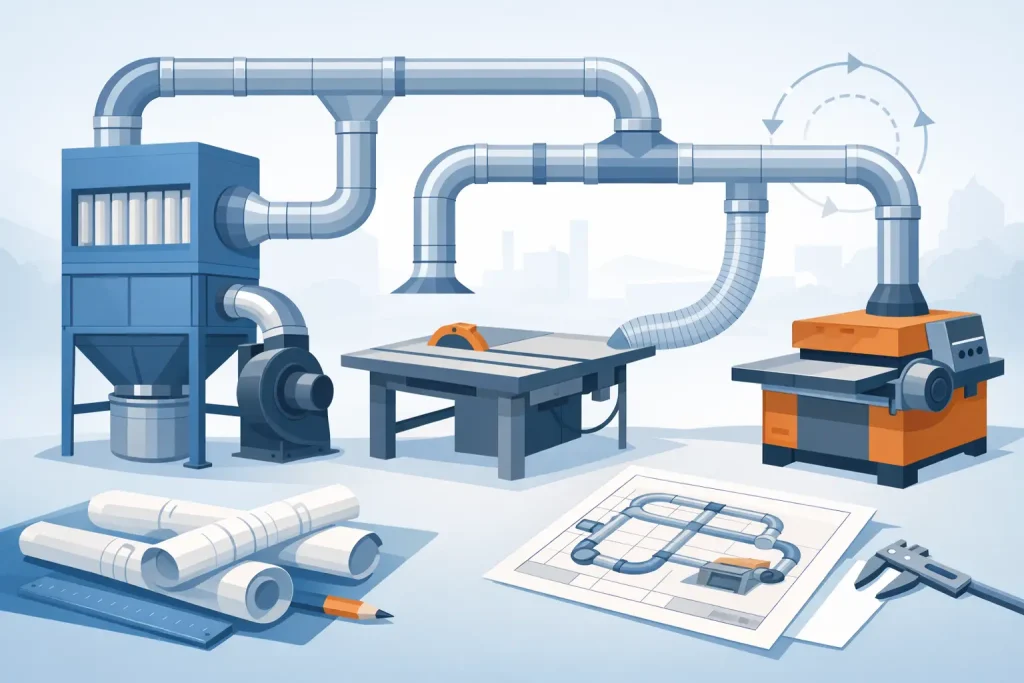
A dust collector can be correctly sized, fitted with the right filter media, and still underperform because the ducting layout was treated as an afterthought. In most industrial plants, how to plan dust collector ducting layout is what determines whether you achieve stable airflow at every pickup point or spend months dealing with weak suction, dust escape, high static pressure, and repeated maintenance calls.
For plant managers, EHS leaders, and project engineers, this is not only a housekeeping issue. Duct routing affects capture efficiency, fan energy use, combustible dust risk, filter loading, worker exposure, and the quality of compliance evidence during auditing, testing, and commissioning. A good layout is not the shortest sketch on paper. It is the arrangement that delivers required transport velocity and balanced extraction under actual operating conditions.
Start with the process, not the duct
The first mistake in duct design is beginning from available ceiling space instead of the emission source. Before drawing a single branch, define what must be captured, where it is generated, how often it is generated, and whether all pickup points will operate at the same time.
A grinding booth, bag dumping station, ribbon blender, shot blasting line, and transfer conveyor do not behave the same way. Dust particle size, moisture, bulk density, abrasiveness, and explosibility all influence duct diameter, branch velocity, hood design, and collector selection. Fine dry powder may stay suspended easily but can settle in oversized duct runs when air volume drops. Heavier particulate may require higher conveying velocity to prevent buildup. Sticky material may force you to simplify routing and reduce horizontal sections where accumulation can occur.
This early process review also clarifies whether you are designing for nuisance dust, product recovery, hazardous particulate, or regulated worker exposure control. That distinction matters because the acceptable margin for leakage, poor balancing, or unstable airflow is very different.
How to plan dust collector ducting layout from the hood backward
The most reliable approach is to work backward from each hood or pickup point to the dust collector. Each source needs a target capture velocity or required airflow based on the process geometry and emission behavior. If the hood is weak or poorly positioned, no amount of downstream duct optimization will fully recover performance.
Once airflow is established at each pickup point, you can build the branch and main duct network around those requirements. This prevents the common problem of selecting a main trunk size first and then forcing all sources to fit it. In practice, the hood, branch losses, total equivalent duct length, and collector resistance must all be evaluated as one system.
A layout that looks neat may still fail if the branches closest to the fan pull too much air while distant points starve. Balanced extraction is the real target, especially in plants where production variation means some stations open and close throughout the shift.
Keep duct runs direct, but not simplistic
Shorter duct runs usually reduce pressure loss, but shortest is not always best. The layout should minimize unnecessary length, abrupt direction changes, and transitions, while still allowing access for maintenance, safe routing around structural obstacles, and proper placement of blast gates, cleanout points, and supports.
Long horizontal runs are often where performance problems begin. If transport velocity is marginal, settled dust will collect in these sections first. That increases resistance, changes branch balance, and can create a recurring housekeeping and fire risk. Where horizontal routing cannot be avoided, velocity must be adequate and elbows, branches, and access points should be selected with maintenance in mind.
Elbows deserve particular attention. Tight-radius bends increase turbulence and pressure loss, and they can accelerate wear in abrasive applications. Long-radius elbows generally perform better. Branch entries should be angled in the direction of flow rather than connected at sharp ninety-degree intersections, which disrupt air movement and encourage material dropout.
Size ducts for transport velocity and system stability
Duct sizing is where many layouts drift from engineering into guesswork. If ducts are too large, air velocity drops and particulate settles. If ducts are too small, static pressure rises, fan demand increases, and the system becomes noisy and energy intensive.
There is no single correct diameter without knowing the dust characteristics and required airflow. That is why planning must be based on calculated air volume and target conveying velocity for the material involved. Fine fumes, wood dust, metal grinding dust, and granular process dust all behave differently. The right design maintains enough velocity to keep material moving while avoiding unnecessary pressure loss.
System stability also matters. A layout should perform not only at full production, but during partial operation. If only a few pickup points run at once, branch velocities and fan conditions may change significantly. In these cases, damper strategy, variable frequency drives, or carefully staged extraction zones may be required to maintain control.
Plan for pressure loss before equipment selection
The ducting layout and the dust collector are inseparable. Total static pressure includes hood entry loss, branch duct friction, elbow and fitting loss, dirty filter resistance, spark arrestors or pre-cleaners where applicable, and discharge-side considerations. If this is underestimated, the installed fan may never reach the required airflow.
This is why experienced system design does not begin with a catalog fan curve alone. It begins with a realistic pressure-loss model based on the final routing. Even small layout changes can affect fan selection, motor size, noise treatment, and operating cost over the system life cycle.
For retrofit projects, this point is even more critical. Existing collectors are often reused with new branch lines added over time. The result is a network that has outgrown the original fan capacity. Weak suction at new points is then blamed on the collector when the real issue is accumulated system resistance.
Design for maintenance access and compliance verification
A ducting layout is not complete when the fabrication drawing is issued. It must also be serviceable. Access doors, cleanout locations, inspection points, and safe approach for maintenance teams need to be part of the plan. If operators cannot reach a branch to inspect buildup or adjust balancing dampers, performance will deteriorate quietly until it becomes a production or compliance issue.
This is particularly relevant in facilities that require defensible environmental and occupational records. During field auditing, stack sampling, or performance review, airflow instability and visible leakage can quickly raise questions about whether the system is operating as designed. A clean layout with accessible test points supports reliable testing and commissioning and makes future troubleshooting far more efficient.
Plants subject to air emission permits, internal ESG reporting, or worker exposure controls should also think beyond startup. Differential pressure trends, airflow checks, and online monitoring become more meaningful when the ducting system has been designed for repeatable performance rather than improvised around site constraints.
Common layout errors that create recurring problems
Most recurring duct problems come from a short list of design decisions. One is placing the collector wherever there is leftover space, forcing excessive bends and long runs. Another is using the same duct size throughout the system instead of stepping the main as airflow accumulates. A third is relying on branch dampers to fix a layout that was never balanced by design.
Another frequent issue is ignoring future expansion. If the plant may add another process line, transfer point, or enclosure within two years, that should be considered now. It may be more economical to plan fan margin, collector capacity, and duct routing for staged growth than to reconstruct the network later.
Combustible or high-value dust applications also require more discipline. Material accumulation, poor grounding, unsuitable routing, and inaccessible sections create avoidable risk. In these applications, ducting design should be reviewed as part of the full hazard and compliance framework, not treated as a fabrication exercise.
A practical engineering workflow
For most industrial projects, the best path is straightforward. Confirm the dust characteristics and process duty. Establish airflow requirements at each hood. Develop a routing concept that minimizes pressure loss and supports maintenance access. Calculate total system resistance under real operating scenarios. Then select the collector, fan, controls, and duct sizes as an integrated package.
That workflow sounds basic, but it is where project outcomes are decided. A compliance-led design partner will usually add site audit observations, fabrication constraints, installation sequencing, testing and commissioning criteria, and post-installation verification into the same scope. That is the difference between installing equipment and delivering a working extraction system.
In practice, how to plan dust collector ducting layout is less about drawing lines between machines and more about controlling airflow with accountability. When the layout is engineered correctly, suction is stable, filters load as expected, maintenance becomes predictable, and your plant is in a stronger position for both operational reliability and compliance review.
If you are planning a new system or correcting an underperforming one, the smartest first step is to treat ducting as a performance-critical asset, not a supporting accessory.