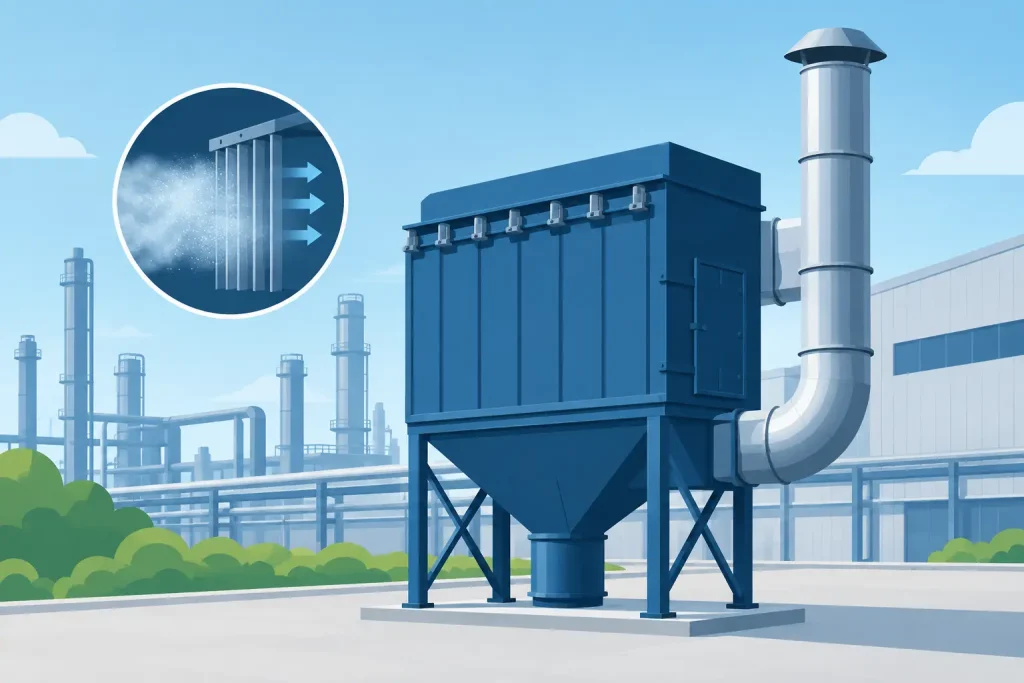
A mist collector review should begin at the machine, not with a catalog specification. A collector can show strong filtration efficiency on paper and still leave visible haze, slippery floors, oil odor, or operator exposure if the hood, ductwork, airflow, and maintenance plan are wrong. For plant managers and EHS leaders, the relevant question is whether the complete local exhaust ventilation system controls the contaminant at the point of generation and provides records that support continued compliance.
Oil mist and coolant aerosol are common in CNC machining, grinding, stamping, rolling, cold heading, and other metalworking processes. Their particle size, concentration, temperature, chemistry, and fire behavior vary substantially. That is why an industrial mist collector must be reviewed as an engineered control system, with capture performance and lifecycle service considered alongside the filter housing itself.
What a Mist Collector Review Should Measure
The first measure is source capture. A high-efficiency final filter cannot compensate for an enclosure opening that is too large, a hood set too far from the emission source, or insufficient duct velocity. Air takes the path of least resistance. If the machine enclosure leaks or process-generated mist is pushed beyond the hood by rotating tools, coolant pressure, or cross-drafts, contaminated air can enter the work area before it reaches the collector.
Review the actual operation, including door-open cycles, loading arrangements, part geometry, tool speed, coolant delivery, and simultaneous machine use. A system that works during a short demonstration may perform differently across a full production shift. Smoke visualization, airflow measurements, static-pressure readings, and operator observations provide a more credible picture than a single visual inspection.
The next measure is separation efficiency across the relevant aerosol range. Larger droplets are generally easier to remove than fine, respirable mist. A properly configured multistage system often uses a pre-separator or impingement stage to remove bulk liquid, followed by coalescing media that joins small droplets into larger drops for drainage. A final high-efficiency filter may be appropriate where clean discharge air or recirculation requires tighter control.
Efficiency must be considered with pressure drop. A fine filter that loads quickly can reduce airflow and weaken capture at the machine. The best arrangement balances contaminant removal, fan capacity, energy consumption, filter life, and access for service. Review both clean and dirty pressure-drop conditions, not only the initial performance value.
Match the Technology to the Mist
There is no universal mist collector design. The correct technology depends on whether the process produces water-soluble coolant mist, straight-oil mist, smoke from high-speed machining, or a mixed contaminant stream containing fine metal particulate. The collection method should also account for the required airflow, number of connected machines, available footprint, discharge route, and whether recovered fluid can be drained or reused.
Centrifugal collectors can be effective for heavier droplets and applications requiring compact equipment, but they may need additional stages where fine aerosol or smoke is significant. Media-based coalescing collectors can provide strong fine-mist control when the media is selected correctly and drainage is maintained. Electrostatic precipitators may be considered for specific oil-smoke applications, although performance depends on regular cell cleaning and the electrical condition of the collection section.
A review should identify what is actually being generated rather than relying solely on process labels. Two machining centers using the same coolant can create very different emissions because of spindle speed, tool condition, workpiece material, enclosure design, and coolant concentration. Where uncertainty is material, field auditing and sampling establish a firmer design basis.
Recirculation Requires Greater Discipline
Returning treated air to the facility can reduce conditioned-air losses, but it introduces a higher burden of verification. The system must consistently maintain required airflow and filtration performance, and the plant should confirm applicable OSHA requirements, local building codes, fire codes, and insurance requirements. Discharge air that is acceptable outdoors is not automatically suitable for recirculation.
For externally exhausted systems, the review should examine discharge location and possible impacts on adjacent air intakes, roof access areas, neighbors, and future expansion. If permitting or emissions documentation applies, the design should support defensible testing and operating records.
Airflow, Ductwork, and Hood Design Decide Results
Many mist-control problems are duct-design problems. Excessively small ductwork creates high resistance and can overload the fan. Oversized ductwork can allow liquid to drain or collect in undesirable locations. Poorly placed elbows, branch connections without balancing, and long flexible duct runs can all reduce extraction from the machines that need it most.
A competent review should verify fan static pressure against the complete system resistance, including hoods, ductwork, dampers, collector stages, and final filter loading. It should also establish a practical operating range for airflow and differential pressure. Without this baseline, maintenance teams cannot tell whether declining performance is caused by a loaded filter, a damaged fan, an obstructed drain, or a changed production condition.
Pay close attention to liquid management. Collected oil or coolant must drain reliably from each stage without re-entrainment into the airstream. Drain traps, hoses, sumps, and containers need to be accessible and compatible with the fluid. A collector that accumulates liquid internally can become inefficient, difficult to service, and potentially hazardous.
Fire and Safety Risks Must Be Reviewed Early
Oil mist is not simply a housekeeping issue. Certain oils, finely divided metal particles, sparks, hot chips, and combustible residues can create fire risk. The review must identify ignition sources, fluid flash point, process temperatures, and the possibility of aluminum, magnesium, or other reactive dust entering the system. A mist collector should never be selected on airflow alone when combustible-metal or flammable-vapor hazards are present.
The required safeguards may include suitable separation stages, spark control, fire suppression, interlocks, electrical classification review, and operating procedures for filter replacement and waste handling. The exact requirements depend on the hazard assessment and applicable codes. In these cases, consultation with qualified fire-protection and process-safety professionals is part of responsible project planning.
Maintenance Is a Performance Requirement
A collector that cannot be serviced safely and predictably will not sustain its design performance. Review access doors, filter-change clearance, lifting needs, drain points, fan inspection access, electrical isolation, and the availability of replacement parts. If a technician must remove ductwork or work in an awkward position to change a filter, routine service will be delayed.
A practical maintenance plan should define inspection intervals, differential-pressure limits, cleaning procedures, drainage checks, fan and motor checks, and records of corrective action. The plan should distinguish between washable components, disposable media, and components that require specialist cleaning. Washing a media filter that is not designed for washing can permanently reduce efficiency or damage the filter structure.
For facilities with multiple machines, monitoring adds value when it gives maintenance teams actionable information. Differential pressure, fan status, airflow indication, and operating hours can be incorporated into a plant monitoring strategy. Online performance monitoring is most useful when alarms lead to an assigned response, documented inspection, and timely correction.
Documentation Makes Performance Defensible
A credible mist collector review produces more than a recommendation. It should create a traceable basis for procurement, commissioning, and future audits. At minimum, the project file should capture the process description, emission characteristics, required airflow, hood and duct arrangement, collector configuration, fan duty, electrical requirements, safety considerations, and maintenance requirements.
During testing and commissioning, record airflow at designated points, static pressure, filter differential pressure, fan rotation and current draw, drainage operation, and observations of capture at each connected machine. If exposure monitoring, indoor-air evaluation, or emissions testing is required, establish the sampling plan before installation rather than after concerns arise.
For organizations operating under formal environmental and occupational health programs, this information supports management review, corrective action, and change control. It also prevents a common failure: adding another machine to an existing collector without confirming whether the fan and filtration stages have sufficient capacity.
When Replacement Is Not the Only Answer
A new collector is not always the best first response. An existing unit may be recoverable through fan correction, duct balancing, replacement coalescing media, better drainage, enclosure improvements, or a revised hood arrangement. Conversely, repeated filter loading, persistent haze, and inadequate capture may show that the current system was never sized for the process.
The decision should compare the cost of corrective upgrades against the operational risk of continuing with poor control. Consider downtime, coolant loss, slip hazards, cleaning labor, employee complaints, replacement filters, energy use, and the likelihood of compliance issues. Master Jaya Group applies this lifecycle perspective through field auditing, engineered upgrades, testing and commissioning, and ongoing service support rather than treating filtration equipment as a standalone purchase.
The most useful closing question is simple: can the facility demonstrate that mist is being captured where it is generated, transported safely, separated effectively, and controlled consistently over time? When the answer is supported by measured performance and disciplined maintenance, the mist collector becomes a reliable part of plant air-quality management rather than another piece of equipment waiting for attention.