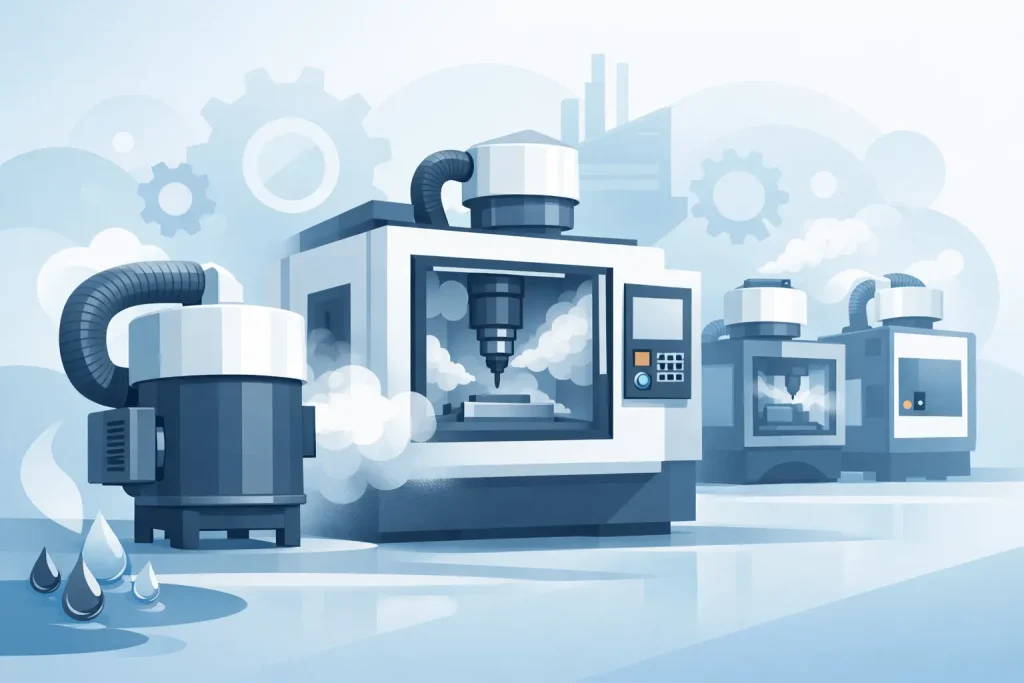
A CNC enclosure that looks clean at the door can still be pushing fine oil aerosol into the shop air, coating electrical cabinets, loading HVAC filters, and exposing operators to persistent mist. That is why choosing the best oil mist collectors for CNC machines is not a simple catalog exercise. The right system has to match the machining process, the coolant chemistry, the enclosure design, the plant’s ventilation balance, and the site’s exposure-control obligations.
For plant managers, EHS leaders, and maintenance teams, the practical question is not which unit has the strongest sales claim. It is which collection method will remain effective after commissioning, after production rates change, and after six months of actual coolant carryover. Oil mist collection is a long-life engineering decision with direct impact on housekeeping, machine uptime, fire risk, and defensible compliance.
What makes the best oil mist collectors for CNC machines
The best-performing systems are selected around particle behavior, not just nameplate airflow. CNC machining generates different contaminants depending on operation. High-speed milling with water-soluble coolant often creates very fine mist. Turning and drilling may generate a larger droplet distribution. Grinding can produce a more difficult mix of mist and ultra-fine particulate. If the collector technology does not match that profile, capture efficiency falls quickly in real service.
Airflow also needs to be evaluated at the machine, not only at the collector. A collector with attractive rated CFM can still underperform if the duct layout is restrictive, the hood entry is poorly located, or multiple machines are manifolded without proper balancing. In production environments, the better solution is often the one with predictable pressure drop, stable filtration performance, and service access that maintenance teams will actually use.
A serious selection process should also consider discharge routing, fire prevention, condensate drainage, replacement media availability, and whether the installation can support inspection, testing, and ongoing monitoring. This is where an engineered supplier has an advantage over a box-only vendor.
The main collector types and where they fit best
Centrifugal oil mist collectors
Centrifugal units use rotational force to separate larger oil droplets from the airstream. They are commonly used on individual CNC machines and can be effective for applications with relatively coarse mist loading and stable operating conditions. Their main strength is low initial pressure drop and compact machine-mounted installation.
The trade-off is that centrifugal separation alone is usually less effective on very fine mist and smoke. If the process includes high spindle speeds, aggressive coolant atomization, or thermal generation, these units may need secondary filtration to achieve acceptable air quality. They can be a good fit for straightforward machining cells, but they are not always the best answer for complex contaminant profiles.
Media filter collectors
Media-based systems are among the most common options for CNC oil mist control because they can handle a wide range of particle sizes. A typical arrangement may include a pre-filter, coalescing stage, and final high-efficiency filter. This staged design allows small droplets to merge and drain while the final stage captures residual fine mist.
For many plants, this is the most practical balance of efficiency and flexibility. It works well across mixed machining operations and can be scaled from single machines to centralized systems. The downside is maintenance discipline. If filter loading is not monitored, static pressure rises, capture suffers, and operators start noticing haze and odor long before anyone changes media.
Electrostatic precipitators for oil mist
Electrostatic precipitators, or ESP systems, are highly effective where the contaminant is very fine oil smoke or submicron mist. They charge particles and collect them on oppositely charged plates, which can then be washed and returned to service. In the right application, ESP technology offers high efficiency with lower ongoing consumable costs than heavy media replacement programs.
However, they require careful application engineering and regular cleaning to maintain performance. Electrical components must be protected, wash cycles must be managed, and some facilities prefer not to rely on a system that can lose efficiency when plates are neglected. For high-volume, fine-mist CNC environments, though, ESP remains one of the strongest options.
Hybrid systems
The best answer in demanding plants is often a hybrid arrangement. This may combine inertial separation, coalescing filtration, and final HEPA or high-efficiency polishing. In some cases, electrostatic pre-cleaning is paired with media finishing. Hybrid designs are especially useful where processes vary by machine, coolant types change, or the plant needs stronger assurance on indoor air quality.
The benefit is resilience. The trade-off is higher capital cost and the need for proper testing and commissioning.
How to compare the best oil mist collectors for CNC machines
The first comparison point is contaminant size distribution. If your process mainly generates visible wet mist, a coalescing media system or centrifugal collector may be sufficient. If the issue is smoke-like aerosol that lingers in the air and leaves residue across the shop, you likely need a finer-efficiency approach, often with electrostatic or multi-stage filtration.
The second is airflow strategy. A machine-mounted collector can work well for isolated CNC cells and simplifies source capture. A centralized ducted system may be better when many machines run similar processes and maintenance resources are limited. But central systems require proper balancing, condensate management, and shutdown planning. If one collector serves many machines, one failure can affect a full production zone.
The third is maintenance reality. Some plants are capable of disciplined plate washing, pressure-drop checks, and scheduled service intervals. Others need a simpler design with fast filter changeout and clear spare-parts planning. The best collector on paper is not the best collector if upkeep does not match plant behavior.
The fourth is discharge and recirculation risk. In many facilities, air is recirculated for energy reasons. That decision should never be casual. It requires confidence in filtration efficiency, stable maintenance practices, and site-specific review of occupational exposure, fire considerations, and local code requirements. In compliance-driven projects, this review should be documented.
What buyers should ask before approving a system
A proper oil mist project starts with process data. What machining operations are involved? What are the spindle speeds, coolant types, sump temperatures, enclosure leakage points, and expected duty cycles? Without this information, collector sizing is often reduced to guesswork.
Buyers should also ask how performance will be verified. A credible supplier should be ready to define scope for airflow measurement, static pressure checks, balancing, drainage review, and testing and commissioning. In more regulated environments, field auditing and exposure-focused assessment may also be necessary to support EHS documentation.
Service support matters just as much as design. Spare filters, wash procedures, electrical maintenance, and fault response should be part of the procurement discussion, not a separate issue after startup. The real cost of a mist collector is lifecycle cost, including service labor, media replacement, downtime exposure, and production losses from poor capture.
Common mistakes that lead to poor results
The most common failure is underspecifying the contaminant. Shops often buy for visible mist and overlook the fine aerosol fraction that causes the persistent blue haze above machines. Another frequent problem is choosing a collector based on blower size while ignoring hood entry, duct losses, and machine enclosure leakage.
A third mistake is treating oil mist as only a housekeeping issue. In reality, uncontrolled mist can affect worker exposure, create slippery floors, contaminate finished parts, and increase residue around motors and control equipment. Where thermal generation is involved, fire risk assessment also becomes part of the decision.
Finally, many projects fail because maintenance is not engineered into the system. If drains are poorly routed, filters are hard to access, or wash intervals interrupt production, the collector will gradually stop performing as designed.
A better procurement approach
For most industrial buyers, the best oil mist collectors for CNC machines are not a single brand category. They are the systems that align collector technology, airflow design, machine conditions, and compliance requirements into one accountable scope. That usually means evaluating the application at the source, reviewing process variability, and specifying commissioning and after-sales service from the start.
This is the approach used by engineering-led clean-air partners such as Master Jaya Group, where equipment selection is tied to field conditions, documentation, testing, and long-term serviceability rather than only unit supply. That distinction matters when the objective is not just cleaner machines, but cleaner air with measurable, sustainable performance.
If your shop is planning a new CNC line or trying to correct persistent oil haze around existing machines, the best next step is to treat mist collection as part of plant air-quality engineering, not as an accessory. A well-selected system should keep operators protected, machines cleaner, and compliance conversations far easier a year after startup than they are on installation day.