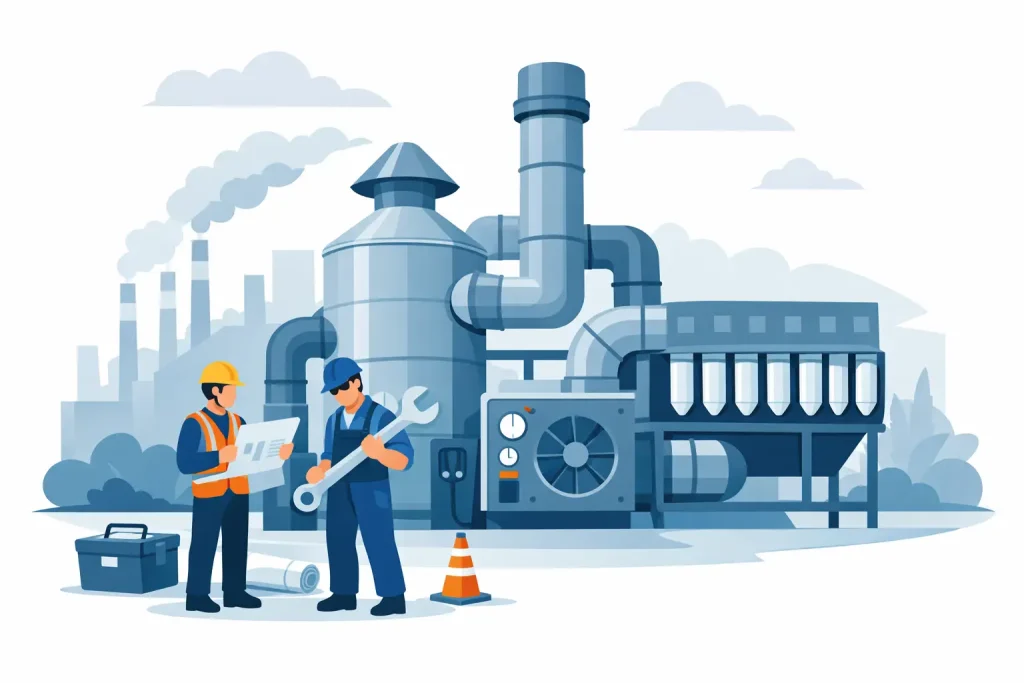
A failed startup rarely begins at startup. It usually begins months earlier – when duct velocities were estimated too loosely, access platforms were left out, pressure drop was treated as a secondary issue, or the control sequence was not written around the actual process. Industrial emission control system installation is not just a construction activity. It is the point where environmental compliance, worker exposure control, process reliability, and maintainability either come together properly or begin to drift apart.
For plant managers, EHS leaders, and project engineers, that distinction matters because emission control equipment is judged in the field, not on a datasheet. A packed tower scrubber that looks correct on paper can still underperform if recirculation piping is poorly routed. A pulse-jet dust collector can lose suction performance if the duct layout ignores material loading and air balance. An electrostatic precipitator, cyclone, activated carbon filter, or regenerative thermal oxidizer can all become expensive sources of downtime if installation decisions are separated from testing, commissioning, and ongoing monitoring.
Why industrial emission control system installation is a compliance issue
Installation quality has direct regulatory consequences. In most industrial settings, the system is expected to do more than collect dust or reduce odor. It must support documented compliance, consistent stack performance, and in many cases safer indoor air conditions for operators. That means the installation scope should be aligned with the applicable emissions limits, occupational exposure requirements, and the evidence needed for audits, stack sampling, and official review.
This is where many projects become fragmented. One party supplies equipment, another handles steelwork, a third installs ducting, and an internal team is left to reconcile controls, documentation, and startup. The result can be a technically complete system that is still operationally weak. If there is no single owner of design intent, practical issues emerge quickly – inaccessible dampers, poor fan selection, unstable flow, difficult maintenance clearances, or instruments installed in positions that do not support reliable readings.
A compliance-led approach starts earlier. The target emission profile, airflow requirement, pollutant characteristics, temperature range, moisture loading, chemical compatibility, and discharge conditions should all shape how the system is installed. That includes support structures, access points, insulation where needed, drain provisions, explosion risk considerations, and interlocks with upstream process equipment.
What a well-planned installation actually includes
A proper installation program is not limited to placing equipment on a pad and connecting utilities. It begins with field verification. Existing layout constraints, elevation differences, crane access, shutdown windows, tie-in locations, and structural loading all need to be confirmed before fabrication and site works advance too far.
For dust and particulate applications, details such as duct routing, branch balance, hood capture design, hopper discharge arrangement, rotary valve selection, and compressed air quality for pulse cleaning all affect performance. For wet scrubbing systems, nozzle arrangement, pump sizing, mist elimination, liquid distribution, sump management, and corrosion-resistant material selection are equally important. VOC control systems such as activated carbon units and regenerative thermal oxidizers add another layer, because temperature control, fire protection logic, bypass arrangement, and media changeout access become central to safe operation.
In practice, installation should also account for future servicing. Maintenance managers do not benefit from a technically advanced system if filter access doors cannot be opened fully, instruments cannot be calibrated safely, or replacement parts require extensive dismantling. Good engineering reduces these avoidable burdens from the start.
Equipment selection and installation cannot be separated
One of the most common project risks is treating equipment selection as a standalone purchasing decision. In reality, the chosen technology affects every installation detail around it. A cyclone or multicyclone may be suitable for high-loading particulate pre-separation, but downstream fan performance and dust discharge handling must still be coordinated carefully. A packed tower scrubber may address acid gases effectively, but only if circulation rate, packing depth, liquid chemistry, and demister arrangement are installed as designed. An electrostatic precipitator may be the right fit for fine particulate under specific process conditions, yet electrical integrity, gas distribution, and maintenance access determine whether it performs consistently.
That is why system design, fabrication, site installation, and commissioning work best under one accountable framework. When these stages are split too aggressively, trade-offs are made in isolation. The project may save on one line item while creating recurring problems in airflow stability, consumable use, or shutdown frequency.
The installation phases that matter most
The early phase is usually the most underestimated. Site survey, process review, and emissions characterization should be completed before finalizing equipment arrangement. If the plant has variable loading, batch discharge, thermal cycling, sticky particulate, oil mist, or corrosive gas streams, the installation approach must reflect that reality rather than rely on nominal operating conditions.
The next critical phase is fabrication and pre-install coordination. Structural supports, duct sections, platforms, ladders, hoppers, drains, and utility headers should be checked against actual site dimensions and lifting constraints. This sounds basic, but many delays come from fabricated items that fit the drawing but not the plant.
Mechanical and electrical installation then need disciplined sequencing. Fans, dampers, motors, instruments, control panels, compressed air lines, pumps, level switches, and stack sections should not be installed as disconnected packages. Their function depends on how the entire system responds under load. Interlocks with process equipment are especially important. If a furnace, dryer, mixer, or transfer point starts before the control system is ready, emissions and safety risks rise immediately.
Testing and commissioning are where performance becomes real
Testing and commissioning should never be treated as paperwork at the end of the job. This stage verifies whether the installed system can actually achieve the expected pressure profile, airflow, capture efficiency, reagent circulation, temperature control, or discharge concentration.
A serious commissioning scope typically includes leak checks, motor rotation checks, vibration review, instrument verification, control logic testing, balancing, and trial operation under process conditions. For systems serving regulatory obligations, the commissioning package should also support follow-on field auditing and stack sampling. If baseline operating data is not established at handover, troubleshooting later becomes slower and far more subjective.
This is also where online monitoring adds practical value. An IoT-enabled performance layer does not replace inspections, but it does help teams see pressure trends, abnormal loading, fan behavior, or maintenance indicators early enough to act. For facilities managing recurring compliance obligations, that visibility can reduce the gap between a functioning system and a defensible one.
Common installation failures and why they happen
Most failures are not dramatic. They show up as unstable suction, rising differential pressure, carryover, odor complaints, excessive media consumption, shortened filter life, or frequent operator intervention. These issues often trace back to predictable installation mistakes.
Poor hood placement can undermine capture before contaminants even enter the duct. Undersized ducting can increase pressure losses and reduce system balance. Inadequate support steel can create vibration problems that damage joints and instrumentation. Incorrect fan orientation or inaccessible maintenance zones can turn routine service into a shutdown event. For wet systems, neglected drainage and poor sump design can create corrosion, scaling, and pump reliability issues.
Some failures are organizational rather than technical. If operations, maintenance, and EHS are not aligned during the installation phase, the system may meet mechanical completion without meeting plant reality. Operators need clear startup logic. Maintenance teams need spare parts planning and safe access. Compliance personnel need records, test data, and defined monitoring points.
Choosing an installation partner for long-term performance
The right partner is not simply the lowest equipment bidder or the contractor with general mechanical capability. For industrial emission control system installation, the better question is whether the provider can take responsibility across design, fabrication, installation, testing and commissioning, and post-handover support.
That matters because emission control systems do not remain static after startup. Processes change. Production rates increase. Fuel profiles shift. Dust loading rises. Regulatory scrutiny becomes tighter. Plants need a partner that can return for field auditing, stack sampling support, upgrades, spare parts, and performance troubleshooting without having to relearn the system each time.
This is where a one-stop solution provider has practical advantages. When engineering, steel fabrication, compliance support, and after-sales service sit under one roof, accountability is clearer and response time is usually better. For organizations managing internal competency requirements, access to related training such as CePSO and CePBFO also strengthens the operating environment around the installed system. Master Jaya Group works in this compliance-first model because clean-air performance is rarely sustained by equipment alone.
The most reliable projects are usually the ones that respect both engineering detail and plant reality. If your facility is planning a new installation or correcting an underperforming system, treat the job as a full lifecycle performance project rather than a one-time equipment placement exercise. That decision tends to pay back in fewer surprises, stronger documentation, and a system your team can actually operate with confidence.