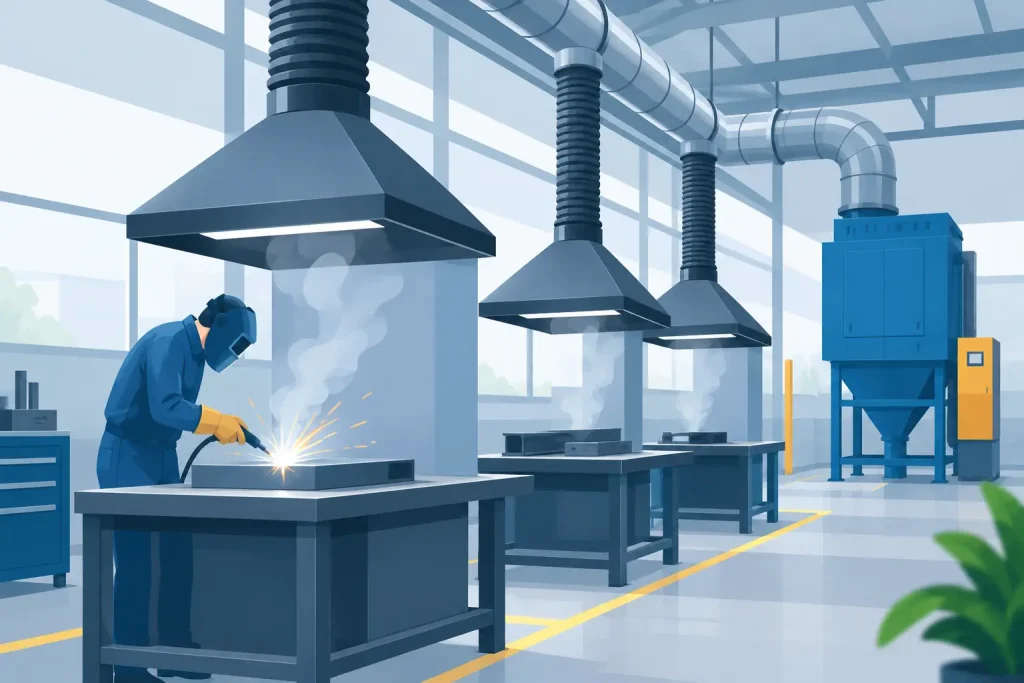
A fume hood can appear effective while allowing worker exposure to continue. The visible plume may be partially captured, but cross-drafts, excessive hood distance, poor duct velocity, or an unsuitable filter can carry contaminants into the breathing zone. For industrial facilities, the best fume extraction hoods are not simply the units with the highest advertised airflow. They are engineered local exhaust ventilation systems designed around the contaminant, process geometry, operator movement, and discharge requirements.
Selecting the right hood affects more than housekeeping. It influences occupational exposure, fire risk, product quality, equipment reliability, emissions compliance, and the documentation available during an EHS audit. A suitable system must capture contaminants at their source, convey them without deposition or leakage, treat them appropriately, and maintain performance over time.
What Makes the Best Fume Extraction Hoods Different?
An industrial fume extraction hood is the capture point of a complete local exhaust ventilation, or LEV, system. The hood is connected to ductwork, an exhaust fan, an air cleaning device where required, and a discharge stack or controlled return-air arrangement. Evaluating the hood alone, without considering the rest of this system, is a frequent cause of underperformance.
The best hood for a process is usually the one that can be located closest to the emission source while still allowing safe production work. Capture becomes significantly more difficult as the distance between the hood and the fume source increases. A large canopy hood placed high above a welding table, for example, may require substantial airflow yet still pull welding fume through the welder’s breathing zone before it reaches the hood.
Good hood selection begins with the nature of the contaminant. Welding produces fine metal fume that may contain manganese, chromium, nickel, or other metals depending on the consumable and base material. Solvent cleaning can release volatile organic compounds, while acid pickling generates corrosive mist. Thermal processes may create hot gases, oil mist, smoke, or condensable vapor. Each contaminant presents different capture, ducting, filtration, corrosion-resistance, and disposal requirements.
Capture Velocity Is Not a Standalone Answer
Capture velocity is often used as a shortcut when specifying extraction equipment. It matters, but it does not tell the full story. Required airflow depends on hood shape, the size of the opening, emission energy, thermal buoyancy, air currents, and how far contaminants must travel to enter the hood.
A hot process can create a rising plume that suits a carefully designed canopy hood. By contrast, a cross-draft or side-draft hood may be more effective for cold vapor, grinding dust, or welding fume where an overhead hood would draw contaminants across the operator. Enclosing the process, even partially, reduces the volume of air that must be exhausted and generally improves capture consistency.
The objective is controlled airflow at the source, not the largest possible fan. Excessive exhaust volume increases energy demand, conditioned-air losses, noise, and makeup-air requirements. Insufficient volume leaves emissions uncontrolled. Engineering calculations and field verification are therefore more defensible than selecting a hood by duct diameter or fan horsepower alone.
Common Hood Types and Their Proper Applications
The best fume extraction hoods vary by operation. A fixed canopy hood, slot hood, downdraft bench, enclosed booth, movable extraction arm, and laboratory-style enclosure solve different capture problems.
A canopy hood is appropriate when heat naturally lifts contaminants and the operator does not need to work directly beneath the plume. It is commonly considered for ovens, thermal oil equipment, hot tanks, and certain melting or heating operations. Its limitation is clear: it can capture rising air, but it is rarely the preferred choice where the process places workers between the source and the hood.
Side-draft and back-draft hoods pull contaminants away from the worker and toward a rear or side plenum. They are effective for welding benches, manual soldering, small chemical operations, and parts cleaning, particularly when the work can be consistently positioned near the capture face. Slot hoods provide even airflow along a narrow opening and can be integrated into process equipment where access is limited.
Downdraft tables are useful for welding, deburring, polishing, and light grinding when the workpiece can rest on a perforated surface. They keep the capture direction downward, but they are not suitable for every task. Hot slag, heavy parts, large assemblies, and work that obstructs the table openings can reduce performance or create maintenance challenges.
Flexible extraction arms provide adjustable source capture for variable work locations. They are practical for repair bays, occasional welding, laboratory transfer points, and maintenance activities. Their effectiveness depends heavily on operator positioning. If the arm is left too far from the source or pointed incorrectly, actual capture can fall well below design intent.
For high-hazard chemical processes, partial or full enclosures are often the most reliable option. Enclosing a mixing station, charging point, or cleaning process limits the influence of plant air movement and requires less exhaust air than an open hood. The trade-off is reduced operator access, which must be addressed during process design and safety review.
Match the Hood to the Full Air Pollution Control System
A hood captures contaminants. It does not automatically make them safe to discharge. Downstream treatment must be selected according to particle size, chemical composition, concentration, temperature, moisture, explosibility, and applicable permit conditions.
For dry welding fume, grinding dust, and metal particulates, a cartridge collector or pulse-jet dust collector may be appropriate when filtration media and cleaning mechanisms are correctly selected. Fine particulate applications may require high-efficiency filtration after the primary collector, particularly where air is recirculated or exposure limits are stringent.
For acid gases, alkaline vapors, and water-soluble chemical emissions, a packed tower scrubber may be required. The scrubbing liquid, recirculation rate, packing design, pH control, and mist elimination all affect removal performance. VOC-bearing air may call for activated carbon adsorption, condensation, thermal oxidation, or another control approach based on solvent characteristics and loading. Oil mist requires a different treatment path again, often involving mist collectors with staged filtration.
Ductwork deserves equal attention. Transport velocity must keep particulate from settling in ducts, while pressure losses must remain within the fan’s available static pressure. Poorly designed elbows, unnecessary duct length, leaking access doors, and undersized ducts can compromise suction even when the hood and fan are correctly specified. For corrosive service, material selection may include polypropylene, FRP, stainless steel, or protected carbon steel depending on chemical compatibility and operating temperature.
Design for Compliance, Inspection, and Maintainability
A defensible fume extraction installation should be designed with occupational and environmental obligations in mind. In the United States, relevant requirements may include OSHA ventilation provisions, permissible exposure limits, hazard communication requirements, fire protection standards, and local air permitting conditions. Facilities operating internationally should also align the system with their applicable local regulations, such as Malaysia’s Clean Air Regulations 2014 and DOSH-LEV requirements where relevant.
Compliance cannot be demonstrated by a fan nameplate or a commissioning photograph. It requires measurable evidence. Airflow readings, hood face velocity or capture verification, duct static pressure, fan performance, filter differential pressure, stack testing where required, and maintenance records establish whether the system is operating as intended.
Access for inspection should be planned before fabrication and installation. Filters need safe replacement space. Dust collectors require hopper discharge arrangements that prevent secondary exposure. Scrubbers require access to pumps, nozzles, packing, instrumentation, and chemical dosing equipment. Hoods and ducts require inspection openings where buildup is possible. If maintenance is difficult, it will eventually be deferred, and system performance will decline.
Commissioning Should Replicate Actual Production
Testing and commissioning must be performed under representative operating conditions. A hood may meet an airflow target when only one machine is running, then fail when multiple branches open simultaneously. Similarly, a process may produce far more fume during peak throughput, use of a different material, or elevated operating temperature.
A complete commissioning scope should confirm airflow balance across branches, hood capture behavior, fan duty point, control-device performance, safety interlocks, alarms, and operator usability. Smoke visualization can help identify airflow direction, but it should be supplemented by measured data and, where applicable, industrial hygiene sampling or stack sampling.
Ongoing monitoring is especially valuable for critical systems. Differential-pressure trends can indicate blocked filters or damaged media. Fan vibration and motor current can provide early warning of mechanical issues. Airflow switches and static-pressure sensors can identify loss of extraction before it becomes an exposure event. An online monitoring layer gives maintenance and EHS teams better operational visibility than periodic checks alone.
Questions to Ask Before Specifying a Hood
Before requesting a quotation, define the process rather than only describing the desired equipment. A supplier should know what materials are handled, how much is processed per hour, whether contaminants are hot or corrosive, where operators stand, whether the operation is continuous, and whether multiple stations run at once. Photographs, layout drawings, process temperatures, material safety data, and existing airflow measurements materially improve design accuracy.
Also clarify whether the facility needs source capture for worker protection, treatment before atmospheric discharge, odor control, contamination control, or all of these outcomes. The system architecture can change substantially depending on the objective. A welding arm and cartridge collector may suit a low-volume repair area, while a production line may require engineered enclosures, branch balancing, a central collector, automatic dampers, and monitored emissions control.
Master Jaya Group approaches fume extraction as a lifecycle responsibility, combining system design, in-house fabrication, installation, testing and commissioning, field auditing, stack sampling, performance monitoring, servicing, and spare-parts support. That level of accountability is valuable where an extraction failure can affect both production uptime and regulatory standing.
The most useful next step is to observe the process during its most demanding shift, not during a quiet walkthrough. Watch where the plume travels, where employees stand, which stations operate together, and what maintenance teams can realistically access. Those details lead to a hood design that protects people and supports long-term compliance rather than merely moving air.