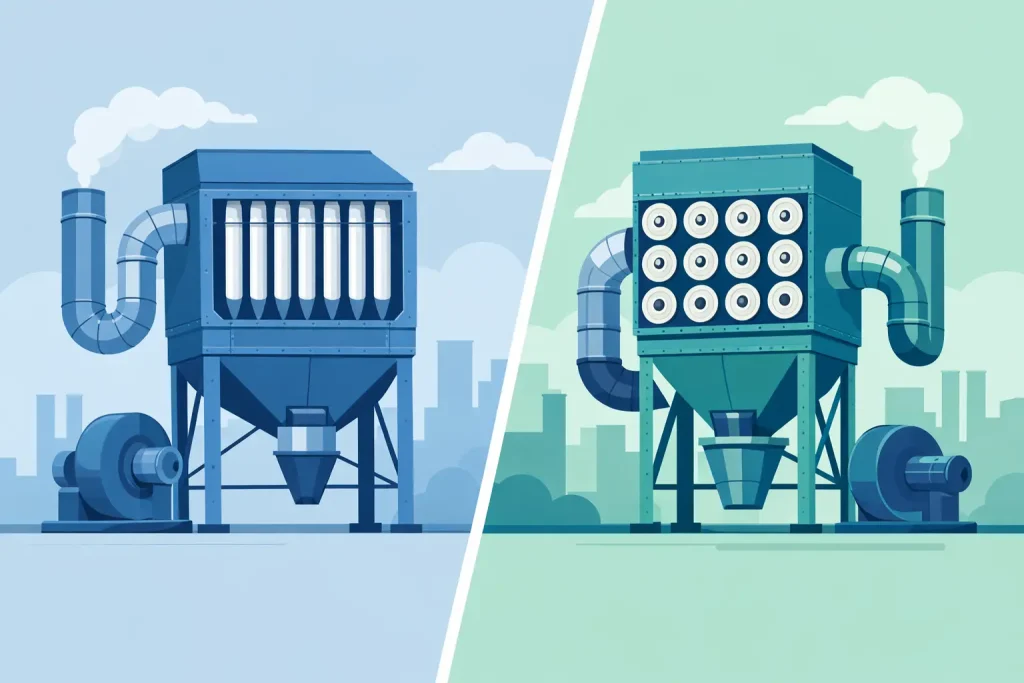
When a plant starts seeing rising differential pressure, frequent filter changeouts, or stack results that leave little compliance margin, the baghouse vs cartridge collector question stops being theoretical. It becomes an engineering and risk-management decision tied to production uptime, housekeeping, worker exposure, and whether your facility can maintain stable performance under real operating conditions.
For many facilities, both technologies can collect particulate effectively. The better choice depends on dust characteristics, process temperature, moisture, loading rate, available footprint, and the level of maintenance discipline the site can sustain. A collector that looks efficient on paper can become expensive quickly if the dust is abrasive, hygroscopic, fibrous, or prone to bridging.
Baghouse vs Cartridge Collector: The Core Difference
A baghouse uses elongated fabric filter bags, usually mounted vertically in a housing and cleaned by pulse-jet air or another cleaning method. A cartridge collector uses pleated filter cartridges that provide high media area in a compact housing. Both separate particulate from an air stream, but they do so with very different geometry, air-to-cloth ratios, and maintenance behavior.
In practical terms, baghouses are usually favored for heavier dust loading, higher temperatures, and more punishing industrial service. Cartridge collectors are often selected where fine, dry dust must be captured efficiently in a smaller footprint. That is the broad distinction, but broad distinctions are where many specification errors begin.
Dust Characteristics Matter More Than Catalog Ratings
The first question is not which unit is smaller or cheaper. The first question is what kind of dust the process produces over a full operating cycle.
If the plant handles coarse particulate, high inlet loading, abrasive solids, or material that enters the collector in slugs, a baghouse often provides a more forgiving design window. The bags generally tolerate tougher service conditions and can be configured with media suited for temperature, chemical resistance, and dust release characteristics. In foundry, minerals, boiler ash, and certain bulk solids applications, this matters more than initial footprint savings.
Cartridge collectors perform very well with light to moderate dust loading and fine particulate when the dust is dry and free-flowing. Metalworking, pharmaceutical powder handling, food ingredients, and some packaging or blending operations can be good fits. The pleated geometry increases filter area in a compact body, which can support strong filtration efficiency in a relatively small system.
The trade-off is that pleats can become a liability with sticky, oily, fibrous, or moisture-affected dust. Once particulate packs into the pleat valleys, pulse cleaning becomes less effective. Differential pressure rises, air volume drops, and maintenance intervals shorten. A system that looked efficient in vendor literature may struggle in actual plant conditions.
Where Baghouses Usually Win
A baghouse is often the safer choice when the application has process variability, elevated gas temperatures, or heavier particulate burden. It is also commonly preferred when facilities need long-term durability and easier adaptation to harsher service.
Temperature is a major factor. Many industrial processes produce air streams that exceed the comfort zone of standard cartridge media. While specialized cartridge options exist, baghouses offer broader media flexibility for demanding thermal conditions. If the process includes upset conditions, intermittent heat spikes, or abrasive carryover, the design margin of a baghouse can protect both filtration performance and equipment life.
Baghouses also tend to suit applications where dust cake formation is part of stable operation. A managed dust cake can improve collection efficiency, provided cleaning frequency is properly controlled. With the right bag media, cage design, hopper geometry, and pulse sequence, the system can operate predictably over long service intervals.
That said, baghouses are not automatically low-maintenance. They require proper hopper evacuation, compressed air quality, leak detection, and bag integrity management. If these basics are neglected, emissions can rise and fan energy can increase without obvious warning.
Where Cartridge Collectors Usually Win
A cartridge collector is often attractive where floor space is limited and the particulate is fine, dry, and relatively low in volume. Because cartridges pack a large amount of media into a compact housing, the system can deliver effective filtration with a smaller footprint than a comparable baghouse.
This can be valuable in brownfield retrofits where duct routing, structural support, or equipment placement are constrained. Cartridge systems are also commonly used near process equipment for source capture when the duty is well defined and dust characteristics are stable.
Maintenance can be cleaner and more accessible in some cartridge designs, especially where quick-change access is built into the housing. For facilities focused on housekeeping and indoor air quality, this can be an advantage. But the same convenience does not override application limits. If the dust is sticky or loading is too high, cartridge replacement frequency may offset any benefit from compact design.
Energy, Airflow, and Operating Stability
In a baghouse vs cartridge collector comparison, energy should be evaluated over actual operating life, not just startup conditions. A new cartridge collector may show attractive pressure drop performance. Over time, if pleat loading becomes uneven or cleaning weakens, fan demand can rise and capture velocity at pickup points can fall below design intent.
Baghouses can also suffer from pressure drop escalation, particularly when pulse settings are poor, hoppers do not discharge properly, or the selected media is mismatched to the dust. The difference is that baghouses often provide more tolerance for high loading and more room to tune cleaning behavior over time.
This is why field auditing and performance monitoring are not optional for critical systems. A collector should not be judged only by nominal efficiency. It should be judged by whether it maintains required airflow, stable differential pressure, and compliant emissions under normal production and upset conditions.
Compliance Is Not Just About Capture Efficiency
Industrial buyers rarely select a collector for filtration alone. They select it because the plant must meet permit conditions, support worker exposure control, and sustain defensible operating records. That shifts the discussion from equipment preference to compliance assurance.
A cartridge collector that captures fine dust very efficiently may still be the wrong choice if process conditions cause repeated plugging, airflow instability, or frequent maintenance bypasses. A baghouse that is oversized or poorly cleaned may meet a specification at commissioning but drift away from target performance during production peaks.
For regulated facilities, the right system is the one that supports repeatable compliance outcomes. That includes proper design basis, testing and commissioning, differential pressure trending, stack sampling where required, and after-sales servicing that prevents gradual performance decline. In many plants, the collector is only one part of the compliance chain. Hood design, duct velocity, fan selection, discharge arrangement, and monitoring discipline all affect whether the plant stays within limit.
How to Decide Between a Baghouse and Cartridge Collector
The most reliable way to choose is to start with process data, not preference. Review particulate size distribution, dust loading, moisture content, temperature range, explosibility where relevant, and whether the material is abrasive, hygroscopic, fibrous, or sticky. Then assess production variability. A collector sized only for average conditions may underperform when the line runs at full rate.
Next, look at the plant itself. If you have limited footprint and a dry, fine dust with predictable loading, a cartridge collector may be a sound option. If the duty is harsh, temperatures are elevated, or dust behavior is inconsistent, a baghouse is often the more conservative and durable choice.
Maintenance capacity should also be considered honestly. Some sites have strong preventive maintenance programs, instrument trending, and trained technicians who can manage tighter operating windows. Others need a design with more tolerance for variation. There is no value in selecting a high-performance collector that the site cannot sustain.
This is where a one-stop partner adds practical value. System design, in-house fabrication, installation, testing and commissioning, field auditing, stack sampling, and ongoing monitoring should work as one accountability chain. For facilities operating under compliance pressure, that integrated approach reduces the gap between what was specified and what actually performs on the plant floor.
The Better Question to Ask
Instead of asking which technology is better in general, ask which one will still be delivering stable airflow, manageable maintenance, and compliance confidence two years after startup. In many cases, that answer will favor a baghouse. In others, a cartridge collector will be the smarter fit. The difference lies in dust behavior, process reality, and the quality of engineering behind the system.
If your plant is making this decision now, do not let footprint or first cost dominate the discussion. The collector you choose will shape emissions performance, service intervals, and production reliability long after installation. A well-matched system is not just dust control equipment. It is operating insurance for the facility.