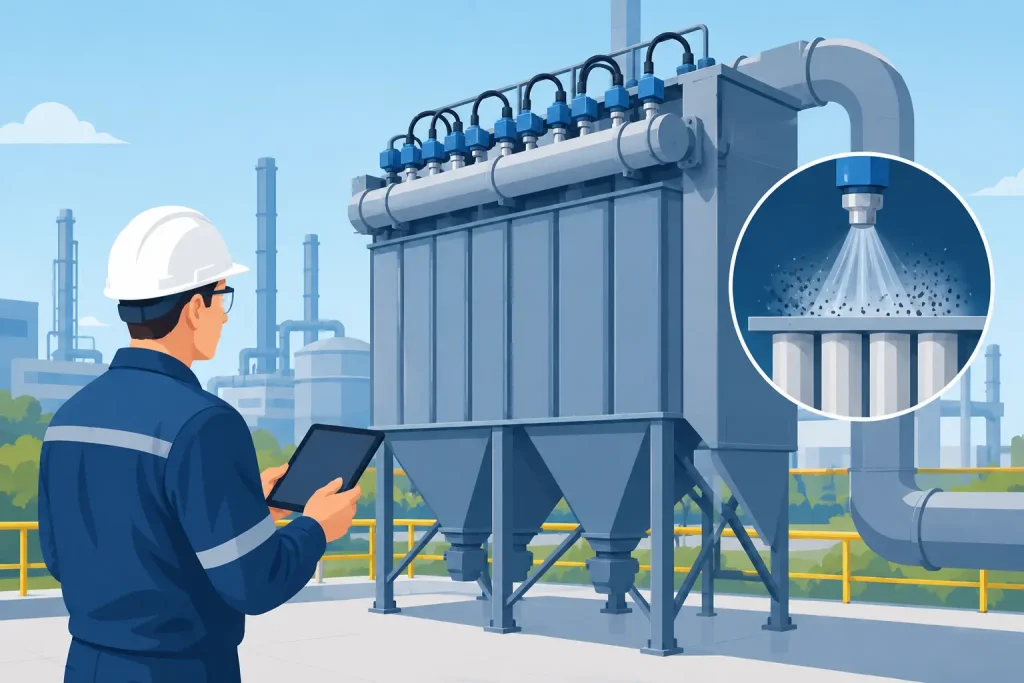
A pulse-jet dust collector can appear to be operating normally while quietly losing capture performance, consuming excessive compressed air, or shortening filter life. This guide to pulse jet tuning is intended for plant engineers, maintenance managers, and EHS teams who need a collector to maintain stable airflow and produce defensible compliance results – not simply cycle its solenoids.
Pulse cleaning is a controlled disturbance to the filtration process. The compressed-air pulse must release accumulated dust from the filter media without damaging the filter, re-entraining excessive dust, or interrupting process capture. Proper tuning therefore requires more than changing a timer setting. It requires an understanding of dust characteristics, air-to-cloth ratio, fan capacity, duct static pressure, filter media, hopper discharge, and the site’s permit or occupational exposure requirements.
What Pulse Jet Tuning Is Designed to Control
A pulse-jet collector removes dust by injecting a short burst of compressed air through a blowpipe and venturi into each filter bag or cartridge. The pulse expands the media and dislodges the dust cake. A controlled residual dust cake remains desirable because it can improve filtration efficiency. The objective is not to leave filters visibly clean. The objective is to hold differential pressure and airflow within an operating range that supports capture, filtration, and equipment reliability.
Poor tuning usually takes one of two forms. Over-cleaning applies too much energy or cleans too frequently, which wastes compressed air and can accelerate abrasion, seam failure, media fatigue, and dust penetration. Under-cleaning allows the dust cake to build until differential pressure rises, airflow falls, and the local exhaust ventilation system no longer captures contaminants effectively at hoods or process enclosures.
The correct setpoints depend on the collector design and the process. Fine, cohesive powder behaves differently from dry metal particulate, fibrous dust, wood dust, food ingredients, or sticky material containing oil or moisture. A setting that performs well on one line can be unsuitable for another, even when the dust collectors are the same size.
Start With a Reliable Operating Baseline
Do not tune a collector around faulty instruments or mechanical restrictions. Before adjusting pulse pressure, on-time, or cleaning intervals, inspect the complete system under normal production load.
Confirm that the differential-pressure gauge or transmitter is reading correctly. A blocked sensing line, damaged diaphragm, or improperly located pressure tap can lead operators to tune against false data. Compare the installed instrument with a calibrated portable manometer where practical. Record both clean-start and stabilized differential pressure, rather than relying on a single reading.
Next, verify fan rotation, damper position, motor load, belt condition where applicable, and static pressure at representative capture points. A high collector differential pressure may be a cleaning issue, but weak hood suction can also result from fan wear, duct leakage, a closed damper, blocked ductwork, or excessive system resistance. Pulse tuning cannot correct an undersized fan or a poorly designed local exhaust ventilation system.
Inspect the hopper, rotary valve, screw conveyor, or dust-discharge arrangement. Dust that bridges in the hopper can rise into the filter section, interfere with cleaning, and quickly return to the media after each pulse. In combustible-dust applications, all inspection and maintenance work must follow the facility’s documented hazard controls, isolation procedures, and applicable fire and explosion protection requirements.
Guide to Pulse Jet Tuning: Set the Right Variables
Three settings do most of the work: pulse pressure, pulse duration, and cleaning frequency. Their relationship matters more than any isolated number.
Set compressed-air pressure from collector requirements
Begin with the pressure recommended by the collector manufacturer and confirm the value at the clean-air manifold, not only at the main compressor. Pressure losses from undersized piping, clogged filters, leaking fittings, poorly maintained regulators, or simultaneous demand elsewhere in the plant may prevent the pulse valves from receiving the intended pressure.
Higher pressure is not automatically better. A pulse that is too forceful may damage filter media or cages and can drive dust into the media structure. If differential pressure remains high despite adequate pulse pressure, investigate pulse-valve condition, diaphragm wear, blowpipe alignment, venturi condition, moisture contamination, and the suitability of the filter media before increasing pressure.
Compressed air must also be clean and dry. Water, oil, and rust scale can impair diaphragm valves and create dust adhesion problems that no timer adjustment will solve. For plants with recurring pulse-valve failures, compressed-air quality should be treated as a maintenance and reliability issue, not merely a utility issue.
Use the shortest effective pulse duration
Pulse duration is typically measured in fractions of a second. The best setting is the shortest duration that produces sufficient cleaning energy for the specific collector and dust load. Extending the pulse unnecessarily increases compressed-air consumption and can cause aggressive media movement.
Observe differential-pressure recovery after a cleaning cycle. If each pulse produces little or no reduction in differential pressure, longer pulse duration may not be the answer. The problem may be blinded media, hardened dust cake, blocked venturis, inadequate air delivery, or dust that is unsuitable for the installed media or surface treatment.
Prefer demand cleaning over fixed timer cleaning
When the controls allow it, differential-pressure-based cleaning is generally more efficient than continuous timer cleaning. The controller begins a cleaning sequence when differential pressure reaches an upper setpoint and stops when pressure falls to a lower setpoint. This allows the collector to respond to actual dust loading rather than clean filters repeatedly during low-production periods.
The upper and lower limits should be established through commissioning data and production trials. Set the upper point too high, and airflow may decline before cleaning begins. Set it too low, and the system may pulse continuously without allowing a stable dust cake to form. A reasonable pressure band prevents rapid cycling and provides useful operating data for maintenance review.
For critical processes, trend differential pressure, pulse count, compressed-air use, fan amperage, and airflow or hood static pressure. A rising pulse count at the same production rate often provides earlier warning than a high-pressure alarm. It can indicate aging filters, a change in raw material, moisture intrusion, inadequate hopper evacuation, or a developing compressed-air fault.
Validate Results at the Process, Not Only at the Collector
A collector can show acceptable differential pressure while the process hood still fails to capture dust. After tuning, verify performance where exposure and emissions begin: at the hood, enclosure, pickup point, or transfer station.
Measure airflow and static pressure at established test points, and compare results with the design basis or prior testing and commissioning records. Observe whether visible dust escapes during material transfer, bag dumping, grinding, mixing, or other high-load events. For facilities operating under air permits, confirm outlet emissions through the appropriate stack sampling or compliance-testing program rather than assuming that a stable collector reading proves compliance.
For worker exposure control, evaluate the complete local exhaust ventilation system against applicable OSHA requirements, industrial hygiene objectives, and site procedures. Capture velocity, hood placement, enclosure integrity, make-up air, and operator work practices can all affect results. A well-tuned collector is one part of an effective exposure-control strategy.
Common Tuning Problems and What They Usually Mean
A collector that pulses almost continuously is often operating with an upper setpoint that is too low, excessive air-to-cloth ratio, restricted filters, or an abnormal dust load. First confirm actual differential pressure and check whether the fan and ductwork are delivering the design airflow.
When differential pressure remains high after a full cleaning sequence, inspect for blinded or damaged filters, weak or leaking pulse valves, blocked blowpipes, failed venturis, and poor hopper discharge. If filters are near the end of their service life, replacing them may be more economical than increasing pulse energy and compressor demand.
Low differential pressure is not always good news. An unusually low reading can indicate torn filter bags, missing cartridges, leaking gaskets, open access doors, or failed pressure instrumentation. Signs such as dust downstream of the collector, increased visible emissions, or dust accumulation in the clean-air plenum require immediate investigation.
Make Tuning Part of a Controlled Maintenance Program
Pulse-jet tuning should be documented as a controlled operating standard. Record the baseline differential-pressure range, regulator pressure, pulse duration, cleaning mode, valve sequence, production condition, and inspection findings. Changes should be made one variable at a time and observed through enough production cycles to separate a real improvement from a temporary variation.
Maintenance teams should also schedule inspections of diaphragms, solenoid coils, valves, blowpipes, venturis, filter condition, hopper discharge equipment, compressed-air treatment, and instrumentation. Keeping critical spare parts available reduces the risk that a small valve or diaphragm failure develops into lost production or a compliance event.
Master Jaya Group applies this same lifecycle approach through system auditing, testing and commissioning, servicing, spare-parts support, and performance monitoring. The strongest tuning program is not the one with the lowest differential-pressure number. It is the one that keeps capture effective, filters serviceable, compressed-air demand controlled, and compliance evidence ready when the plant needs it.