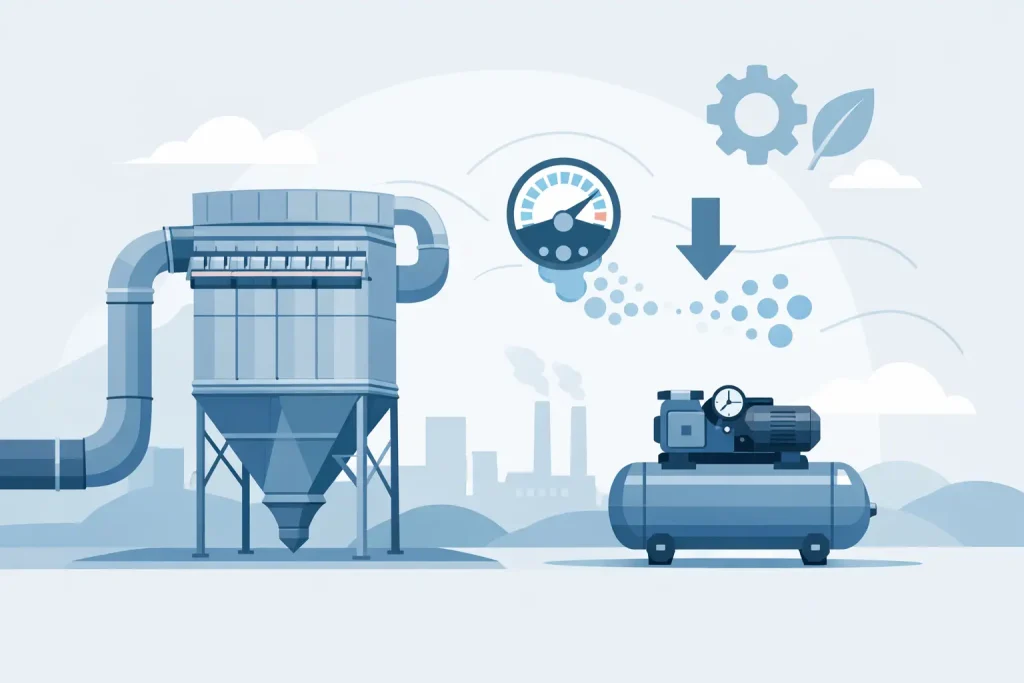
Compressed air is often treated as a utility line item until a pulse-jet baghouse starts consuming more than expected, compressors run longer, and differential pressure still creeps upward. In most plants, baghouse compressed air consumption reduction is not a matter of simply lowering header pressure. It requires balancing cleaning energy, filter condition, fan performance, hopper discharge, and emissions compliance so the system remains stable under real process loads.
For plant managers, EHS leaders, and maintenance teams, this matters on two fronts. First, compressed air is expensive energy. Second, over-cleaning or poorly controlled cleaning can shorten filter bag life, disturb the dust cake, and create unstable emissions performance. A baghouse that uses less air but loses filtration efficiency is not an improvement. The correct target is lower air use with controlled differential pressure, reliable hopper evacuation, and compliance-aligned outlet performance.
Where baghouse air consumption really comes from
In a pulse-jet dust collector, compressed air demand is driven by more than pulse frequency alone. The total load depends on header pressure, blowpipe and venturi condition, pulse valve timing, number of rows cleaned, cleaning sequence logic, filter media selection, and the incoming dust burden. Plants often focus on the compressor side when the root cause is inside the collector.
A common example is a baghouse that has gradually moved from on-demand cleaning to effectively continuous cleaning. Differential pressure rises because of blinded media, poor hopper discharge, or moisture-related dust buildup. Operators respond by increasing pulse frequency or pressure. Air consumption climbs, but the underlying restriction remains. That pattern raises utility cost while masking a mechanical or process problem.
Another overlooked source is leakage in the compressed air distribution system. Small leaks at fittings, valves, drain points, and header connections can create a meaningful base load, especially on systems operating around the clock. If the baghouse header is not isolated and pressure-tested during inspection, plants can overestimate the air actually required for pulse cleaning.
Baghouse compressed air consumption reduction starts with diagnosis
The fastest way to waste time on optimization is to adjust pulse settings before establishing the current condition of the collector. A proper assessment should review compressed air pressure stability, pulse frequency, pulse duration, differential pressure trend, hopper discharge reliability, fan operating point, and visible emissions history. If available, stack sampling and online monitoring data help distinguish between normal process variation and a cleaning control issue.
This is where a compliance-led approach matters. If a system is already operating close to its permitted emission limit, aggressive air reduction can introduce risk. The correct sequence is to confirm whether the collector is mechanically sound, whether the bags and cages are fit for service, and whether the process dust characteristics have changed. Only then should pulse optimization proceed.
What to check before changing pulse settings
Start with filter condition. Bags that are blinded, chemically attacked, oil-fouled, or damaged will not respond predictably to reduced cleaning. Next, inspect pulse valves, diaphragms, solenoids, blowpipes, and venturis. A worn or partially blocked blowtube can reduce cleaning effectiveness on one row and cause operators to compensate by increasing overall pulse frequency.
Then review the hopper and discharge devices. Dust buildup, bridging, rotary valve issues, or air ingress at the hopper can increase re-entrainment and raise differential pressure. In those cases, the collector may appear to need more pulse cleaning when the real issue is poor solids evacuation.
Control strategy has the biggest effect
The most effective baghouse compressed air consumption reduction usually comes from control logic rather than hardware replacement. Many older collectors still run on timer-based cleaning with fixed intervals, regardless of actual filter loading. That approach is simple, but it is rarely efficient across changing production rates.
Differential pressure-based cleaning is generally the better control method when the collector and instrumentation are in good condition. Instead of pulsing on a rigid schedule, the system cleans only when pressure loss across the bags reaches a defined high setpoint and stops when it falls to a low setpoint. This prevents unnecessary pulsing during low dust loading periods and reduces total air demand without sacrificing baghouse performance.
That said, setpoints must be chosen carefully. If the high setpoint is too low, the collector still over-cleans. If it is too high, pressure drop may remain elevated long enough to affect hood capture, branch duct transport velocity, or process ventilation performance. In plants subject to occupational exposure control, this can become a workplace risk, not just a baghouse issue.
Pulse pressure and duration are not the same thing
Plants often increase air header pressure because it appears to provide stronger cleaning. Sometimes that is justified, especially with longer bags or difficult dusts. But excessive pressure can stress bags, increase wear around the top, and consume more air than necessary. Pulse duration also matters. A pulse that is longer than needed wastes air, while one that is too short may fail to release the dust cake effectively.
The practical approach is to tune pressure and duration together while observing differential pressure recovery, emissions behavior, and bag condition over time. A slightly lower pressure with correct pulse duration can outperform a high-pressure, poorly timed system.
Mechanical improvements that reduce air demand
Once controls are optimized, targeted mechanical corrections often deliver additional savings. Replacing failed pulse valves and diaphragms is an obvious step, but alignment issues are just as important. Blowpipes should direct the pulse cleanly into the venturi. If the jet is off-center, cleaning energy is lost.
Filter media selection can also shift compressed air demand significantly. If the current bags are not suited to the dust characteristics, operating temperature, or moisture profile, the collector may require frequent cleaning just to remain stable. Upgrading to media with appropriate surface treatment or membrane characteristics can reduce dust penetration and improve cake release, lowering the number of pulses needed over the bag life cycle.
System design limits should also be reviewed. If the air-to-cloth ratio is too high for the actual duty, the collector may be inherently difficult to operate at low pulse frequency. In those cases, optimization has limits. The plant may need compartment changes, added filtration area, or a retrofit rather than further control adjustment.
Utility savings should not outrun compliance
Compressed air reduction is worthwhile only if the collector continues to support statutory and internal performance requirements. For regulated facilities, that means the baghouse must still maintain emission performance consistent with permit obligations, documented testing, and any applicable inspection regime. For process ventilation systems, it must also preserve capture performance at hoods and extraction points.
This is why post-adjustment verification is essential. Differential pressure trends, compressor loading, and pulse counts tell only part of the story. The plant should also review visible stack conditions, housekeeping around the collector, process area dust levels, and, where required, testing and commissioning or stack sampling results. A utility improvement that weakens defensible compliance documentation is not a durable gain.
Facilities with IoT-based monitoring have an advantage here because they can correlate pulse activity, pressure drop, airflow behavior, and alarm history over time. That makes it easier to confirm whether compressed air savings are real and sustainable or simply the result of short-term under-cleaning.
A practical path for plants
In most facilities, the right sequence is straightforward. First, establish a baseline for compressed air use, pulse frequency, header pressure, and differential pressure. Second, inspect for leaks, valve failures, bag condition, and hopper discharge issues. Third, move from fixed timer cleaning to differential pressure-based logic where feasible. Fourth, tune pulse pressure and duration instead of assuming more pressure is better. Finally, verify emissions and ventilation performance after each change.
For plants operating multiple dust collectors, compare similar units. If one baghouse has materially higher pulse counts or compressor demand under the same duty, that is usually a sign of a localized issue rather than a plant-wide requirement. Standardizing settings without understanding those differences can spread poor performance instead of correcting it.
Master Jaya Group typically sees the best long-term results when compressed air optimization is handled as part of a broader lifecycle service scope that includes field auditing, testing and commissioning, spare parts readiness, and ongoing performance monitoring. That approach reduces the risk of making isolated adjustments that look efficient on paper but create reliability or compliance problems later.
A pulse-jet baghouse should not need excessive compressed air to stay in control. When it does, the system is usually signaling something useful – a controls problem, a maintenance gap, a filtration mismatch, or a process change that has not been accounted for. Treat that signal seriously, and air savings tend to follow as a result of better engineering discipline, not guesswork.