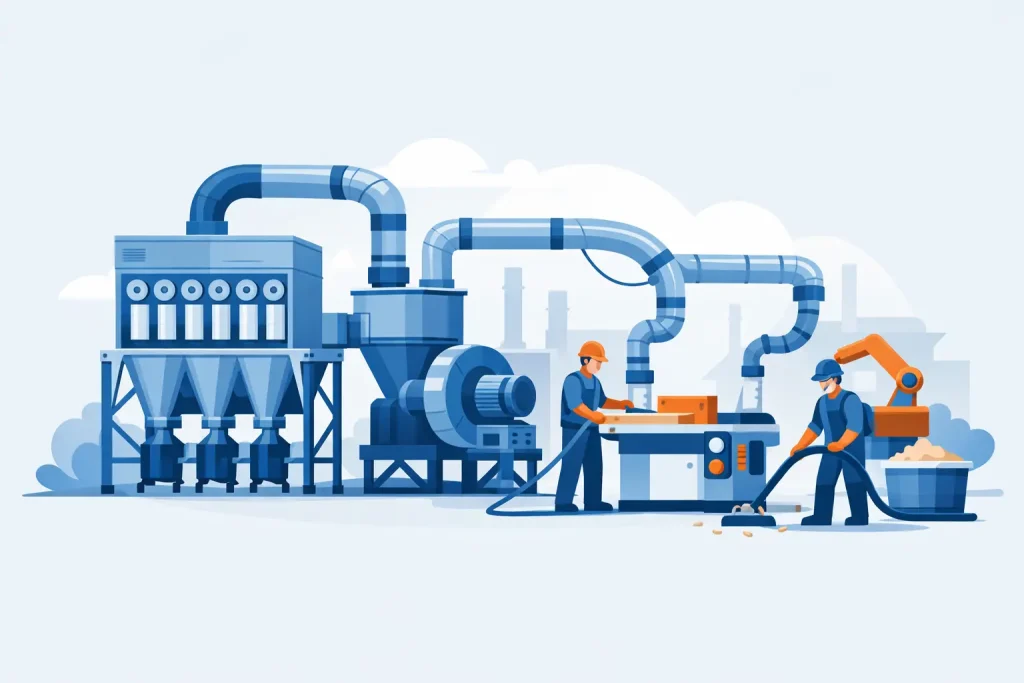
A dust collector can appear to be operating while the production floor continues to accumulate airborne particulate, operators report poor visibility, and housekeeping demands increase. In most cases, the issue is not simply collector capacity. It is a system-level failure involving capture, duct velocity, air balance, filtration, or maintenance. This guide to centralized dust extraction systems explains how plant teams should evaluate the entire arrangement before specifying equipment.
A centralized system connects multiple dust-generating processes to a common duct network, fan, and collection unit. It can provide consistent control across an entire production area, but only when the system is engineered around the actual process, dust characteristics, operating schedule, and compliance obligations. A collector selected from an airflow figure alone is rarely sufficient.
What a centralized dust extraction system must achieve
The purpose of central extraction is to capture contaminants as close as practical to their point of generation, convey them without settling in ducts, separate particulate from the airstream, and discharge cleaned air safely. The system must also support reliable production. Poor extraction can affect worker exposure, product quality, machine condition, fire risk, and emissions documentation at the same time.
For plant management, the expected outcome is not merely a cleaner-looking facility. It is a defensible operating condition supported by engineering calculations, inspection records, testing and commissioning reports, and preventive maintenance evidence. Requirements may arise from OSHA obligations, EPA and state air-permit conditions, NFPA combustible dust standards, local fire authority requirements, or industry-specific rules. The governing requirements depend on the facility location, process, and material handled.
A well-designed system normally includes local exhaust hoods or enclosures, branch ducts, main ducts, a dust collector, a fan, a discharge stack or return-air arrangement, and controls. Each component affects the others. Increasing fan speed, for example, may improve capture at one poorly performing hood while creating excess pressure drop, noise, filter loading, or imbalance elsewhere.
Start with a process and dust assessment
Before selecting a pulse-jet dust collector, cyclone, cartridge collector, or other equipment, document where and when dust is generated. A metal grinding cell, bag dumping station, conveying line, and casting shakeout operation may each produce different particle sizes and release patterns. Treating them as identical sources often leads to underperforming hoods and unnecessary energy use.
The assessment should establish the material being handled, dust loading, particle size distribution, moisture behavior, temperature, abrasiveness, toxicity, and explosibility. Fine aluminum, wood flour, starch, sugar, coal, and many organic powders can create combustible dust hazards under the right conditions. This affects collector location, explosion venting or suppression strategy, isolation devices, grounding, housekeeping controls, and whether air can be returned to the building.
Operating diversity also matters. If every connected machine runs continuously, the system needs full design airflow. If only selected stations operate at the same time, an engineered diversity factor and automatic blast gates may reduce airflow and fan energy. This decision should be based on verified production logic, not assumptions that change after commissioning.
Capture is more important than collector size
The extraction hood is where system performance begins. A collector cannot recover dust that has escaped beyond the hood’s effective capture zone. Hood geometry must account for the dust release direction, process motion, cross-drafts, operator access, and the need to contain rather than chase contaminants.
For example, an open grinding bench requires different hooding from a sealed powder transfer point. A partial enclosure may substantially reduce required airflow while improving capture. Conversely, a large open canopy placed too far above a process can demand high airflow yet still allow dust to pass through the operator breathing zone.
Ductwork must maintain transport conditions
Ducting should be sized to maintain suitable conveying velocity for the material. If velocity is too low, heavier particles settle in horizontal sections, elbows, and branches. Settled deposits restrict airflow, increase cleaning requirements, and can become a significant combustible dust concern. If velocity is too high, energy consumption, abrasion, and noise increase.
Good duct design uses gradual transitions, appropriate branch entry angles, accessible cleanout points, and layouts that avoid dead legs. Balancing dampers are useful during commissioning, but they are not a substitute for correct duct sizing. Flexible hose should be limited and properly grounded where static electricity is relevant.
Selecting filtration equipment for the duty
A centralized dust collector must match the dust and process conditions, not just the total cubic feet per minute. Pulse-jet baghouses are widely used for high dust loads, fine particulate, and continuous industrial service. Their filter media can be selected for temperature, chemical exposure, moisture resistance, and release properties. Cartridge collectors are often suitable for finer, lower-volume applications where footprint and accessibility are priorities.
Cyclones and multi-cyclones can serve as primary separators for larger or abrasive particulate, often reducing load on downstream filtration. They generally do not provide the same fine-particle efficiency as a properly selected fabric or cartridge collector, so they may be used as pre-separators rather than final control devices. Wet scrubbers may be appropriate for certain sticky, hot, or reactive streams, but they introduce water treatment, corrosion, and sludge-handling considerations.
Filter area should be determined using an appropriate air-to-cloth ratio for the material and operating duty. A smaller collector may have a lower initial capital cost, but excessive filter velocity can shorten media life, raise differential pressure, and reduce stable airflow at pickup points. Pulse-cleaning settings should be controlled by differential pressure where practical, rather than operated continuously without regard to actual filter loading.
The centralized dust extraction system design process
A disciplined project process reduces late changes and helps produce records that can withstand internal and regulatory review. The work should begin with a field audit of dust sources, existing ventilation, available space, utilities, structural constraints, and disposal arrangements. Airflow measurements and duct static-pressure readings are especially valuable when upgrading an existing system.
The engineering stage should then define required airflow at each pickup point, hood static pressure, branch and main duct losses, collector pressure drop, fan duty, motor capacity, and discharge configuration. Fan selection must provide the required volume at the calculated total static pressure, with reasonable allowance for filter loading. An undersized fan is a common cause of poor suction after a new collector is installed.
Equipment layout should also consider practical service access. Filter change-out space, hopper access, compressed-air quality for pulse cleaning, rotary valve maintenance, waste container handling, and safe isolation points should be resolved before fabrication. The best collector specification has limited value if maintenance personnel cannot safely service it.
For projects involving emissions limits, the design package should identify the required monitoring and verification approach. Depending on the facility, this may include stack sampling ports, differential-pressure monitoring, fan status indication, airflow measurement, opacity monitoring, or an online performance monitoring layer. Instrumentation does not replace inspection, but it can identify declining performance before it becomes a production or compliance incident.
Commissioning proves the installation, not just the equipment
Testing and commissioning should verify that each hood receives its intended airflow, duct velocities are within the design range, the collector cleans effectively, and the fan operates at the required duty point. Measure and record airflow, static pressure, motor current, differential pressure, compressed-air pressure, and discharge conditions. These baseline values become essential for future troubleshooting.
Commissioning documentation should include as-built drawings, equipment data sheets, operating instructions, preventive maintenance schedules, filter specifications, and inspection checklists. Where applicable, stack sampling and compliance reporting should be coordinated with the relevant authority or permit requirements. A system should not be presented as compliant solely because it has been installed. Compliance depends on verified performance, correct operation, and ongoing records.
Maintenance is the difference between installed and effective
Dust extraction performance degrades gradually. Filters blind, pulse valves leak, compressed-air pressure falls, dampers move, ducts accumulate material, and fan belts or impellers wear. By the time visible dust becomes routine, the system may have been operating below design performance for months.
Maintenance teams should trend collector differential pressure and fan operating data, inspect dust discharge devices, check compressed-air quality, and examine hoods and duct joints for leakage or damage. Filter replacement should be based on condition and operating performance, not calendar intervals alone. A sudden low differential pressure can be as concerning as a high reading because it may indicate torn filters, bypassing, or an instrumentation fault.
For combustible dust service, housekeeping and inspection cannot be separated from extraction maintenance. Deposits on beams, cable trays, and equipment surfaces indicate that capture or cleaning controls need attention. The collection system must be part of a broader dust hazard management program.
Questions to ask before approving a project
Plant teams should require clear answers on design airflow by pickup point, fan static pressure and motor sizing, filter media selection, expected pressure-drop range, dust disposal method, and service access. They should also ask how the design addresses combustible dust, whether process changes can be accommodated, and what records will be supplied for commissioning and future audits.
A one-stop provider can add value when it takes responsibility for field auditing, detailed engineering, in-house fabrication, installation, testing and commissioning, stack sampling coordination, spare parts readiness, and after-sales servicing. Master Jaya Group applies this lifecycle approach so that system performance remains visible after handover, not only during project delivery.
The most useful next step is to walk the process floor with current airflow readings, production data, and maintenance history in hand. That evidence will reveal whether the priority is better capture, duct correction, filtration upgrade, fan optimization, or a complete centralized system designed for the plant’s next stage of operation.