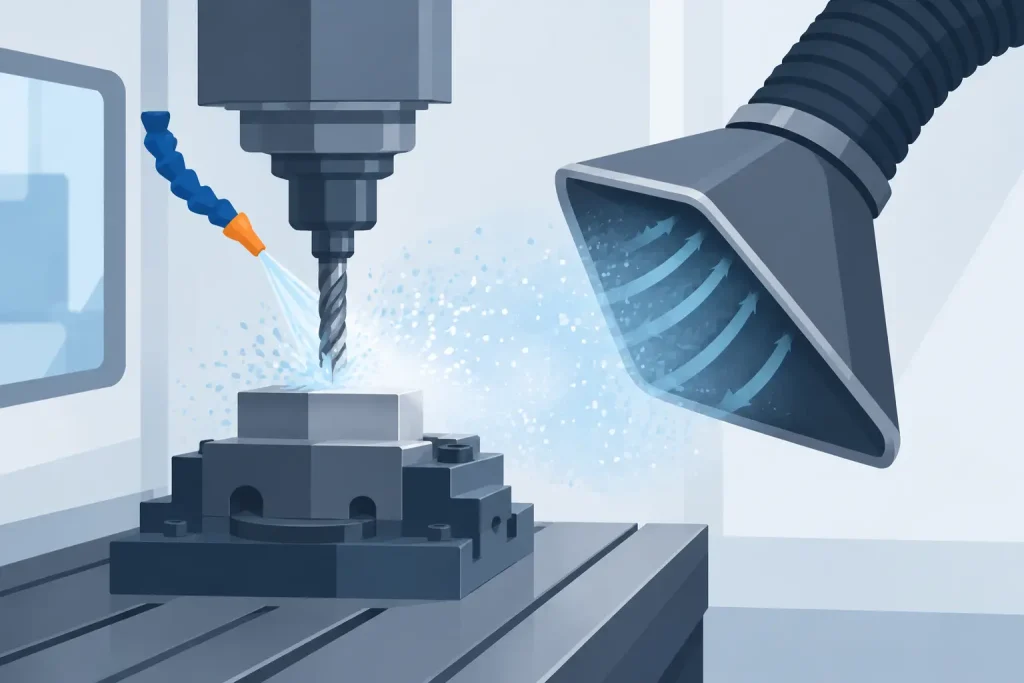
A CNC enclosure that looks clean from the outside can still release a fine oil mist each time its door opens. That mist may settle on walkways, migrate to adjacent workstations, coat electrical panels, and remain in the breathing zone of operators. To control machining aerosols effectively, facilities need more than general ventilation or a filter unit selected by airflow alone. They need engineered source capture, correctly matched filtration, disciplined maintenance, and documented performance verification.
For plant managers, EHS leaders, and maintenance teams, machining aerosol control is an operational issue as much as an air-quality issue. Poor collection affects worker exposure, housekeeping, machine reliability, fire risk, and the facility’s ability to demonstrate that its controls are functioning as intended.
What Machining Aerosols Are and Why They Persist
Machining aerosols are fine airborne droplets and particulate generated when metalworking fluids contact a cutting tool, workpiece, or high-speed rotating component. They can include straight-oil mist, water-miscible coolant mist, smoke created by thermal breakdown, and fine metal particulate. Grinding, turning, milling, drilling, honing, and high-speed CNC operations can all produce different aerosol loads.
The challenge is that not all emissions behave the same way. Larger droplets may be contained within the machine enclosure and captured close to the source. Fine mist can remain suspended, follow thermal currents, and pass through poorly selected filters. Smoke from elevated cutting temperatures may require a different filtration approach from conventional coolant mist.
Fluid selection also matters. A water-soluble coolant, synthetic fluid, or neat cutting oil will generate aerosols with different droplet sizes, viscosity, and filter-loading behavior. A system that performs adequately on one machine may fail when production changes to a higher-speed toolpath, a different alloy, or a different metalworking fluid.
Start With Source Capture, Not Room Dilution
General ventilation has a role in maintaining overall plant air quality, but it should not be the primary strategy for controlling emissions from machining. Once aerosol escapes the enclosure and disperses through the shop, collection becomes less predictable and exposure control becomes more difficult.
The most dependable approach is to capture contaminants at or inside the machining enclosure. This requires evaluating the enclosure’s leakage points, door-opening frequency, access panels, part loading arrangement, and the airflow path created by the extraction connection. A collector can have sufficient fan capacity on paper while delivering poor real-world results if air is pulled from the wrong part of the enclosure.
Capture performance depends on balanced airflow. Excessive negative pressure can interfere with machine operation, draw coolant vapor into areas where it is not needed, or create noise concerns. Insufficient airflow allows mist to escape through door gaps and cable openings. The goal is controlled inward airflow at likely leakage points while preserving practical access for operators.
For machines that cannot be fully enclosed, a properly positioned hood may be needed. Hood design must account for the direction and velocity of the aerosol plume, operator access, and cross-drafts from nearby fans, open doors, or supply air diffusers. A hood placed too far from a high-speed grinding process may collect very little, regardless of the collector installed downstream.
Select Filtration for the Aerosol You Actually Generate
Mist collector selection should follow a site assessment rather than a catalog comparison. The collector type must suit the contaminant, expected loading, operating schedule, available space, and maintenance capability.
Multi-stage mechanical filtration
Many machining applications benefit from staged filtration. A first-stage pre-filter or impingement section removes larger droplets and prevents premature loading of finer filters. Coalescing filters then combine fine droplets into larger ones so they can drain and, where appropriate, be returned or managed as collected fluid. Final-stage filters can address the remaining fine mist before air is discharged or recirculated.
This arrangement is effective for many coolant-mist applications, but filter selection and drain design are critical. If collected oil cannot drain freely, it can saturate media, increase pressure drop, and allow carryover. Maintenance personnel should be able to inspect drains, seals, and filter condition without unsafe access or extended production disruption.
Electrostatic precipitators for fine oil mist
Electrostatic precipitators can be suitable for fine oil mist and smoke where particle size is too small for simple mechanical filtration to operate efficiently over time. These systems electrically charge airborne droplets and collect them on plates or cells. They can offer low operating pressure drop, but their performance depends on regular washing and cleaning of collection cells.
An electrostatic unit is not a maintenance-free solution. Oil buildup, damaged ionizer wires, poor electrical contact, and skipped cleaning intervals can quickly reduce efficiency. Facilities should confirm that staff have a realistic cleaning procedure, safe isolation method, and spare-cell plan before committing to this technology.
HEPA and final polishing stages
Where a process produces exceptionally fine particulate or where air is being recirculated under a carefully evaluated program, a high-efficiency final stage may be considered. However, HEPA filtration is not automatically the right answer. It introduces higher pressure drop, requires strong upstream prefiltration, and can become costly if used to compensate for poor source capture or inadequate first-stage separation.
Activated carbon may be added when odor or volatile organic compound concerns are present, but it does not replace mist filtration. Carbon works by adsorption and has a finite capacity. Its selection should be based on the specific vapor-phase contaminants, expected concentration, humidity, and change-out plan.
Design the System as One Airflow Network
A machining aerosol control system includes more than the collector. Ductwork, fan selection, discharge arrangement, electrical controls, drainage, and machine interfaces all influence the result.
Duct velocity must be sufficient to transport entrained droplets without allowing deposits to accumulate in horizontal runs. At the same time, excessive velocity increases static pressure, energy consumption, and noise. Long duct runs, unnecessary elbows, and undersized branches can starve the machines furthest from the collector.
A correctly engineered system establishes required airflow at each machine, calculates the system resistance, selects a fan to deliver the duty point, and provides balancing capability. Variable-frequency drives may help match extraction to machine operating schedules, but they should not be used without confirming minimum capture airflow. Reducing fan speed to save energy is counterproductive if mist begins escaping at machine doors.
Drainage is equally practical. Collected coolant or oil must be directed to a suitable container or recovery point without creating leaks, overflow, or slippery floors. The design should distinguish between recyclable fluid and waste requiring managed disposal under the facility’s environmental procedures.
Verify Performance Through Testing and Inspection
A new installation is not proven merely because the fan starts and airflow can be felt at a hood. Testing and commissioning should confirm airflow, static pressure, capture performance, filter condition, electrical function, drainage, and operating controls.
Useful verification includes airflow measurement at individual branches, pressure readings across filters, smoke visualization at enclosure openings, and inspection for visible mist escape during representative machining cycles. Where worker exposure is a concern, personal and area monitoring should be coordinated with the facility’s industrial hygiene program and applicable occupational requirements.
Documentation matters. Baseline readings provide a reference for future servicing and help identify performance decline before it becomes a worker-exposure or production problem. For regulated facilities, field auditing, maintenance records, and test reports also create defensible evidence that the control system is being actively managed.
Maintenance Is the Difference Between Installed and Controlled
Oil mist systems lose performance gradually. A filter may load, a drain may plug, a duct may accumulate residue, or an enclosure seal may deteriorate. Without inspections, operators often adapt by opening doors less often, accepting haze, or placing portable fans nearby. Those workarounds do not solve the source problem.
A practical preventive maintenance program should track differential pressure, airflow, drain function, fan condition, electrical readings for electrostatic units, and visible leakage at machine enclosures. Filter replacement intervals should be based on operating evidence, not only calendar dates. A high-production machine running two shifts will not load a filter at the same rate as an intermittently used machine.
Master Jaya Group approaches these systems as lifecycle air-control assets, combining engineering, fabrication, installation, testing and commissioning, after-sales servicing, spare parts readiness, and performance monitoring. That level of accountability is particularly valuable when a facility needs to maintain both production uptime and verifiable clean-air performance.
The most effective way to control machining aerosols is to treat each machine, duct branch, collector, and maintenance task as part of one control strategy. When capture is proven at the source and performance is checked throughout the system’s operating life, clean air becomes a managed plant condition rather than a recurring housekeeping complaint.