A dust collector that keeps the facility visibly clean can still fail the test that matters: whether it captures emissions at the point of generation, protects workers’ breathing zones, and performs consistently during peak production. Selecting industrial dust control options is therefore not a matter of choosing the largest collector or the lowest initial price. It requires a clear understanding of the dust, the process, the airflow path, the compliance obligation, and the maintenance resources available after commissioning.
For plant managers, EHS leaders, and project engineers, the right solution should reduce exposure and emissions without creating an avoidable production bottleneck. The system must also produce records that support inspections, permit conditions, internal ESG commitments, and corrective-action decisions.
Start With the Dust and the Process
Dust control design begins with characterization. Particle size, bulk density, moisture content, abrasiveness, temperature, stickiness, and chemical composition affect collector selection. Fine welding fume behaves very differently from coarse foundry sand, wood dust, flour, animal-feed ingredients, cement, carbon black, or metal grinding particulate.
The generation point is equally important. Dust released during conveying, bag dumping, blending, crushing, screening, furnace charging, or machining needs a capture strategy matched to how the material moves. A canopy hood above an active grinding station, for example, may allow contaminants to pass through the operator’s breathing zone before extraction occurs. A properly positioned enclosure or side-draft hood is usually more effective because it controls the contaminant closer to release.
Before selecting equipment, conduct a field audit that documents process locations, current hood geometry, duct routing, fan performance, discharge points, housekeeping conditions, and worker tasks. Airflow measurements and static-pressure readings frequently reveal that the apparent collector problem is actually a capture or duct-balancing problem.
Dust Control Options for Industrial Facilities
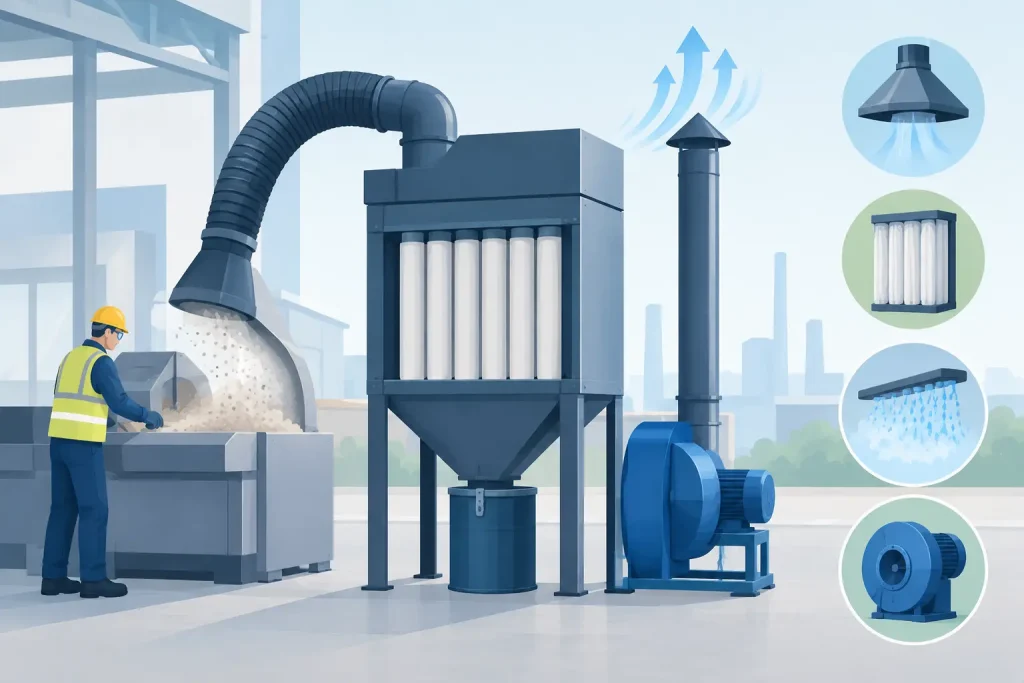
Most effective systems combine local exhaust ventilation with separation and filtration equipment. The following options are selected according to dust loading, particle characteristics, space constraints, discharge requirements, and operational risk.
Source Capture and Local Exhaust Ventilation
Local exhaust ventilation, or LEV, is the first control layer for many manufacturing processes. It includes capture hoods, enclosures, slot hoods, ductwork, dampers, fans, and a discharge or filtration device. Its purpose is to pull contaminated air away from the process before it spreads through the work area.
LEV performance depends on capture velocity, hood placement, duct transport velocity, and system balance. Oversized openings often dilute the airflow and demand an unnecessarily large fan. Undersized ductwork can increase pressure loss, while low transport velocity allows particulate to settle inside ducts. A successful LEV project requires engineered calculations, not only installation of a fan and hood.
Cyclones and Multi-Cyclones
Cyclones use centrifugal force to separate larger, heavier particles from an airstream. They are well suited as pre-cleaners for coarse dust in applications such as sawdust handling, grain processing, mineral handling, and certain boiler systems. Multi-cyclones use multiple small cyclone tubes to improve separation efficiency for finer particulate than a single large cyclone can address.
Their primary advantage is simplicity. Cyclones have no filter media and can tolerate elevated temperatures and abrasive material better than many fabric filters. Their limitation is fine-particle collection efficiency. A cyclone alone may not satisfy a stringent stack-emission target, particularly where light or respirable dust is present. It is often installed upstream of a baghouse to reduce the particulate load reaching the final filter stage.
Pulse-Jet Baghouses
Pulse-jet dust collectors, commonly called baghouses, are a standard solution for high-volume industrial dust collection. Contaminated air passes through fabric filter bags, while a pulse of compressed air periodically cleans the dust cake from the media. The collected material drops into a hopper for disposal, recycling, or return to the process.
Baghouses can achieve very high collection efficiency when filter media, air-to-cloth ratio, cleaning pressure, and hopper discharge are correctly designed. They are commonly used for metalworking, casting, food processing, feed production, wood processing, cement-related operations, and thermal processes with dry particulate.
The trade-off is maintenance discipline. Differential pressure must be monitored, compressed air must be dry and available, and worn bags or failed pulse valves must be addressed before emissions or fan load increase. Dust bridging in hoppers is another frequent issue. A collector cannot perform reliably if captured dust has no dependable path out of the hopper.
Cartridge Dust Collectors
Cartridge collectors use pleated filter media to provide substantial filtration area in a compact footprint. They are often suitable for fine, dry dust from laser cutting, grinding, polishing, powder handling, and similar processes where floor space is limited.
Compared with a conventional baghouse, a cartridge unit may be easier to fit into a constrained production area. However, cartridge media is not the right answer for every dust. Heavy loading, moist material, fibrous dust, high temperatures, or sticky particulate can shorten cartridge life and make cleaning ineffective. The collector must be evaluated against the actual process, not selected solely because it is compact.
Wet Scrubbers
Wet scrubbers bring contaminated gas into contact with water or another scrubbing liquid. They can be effective for sticky dust, hot exhaust, combustible dust concerns, or mixed contaminants containing both particulate and gases. Venturi scrubbers, packed towers, and other wet configurations serve different duties depending on the gas volume and contaminant profile.
A wet system transfers part of the control responsibility to wastewater and sludge management. Water quality, pump condition, pressure drop, mist elimination, chemical dosing, and effluent handling must all be managed. Where acid gases, odors, or soluble contaminants occur alongside particulate, a scrubber may provide a more appropriate integrated control approach than dry filtration alone.
Electrostatic Precipitators and Specialized Systems
Electrostatic precipitators use electrically charged fields to collect fine particulate from large gas volumes. They are commonly considered for specific thermal processes and applications where particle characteristics support electrostatic collection. Their performance is sensitive to gas conditions and particulate resistivity, so they require specialist design and operating knowledge.
Other specialized approaches include oil-mist collectors for machining, activated carbon filtration for vapor-phase contaminants, and regenerative thermal oxidizers for VOC destruction. These are not direct replacements for dust collectors. They address different pollutant mechanisms and may be incorporated into a broader air-pollution-control system when a facility has dust, fumes, oil mist, and VOCs from separate or combined sources.
Design for Compliance, Not Just Collection Efficiency
A collector’s published efficiency does not prove facility compliance. Regulators and occupational safety programs assess the complete control chain: source capture, duct integrity, fan duty, filtration condition, discharge performance, and documentation. In the United States, applicable requirements may involve OSHA exposure obligations, EPA requirements, state or local air permits, and fire-code provisions. Combustible dust applications also require a documented hazard assessment and appropriately engineered explosion protection or isolation measures where applicable.
For organizations operating under Malaysia’s Clean Air Regulations 2014 or DOSH-LEV requirements, the same engineering principle applies: compliance must be demonstrated through suitable design, testing, commissioning, inspection, and records. Stack sampling, emission monitoring, and LEV performance assessment turn a design claim into defensible operating evidence.
Specify measurable acceptance criteria before procurement. These may include target airflow at each hood, suction performance, maximum differential pressure, outlet particulate concentration, fan vibration limits, noise limits, and monitoring requirements. For some projects, a target such as dust filtered below 50 mg/m3 may be relevant, but the governing target must always match the applicable permit, regulation, process, and measurement method.
Lifecycle Decisions Determine Long-Term Results
The least expensive system can become the most costly if filter changes require extended shutdowns, spare parts are difficult to obtain, or the system cannot be tested safely. Evaluate access doors, hopper discharge, compressed-air quality, fan maintenance access, instrumentation, and the availability of replacement filters, valves, bearings, and controls.
Online differential-pressure monitoring, fan-status alarms, and scheduled servicing provide early warning before a control failure becomes a production or compliance incident. Periodic field auditing and stack sampling also identify declining performance that visual checks can miss. This lifecycle approach is central to Master Jaya Group’s role as a one-stop clean-air partner, covering engineered design, fabrication, installation, testing and commissioning, monitoring, and after-sales support.
The best dust control decision is the one that fits the material, captures emissions where they begin, remains serviceable under real production conditions, and produces evidence that the facility can stand behind. Start with a field assessment, define the performance criteria, and treat dust control as an operating system rather than a single piece of equipment.