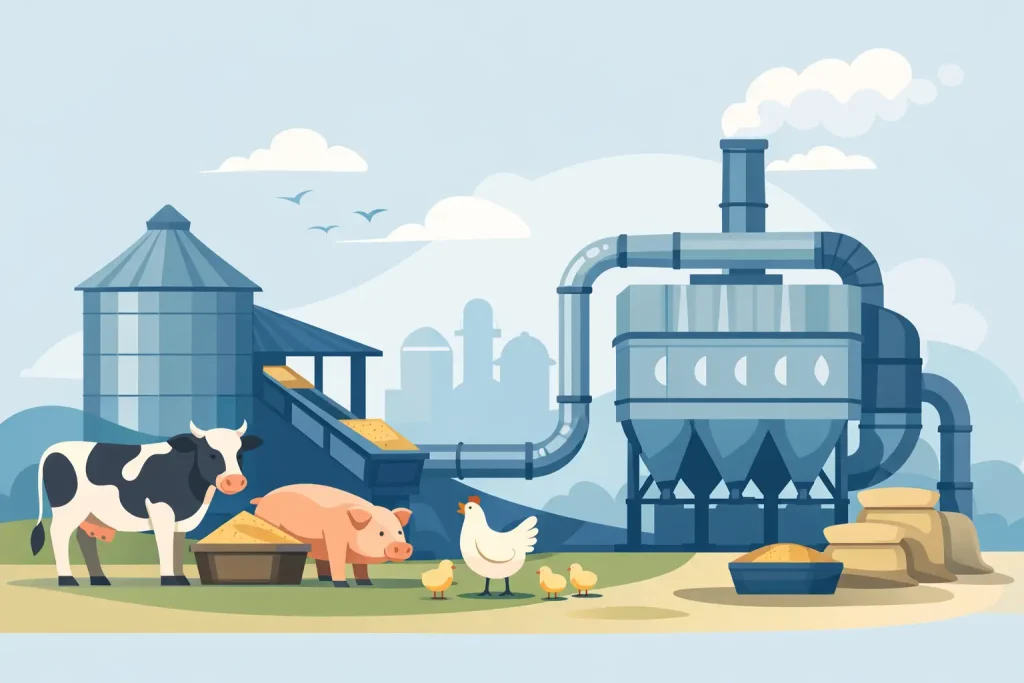
Feed dust is not a housekeeping issue. At receiving pits, hammer mills, mixers, pellet mills, coolers, screens, and bagging lines, airborne particulate can reduce visibility, contaminate equipment, expose workers, create combustible-dust risk, and complicate emissions compliance. Effective animal feed dust collector solutions must therefore do more than capture visible dust. They must match the process, protect production uptime, and produce defensible operating records.
For plant managers and EHS leaders, the most costly mistake is selecting a collector by airflow alone. A dust collection system is a connected engineering package: hood design, duct velocity, fan static pressure, filter media, discharge method, controls, and maintenance access all determine whether the system performs at the pickup point.
Where Feed Dust Collection Systems Commonly Fail
Animal feed production creates varied dust characteristics within one facility. Fine grain flour, soybean meal, mineral premixes, additives, pellets, and fines do not behave the same way in an airstream. Moisture content, particle size, bulk density, and oil content influence how dust conveys, separates, and releases from filter media.
The highest-risk areas are usually ingredient receiving and unloading, transfer points on conveyors and bucket elevators, grinding, batching, mixing, pelleting, cooling, screening, and finished-product bagging. Each source calls for a different capture approach. A receiving pit may require a large, well-enclosed hood with high air volume, while a bagging spout needs localized extraction that does not interfere with operator movement or product flow.
Poor hood placement is a common reason for disappointing results. If a hood is too far from the release point, the fan may move a large volume of air without controlling the dust cloud. If ducts are undersized or poorly routed, dust can settle inside the system, increasing pressure loss and creating a maintenance burden. Oversizing the fan can also be counterproductive, pulling product from the process or creating unnecessary energy consumption.
Animal Feed Dust Collector Solutions by Process Need
Pulse-jet baghouse collectors are typically the primary solution for dry feed dust. They provide continuous filtration while the plant operates, making them suitable for high-duty applications such as grinding, transfer stations, and bulk loading. Compressed-air pulses periodically clean the filter bags or cartridges, allowing the collected dust to fall into a hopper for recovery or controlled disposal.
A properly engineered pulse-jet collector must be selected around air-to-cloth ratio, expected dust loading, media type, cleaning pressure, hopper geometry, and required residual emissions. Fine particulate may require high-efficiency felt media or membrane-laminated bags. Dust that tends to bridge in the hopper may require a steeper hopper angle, vibrator, rotary valve, or screw conveyor. These details are not accessories. They determine whether the collector will run reliably between planned service intervals.
Cyclones or multi-cyclones can be useful as pre-separators where coarse, high-volume dust is present. They reduce the loading on the final filter stage and can recover heavier material before it reaches the baghouse. However, a cyclone is rarely the complete answer when a facility needs low outlet concentrations for fine feed dust. Its separation efficiency declines as particle size becomes smaller, so it is often paired with a pulse-jet dust collector.
Cartridge collectors can suit compact, localized applications where floor space is limited and dust loading is moderate. They offer a high filtration area in a smaller footprint, but the decision depends on the dust characteristics and cleaning performance. Heavy, fibrous, or sticky feed dust may favor baghouse media and hopper configurations that are more tolerant of demanding service conditions.
Wet scrubbers are generally not the first choice for dry animal feed dust because they create a wastewater or sludge stream. They may be considered for specific processes where simultaneous gas cooling or treatment of soluble contaminants is required. The correct technology is process-dependent, not a catalog preference.
Start With a Field Audit, Not a Generic Specification
A reliable design begins with a field audit. The engineering team should observe product movement, identify visible release points, review equipment operating cycles, and measure existing duct dimensions and fan performance. A system that works during steady production may fail during truck unloading, bin changeover, or peak batch demand. Those operating conditions need to be captured before equipment is specified.
The audit should establish the required capture velocity at each hood, duct transport velocity to prevent settling, total airflow, static-pressure losses, and fan duty point. It should also confirm whether the existing fan, motor, stack, electrical supply, compressed-air system, and foundations can support an upgrade.
For existing installations, differential pressure readings tell an important story. Low differential pressure can indicate leaks, damaged bags, or poor airflow distribution. Excessively high differential pressure may point to blinded filters, insufficient pulse cleaning, compressed-air problems, or undersized filtration area. Neither condition should be treated by simply increasing fan speed without a complete review.
Design for Combustible Dust and Worker Exposure
Many agricultural and organic dusts can be combustible when dispersed in air under the right conditions. A dust collector design should therefore include a formal combustible-dust evaluation based on the actual material handled, test data where available, collector location, building arrangement, and applicable local requirements.
In the United States, this often involves aligning the system with OSHA expectations and applicable NFPA combustible-dust standards. Depending on the hazard analysis, safeguards may include explosion venting, isolation devices, suppression, grounding and bonding, spark detection, or locating the collector outdoors. The appropriate protection method depends on dust properties and plant layout. Installing a collector without considering propagation paths through ducts can transfer risk rather than control it.
Worker exposure also depends on source capture. General ventilation improves room conditions but cannot replace local exhaust ventilation at high-release points. Enclosed transfer chutes, sealed covers, flexible connections, and correctly positioned hoods reduce the airflow needed to control dust and improve operator protection at the same time.
Installation and Commissioning Must Prove Performance
A dust collector should be treated as a process-critical system, not a standalone utility. During installation, duct supports, access doors, expansion joints, hopper discharge equipment, electrical interlocks, and compressed-air piping must be inspected against the approved design. Unsealed duct joints, incorrect damper positions, and restricted discharge valves can undermine a technically sound collector.
Testing and commissioning should verify actual airflow at priority pickup points, fan current, static pressure, differential pressure, pulse-cleaning operation, hopper discharge, and control interlocks. Where required, outlet testing and stack sampling provide documented evidence of emissions performance. If the facility operates under jurisdiction-specific requirements, the records should be organized for permit conditions, environmental inspections, and internal ESG reporting.
Master Jaya Group approaches this work as a full lifecycle clean-air program, combining engineered equipment, in-house fabrication, installation, testing and commissioning, field auditing, stack sampling, and performance monitoring. This one-accountable-party approach is particularly valuable when an older system requires modification rather than complete replacement.
Keep the System Effective After Startup
The best collector cannot compensate for neglected maintenance. Operators should trend differential pressure, compressed-air pressure, fan vibration, motor load, and visible emissions at the stack or discharge point. A sudden change in any one of these readings can identify an issue before dust escapes into the workplace or production must stop.
Planned inspections should include filter condition, cage corrosion, pulse valves, diaphragm kits, solenoid function, rotary valve clearances, duct wear points, hopper buildup, and fan impeller condition. Replacement filters must meet the original design intent. A lower-cost bag with different permeability or surface treatment can alter pressure drop, cleaning behavior, and emissions performance.
Online monitoring adds value when it converts these operating signals into actionable maintenance decisions. It is especially useful for multi-line feed mills where manual checks are inconsistent or where compliance teams need traceable operating history. Monitoring does not eliminate physical inspections, but it provides earlier warning of developing problems.
Selecting a Partner That Owns the Outcome
When evaluating animal feed dust collector solutions, ask whether the supplier can calculate the system, fabricate the equipment, install it, commission it, test performance, and support it with spare parts after handover. A vendor that only supplies the collector may leave the plant responsible for airflow balancing, duct modifications, controls integration, and compliance documentation.
A capable partner should clearly define the design basis, expected operating range, filter media selection, residual emission target where applicable, safety provisions, maintenance access, and commissioning deliverables. They should also be prepared to explain trade-offs. A lower initial-cost system may use less filter area, but it can carry higher pressure drop, more frequent filter replacement, and reduced production tolerance. The lowest capital cost is not always the lowest lifecycle cost.
A feed mill stays cleaner and more productive when dust control is designed around the way the plant truly operates. Begin with the release points, confirm the hazard and compliance requirements, and require performance evidence at commissioning. That approach turns dust collection from a recurring operating problem into a controlled, maintainable part of the production system.