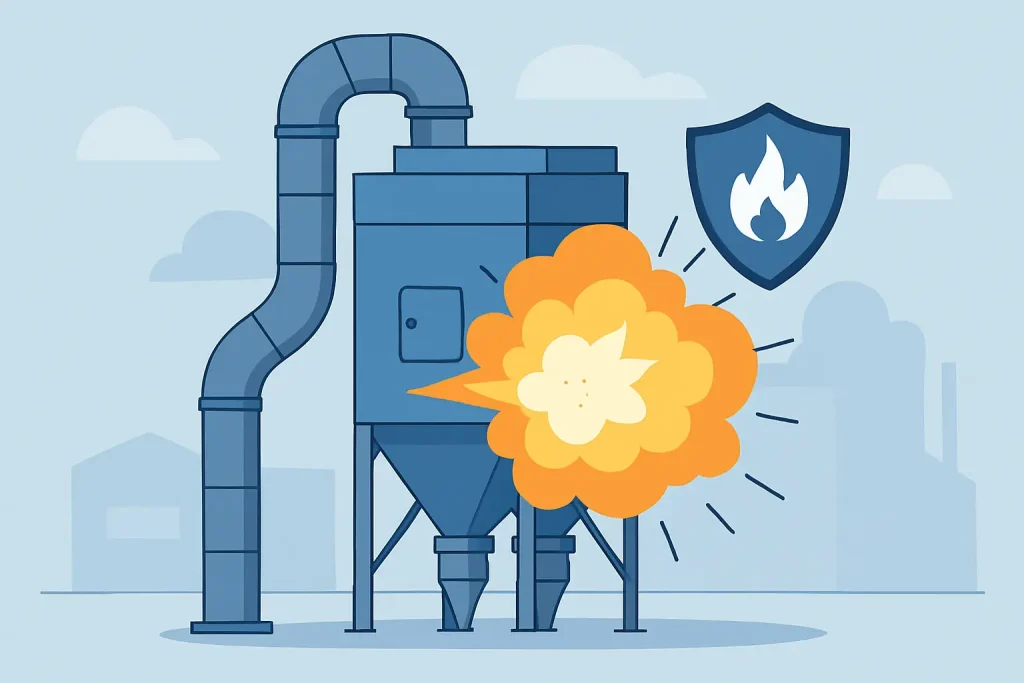
A dust collector rarely fails quietly. When combustible dust is present, the failure mode that matters most is fast, violent, and unforgiving – a deflagration that can rupture housings, propagate through ductwork, and put people at risk in seconds. If you own the system, you also own the question every investigator asks afterward: did you design, install, and maintain explosion protection consistent with NFPA expectations for combustible dust?
This article is a practical, engineering-centric guide to NFPA dust collector explosion protection – what NFPA is trying to prevent, which standards typically apply, what design decisions actually change risk, and what documentation makes your compliance position defensible.
What NFPA means by “dust collector explosion protection”
NFPA’s combustible dust framework is built around a simple reality: many process dusts can ignite and deflagrate when dispersed in air at the right concentration. A dust collector is the perfect place for that concentration to occur, because it is literally designed to suspend and capture fine particulate in moving air.
NFPA dust collector explosion protection is not one device or one checkbox. It is a coordinated set of controls that (1) reduces the likelihood of ignition inside the collector and (2) limits consequences if ignition still occurs. In practice, that means you address the collector body, the dirty-air and clean-air ducting, connected process equipment, the discharge (hopper, rotary valve, screw conveyor), and any occupied areas near vent paths.
It also means you treat explosion protection as part of the overall dust hazard analysis and management system, not a stand-alone accessory.
Which NFPA standards usually govern dust collectors
In the US, most dust-collector explosion protection decisions pull from a small set of NFPA standards that work together.
NFPA 652 sets the baseline requirement for managing combustible dust hazards and establishes the Dust Hazard Analysis (DHA) expectation. NFPA 654 is widely used for general industrial facilities handling combustible particulate solids. NFPA 68 addresses deflagration venting, and NFPA 69 addresses explosion prevention systems such as suppression, isolation, and inerting.
Depending on the industry and dust type, you may also encounter sector standards (for example, wood processing or agricultural and food operations). The practical point is this: your dust collector protection approach should map to the hazard characteristics of your dust and your process, then be justified through the DHA and equipment design basis.
Start with the dust – because the dust dictates the protection strategy
Explosion protection for a dust collector is only as good as the assumptions behind it. NFPA-aligned engineering starts with dust explosibility data and a clear operating envelope.
For many facilities, the most important parameters are:
- Kst and Pmax (how fast pressure rises and the maximum pressure in a deflagration)
- Minimum ignition energy (MIE) and minimum ignition temperature (MIT)
- Particle size distribution, moisture content, and whether the dust changes by campaign or supplier
If you do not have reliable test data, engineers may use conservative assumptions, but that can drive bigger vents, more restrictive isolation, or a shift toward suppression – all of which affect cost, footprint, and maintainability. This is where “it depends” is real: a low-Kst dust in an outdoor collector may be well served by venting, while a high-Kst metal powder inside a building may push you toward suppression and aggressive isolation.
The four building blocks of NFPA dust collector explosion protection
Most compliant designs combine four elements: explosion venting or suppression, explosion isolation, ignition source control, and safe layout/installation.
1) Venting vs suppression – selecting the right consequence control
Deflagration venting is often the simplest approach when you can safely direct the vented flame and pressure to a safe outdoor area. NFPA 68 provides the calculation framework and installation requirements. In the real world, venting is not “add a panel and walk away.” You must account for:
- Vent area required based on collector volume, dust Kst/Pmax, and desired reduced pressure (Pred)
- Ducted vent effects if you cannot vent directly outdoors (which can increase required vent area and complexity)
- Flame jet length and pressure effects in the vent discharge zone
- Weather protection that does not compromise vent function
Explosion suppression uses detectors and suppressant discharge to stop pressure rise early. It can be appropriate when venting is impractical (indoor collectors, limited vent discharge clearance, or processes where vented product release is unacceptable). Suppression systems require disciplined inspection, cylinder management, and functional testing. The trade-off is operational: suppression can reduce external consequences, but it increases reliance on instrumentation health and maintenance response.
A common misstep is selecting venting for an indoor collector and assuming a vent duct solves everything. Vent ducts introduce backpressure, can lengthen flame discharge, and demand careful mechanical support. If you are forced indoors by layout, it is worth evaluating suppression early rather than retrofitting later.
2) Explosion isolation – preventing propagation through ductwork
A dust collector is connected to equipment by ducts that can transmit flame and pressure back into process areas. NFPA 69 addresses isolation methods, and most defensible designs treat isolation as non-negotiable.
Isolation options include passive devices (such as flap valves) and active systems (such as fast-acting valves triggered by detectors), as well as chemical isolation. Selection depends on duct size, airflow direction, dust loading, and whether you have bidirectional flow.
Passive isolation can be attractive for simplicity, but it is sensitive to installation orientation and process conditions. Active isolation provides broader coverage in difficult duct configurations but introduces controls, power, and response-time requirements. Chemical isolation can be effective for complex networks but requires agent management and careful nozzle placement.
The key compliance question is not “do we have an isolation device?” It is “does the chosen isolation method match the duct geometry, air velocities, and credible event scenario identified in the DHA?”
3) Ignition source control – lowering probability of the event
Explosion protection is not only about surviving an event. NFPA-aligned risk reduction also targets ignition sources. For dust collectors, recurring ignition sources include hot work sparks, tramp metal, smoldering nests in ductwork, overheated bearings in upstream equipment, static discharge, and process upsets that create higher-than-normal temperature.
Practical controls often include spark detection and extinguishment in ducting, temperature monitoring where overheats are credible, bonded and grounded ducting and collector components, and strict hot-work and housekeeping programs.
One nuance: spark detection is not a blanket solution. It must be located with enough distance to act before the collector, with proper sensor alignment and reliable water or extinguishing delivery. If the duct run is short, detection may not buy you enough response time, which shifts attention back to isolation and consequence control.
4) Layout and siting – where the collector is installed matters
NFPA expectations consistently push designers to consider where a deflagration’s pressure and flame will go. Outdoor siting can reduce risk to people, but only if the vent discharge zone is clear of walkways, doors, and air intakes. Indoor siting raises the bar for engineered protection and often increases the importance of suppression and duct isolation.
Even outdoors, you must think about secondary dust. A vented event can disturb accumulated dust on nearby structures, creating a secondary explosion hazard. That links explosion protection back to housekeeping, dust layering limits, and facility dust management.
Designing the collector itself for credible explosions
Dust collector selection affects explosion protection outcomes. Pulse-jet baghouses and cartridge collectors vary in volume, internal geometry, and how dust accumulates. These differences influence vent sizing and where ignition may occur.
Engineers should check the collector’s pressure shock resistance, the vent panel certification basis, and whether the clean-air plenum is protected equivalently to the dirty-air side. Discharge devices matter as well. A rotary airlock can serve as part of an isolation strategy in some cases, but only if it is selected, installed, and maintained to the necessary clearances and robustness. Treating any rotary valve as “automatic isolation” without engineering review is a common gap.
Commissioning and lifecycle obligations – where many programs fail
NFPA alignment is not proven at purchase order. It is proven at commissioning, audits, and after maintenance activities that change the system.
Commissioning should verify the as-built vent orientation, required clearances, device installation direction, sensor locations, control logic, and interlocks. It should also confirm that operating parameters match the design basis: airflow, duct velocities, pressure drop, and pulse-cleaning behavior. A collector running outside its intended range can accumulate dust in dead zones or create abnormal concentrations.
After startup, the lifecycle program matters: inspection intervals for vent panels and suppression cylinders, functional tests for active isolation, documentation of repairs, and management of change when ductwork or processes are modified. If your facility switches raw material, adds a grinder, increases conveying velocity, or changes filter media, your DHA assumptions may no longer be valid.
Documentation that supports defensible compliance
When an incident happens, the technical question quickly becomes a documentation question. Facilities that are in the strongest position can show a straight line from hazard identification to engineered controls to maintained readiness.
A defensible package typically includes a current DHA, explosibility test reports or the basis for assumed properties, venting and Pred calculations (or suppression design basis), isolation device selection rationale, installation drawings, commissioning records, and maintenance and inspection logs. Training records also matter – operators and maintenance staff must understand what devices do, what “normal” looks like, and what conditions require shutdown.
For organizations building internal competency, pairing engineered upgrades with formal role-based training is often the fastest way to reduce repeat findings during audits.
Working with a partner that can carry accountability
Explosion protection sits at the intersection of design, fabrication, installation, controls, and compliance documentation. Many plants can buy components, but fewer can integrate them into a system that performs under real operating conditions and remains auditable years later.
For facilities that prefer a one-stop, compliance-led approach – from field auditing and engineered upgrades through testing and commissioning and lifecycle servicing – Master Jaya Group (https://www.masterjaya.com.my) supports end-to-end air pollution control programs and long-term performance monitoring that help plants keep both emissions control and safety risk within controlled limits.
A practical closing thought for decision-makers
If you want one question that reliably exposes weakness in combustible dust programs, ask this: “If we moved this dust collector indoors tomorrow, would we still be confident in our explosion protection strategy?” Even if you never move it, forcing that level of scrutiny drives better isolation decisions, tighter commissioning discipline, and documentation that stands up when it matters most.