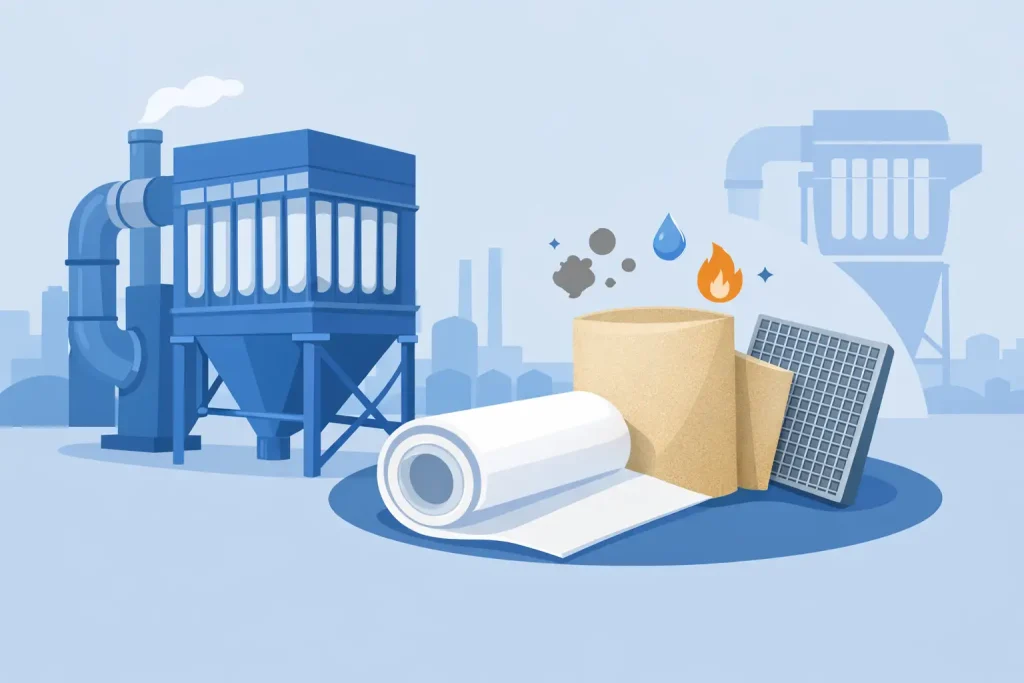
A baghouse that is sized correctly can still underperform if the filter media is wrong. When plant teams ask how to choose filter media for baghouse systems, the real question is usually broader: how do we protect airflow, control emissions, avoid premature bag failure, and maintain defensible compliance under actual process conditions rather than nameplate assumptions?
Filter media selection sits at the intersection of process engineering, emissions control, and maintenance strategy. It affects pressure drop, cleaning efficiency, bag life, energy consumption, downtime, and stack performance. In regulated industrial environments, it also influences whether the system can consistently support permit conditions and inspection-ready operating records.
How to choose filter media for baghouse systems
The first step is to stop treating filter media as a commodity. A bag that works well on one line can fail quickly on another, even within the same facility. Dust loading, particle shape, gas temperature, moisture swings, and chemical constituents all change the way the media performs.
A proper selection process starts with the application, not the catalog. The practical questions are straightforward: What is the dust? What is the gas stream temperature during normal and upset conditions? Is there moisture, condensation risk, oil carryover, or corrosive content? How aggressive is the cleaning cycle? What outlet emission target must be maintained? Those answers narrow the field much faster than comparing material names alone.
Start with the dust and process characteristics
Dust properties should drive the conversation early. Particle size distribution matters because very fine particulate behaves differently from coarse dust in both filtration and pulse cleaning. Fine, cohesive dust may require a media finish that improves cake release. Abrasive dust, common in minerals, cement-related handling, or some metal processes, may demand heavier fabric construction or protective design changes to reduce wear at high-velocity entry points.
Bulk density and dust loading also matter. A high inlet dust concentration increases stress on the media and can change the recommended air-to-cloth ratio. Hygroscopic dust adds another layer of risk because it can absorb moisture, blind the bags, and create hard deposits that no cleaning pulse will remove efficiently.
The process itself often explains why bags fail. If the system handles food ingredients, feed materials, metal fumes, boiler ash, or carbon-based particulate, each calls for a different approach to filtration behavior, release characteristics, and contamination tolerance. The best media choice is the one that matches the actual particulate and operating profile, not a generic “high-temperature” or “standard polyester” label.
Temperature is more than a maximum rating
One of the most common selection mistakes is choosing media based only on normal operating temperature. Baghouse systems should be evaluated against continuous temperature, peak excursions, startup conditions, shutdown conditions, and possible upset scenarios. A media that survives at 275 degrees Fahrenheit continuously may still fail if periodic spikes exceed its tolerance.
Just as important is the relationship between temperature and dew point. If the gas stream drops below acid dew point or water dew point in parts of the collector, condensation can attack the media, promote blinding, and trigger corrosive damage to both bags and steelwork. This is why media selection should be tied to system insulation, hopper heating where applicable, and realistic operating discipline.
For moderate-temperature dry dust service, polyester is often considered because of cost and broad applicability. But it is not suitable for every chemical or moisture condition. Aramid can perform well at higher temperatures, while PPS is frequently considered where acidic gas components and elevated temperature are present. PTFE offers strong chemical resistance and high-end performance, but cost is significantly higher. The right choice depends on the full process window, not just one data point.
Consider chemistry and moisture together
Chemical compatibility is often underestimated during procurement. Acid gases, alkaline particulate, solvents, oxidizing conditions, and hydrolysis risk all affect media life. A fabric that looks acceptable on paper can weaken quickly when exposed to the wrong combination of heat, moisture, and chemistry.
Moisture is especially critical. Even low-level moisture can become a serious issue if temperature falls near dew point or if the dust itself retains water. In those situations, selecting a media with the right finish or membrane may be necessary, but it is rarely enough on its own. You may also need to address duct leakage, collector insulation, compressed air quality, or process stabilization.
This is where engineering judgment matters. Media selection should not be separated from field auditing, operating data review, and emissions history. In many plants, recurring bag problems are not purely a fabric issue. They are the result of unstable process conditions that the media is being asked to absorb.
Woven, felted, and membrane-laminated options
Needlefelt media is widely used in pulse-jet dust collectors because it supports surface filtration and handles pulse cleaning effectively. Within that category, fabric weight, fiber blend, scrim construction, and finish all influence performance. Glazed, singed, calendered, or chemically treated finishes may improve dust release or durability depending on the service.
Membrane-laminated media, often using PTFE membrane over a felt substrate, can improve particulate capture and reduce dust penetration into the fabric. This is valuable where very fine particulate, sticky dust, or lower outlet emissions are required. The trade-off is cost, and in some services the premium is justified only when emissions targets, product recovery, or maintenance reduction clearly support it.
Woven fabrics still have their place in selected shaker or reverse-air applications, but for modern pulse-jet systems, felted media is typically the starting point. The decision should be tied to collector design, cleaning mechanism, and the emission control objective.
Abrasion and cleaning stress affect bag life
Some failures blamed on poor media selection are actually mechanical. If bags are rubbing against cages, if pulse pressure is excessive, or if inlet flow distribution is poor, even a chemically compatible media can fail early. Abrasion resistance should therefore be considered alongside baghouse internals, cage condition, and pulse settings.
Abrasive service may benefit from heavier denier fibers, reinforced wear zones, or collector design changes that reduce direct particle impingement. If the process produces sharp or high-mass particulate, the bag top and lower sections can wear differently, so failure pattern analysis is useful before specifying replacement media.
Pulse-cleaning intensity also matters. Overcleaning can shorten bag life and destabilize the dust cake, while undercleaning drives pressure drop upward and reduces airflow. Filter media should be selected with the intended cleaning regime in mind, not after the fact.
Compliance targets should shape the specification
For regulated facilities, media selection is not just a maintenance purchase. It is part of the plant’s emissions-control strategy. If the baghouse supports compliance with site permit limits, internal ESG targets, or occupational exposure controls, the media specification should reflect that responsibility.
That means documenting process conditions, target outlet performance, and expected maintenance intervals before ordering bags. It also means verifying results after installation through proper testing and commissioning, operating checks, and where required, stack sampling. Plants that treat filter bags as interchangeable spare parts often create avoidable compliance risk because they lose consistency in collector performance over time.
A compliance-led approach also helps with lifecycle cost. The lowest-priced media may carry the highest total cost if it increases compressed air usage, replacement frequency, downtime, or emission instability. A more suitable media often pays back through longer service life and steadier operation.
A practical selection sequence
If you need a workable process for how to choose filter media for baghouse service, begin by collecting actual operating data rather than relying on old design assumptions. Confirm dust type, particle characteristics, gas composition, moisture risk, normal and maximum temperature, collector type, cleaning method, and emission target.
Then review historical failure modes. Are bags blinding, tearing, shrinking, glazing, or chemically degrading? Each pattern points toward a different correction. After that, match candidate media based on temperature tolerance, chemical resistance, release characteristics, and mechanical durability. Finally, validate the selection against maintenance practices and compliance requirements, including testing and commissioning expectations.
In complex applications, this work is best done with a supplier or engineering partner that can assess the full system, not just sell replacement bags. Master Jaya Group approaches baghouse performance the same way it approaches broader air pollution control systems: as a lifecycle responsibility tied to design, field conditions, auditing, servicing, and long-term operational visibility.
The best filter media is rarely the most familiar option. It is the one that keeps your collector stable when process conditions are less than perfect, and keeps your plant ready when performance has to stand up to inspection.