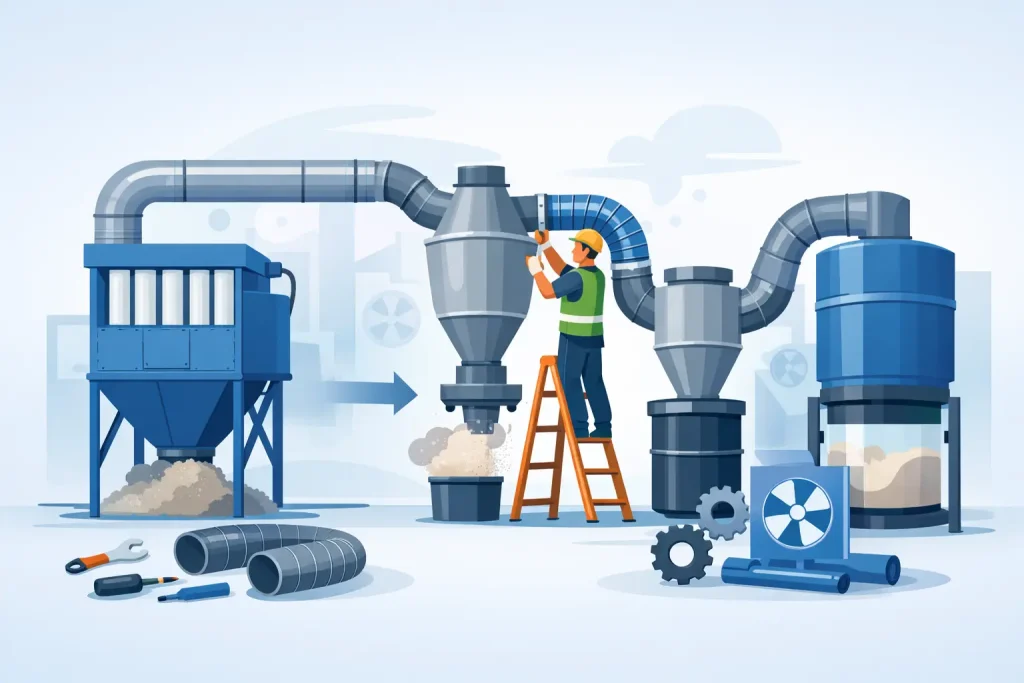
A dust collector that once met production demand can quietly become a liability. Air volume drops as duct runs get modified over the years, filter media no longer matches the dust loading, fan performance drifts, and compliance margins shrink. That is usually when plant teams start asking how to retrofit existing dust collection systems without committing to a full replacement.
In most facilities, retrofitting is not just a cost-saving exercise. It is a risk-control decision tied to emissions, housekeeping, worker exposure, fire and explosion hazards, and production stability. A well-planned retrofit can restore capture efficiency, improve differential pressure control, reduce energy waste, and create defensible documentation for environmental and occupational requirements. A poorly planned one can leave the same weak points in place, only with newer parts.
When a retrofit makes more sense than replacement
Full replacement is justified when the original system is fundamentally undersized, structurally unsound, or unsuitable for the dust hazard. But many existing systems still have useful mechanical life in the housing, hopper, or support structure. In those cases, retrofitting can deliver a better return if the project starts with engineering evidence rather than assumptions.
The first question is not whether the collector is old. It is whether the current system can be brought back to required performance with targeted changes. A pulse-jet dust collector with a sound casing may only need a fan upgrade, revised cleaning controls, a different filter media, and duct balancing. A cyclone or multicyclone may need rework upstream or downstream because the collector itself is not the main bottleneck. Facilities that run thermal processes, grinding, conveying, bag dumping, casting, or bulk powder handling often see this pattern.
Retrofit also becomes attractive when shutdown windows are short. Reusing major components can reduce fabrication time, simplify tie-ins, and limit civil or structural changes. That matters when uptime is as critical as compliance.
How to retrofit existing dust collection systems the right way
The correct retrofit path begins with an audit. Without airflow readings, static pressure profiles, dust characteristics, process data, and emissions observations, the project becomes guesswork. A proper field assessment should review hood capture at source, duct velocity, leakage points, fan condition, collector differential pressure trends, cleaning performance, hopper discharge reliability, and stack condition.
This is also the point where regulatory expectations need to be mapped clearly. Environmental compliance and occupational exposure control are related, but they are not identical. A system that prevents visible emissions may still fail to provide adequate point-of-generation capture. Likewise, a collector that protects indoor air may still struggle to meet stack targets if filtration efficiency or gas flow stability has deteriorated. Testing and commissioning requirements, stack sampling plans, and any local code obligations should be built into the retrofit scope from the beginning.
In practice, most successful retrofit projects address five areas together rather than one by one: source capture, ducting, air mover performance, filtration, and controls. If one is left behind, the upgraded system often underperforms.
Start at the source, not at the collector
Plant teams often focus first on the dust collector because it is the most visible asset. But capture problems usually start upstream. A hood positioned too far from the dust generation point, an enclosure with poor containment, or a branch line with inadequate transport velocity will overload the collector with the wrong airflow pattern.
Retrofitting source capture may involve redesigning hoods, adding side panels or partial enclosures, resizing drops, or correcting branch takeoffs. These changes are rarely expensive compared with replacing a collector, but they have a disproportionate effect on performance. Better capture reduces fugitive dust, improves housekeeping, and prevents operators from relying on manual cleanup to compensate for system weaknesses.
Rebalance the duct system
Many dust collection systems were originally designed for one process layout and are later asked to serve another. Extra branches get added, flexible hose sections remain in service too long, and pressure losses rise beyond the original fan selection. The result is familiar: some pickup points pull hard, others barely capture anything, and the collector receives unstable flow.
A retrofit should include duct inspection and recalculation. That may mean resizing specific sections, replacing damaged elbows, reducing unnecessary flex hose, adding blast gates where process diversity allows, and restoring adequate conveying velocity to prevent settling. The aim is not maximum suction everywhere. It is controlled airflow where the process requires it.
Match the fan to the real system curve
Fan upgrades are among the most common retrofit measures because the original fan often no longer matches actual resistance. Impeller wear, motor inefficiency, process expansion, and changes in filter pressure drop all alter system demand over time. Installing a larger collector without checking the fan is a common mistake, but so is changing the fan without understanding the collector and ductwork.
A proper engineering review should compare measured system resistance against fan performance. In some cases, a new impeller or motor with a variable frequency drive is enough. In others, the fan arrangement, wheel type, or material of construction should change to suit abrasive or sticky dust service. Noise, vibration, and balancing also matter because unstable fan performance will undermine the rest of the retrofit.
Filtration upgrades that actually improve compliance
If there is one area where retrofits deliver immediate gains, it is filter performance. Many older systems still run with media that does not suit current dust loading, moisture conditions, temperature, or required emissions performance.
For pulse-jet collectors, a filter bag or cartridge upgrade may improve surface loading, pulse cleaning efficiency, and pressure drop stability. But media selection should not be based on price alone. Fine powders, hygroscopic dust, fibrous particulates, and high-temperature service all require different considerations. Antistatic properties may also be necessary where combustible dust risk exists.
Just as important is the cleaning system itself. Compressed air quality, pulse pressure, valve timing, and sequencing can make a technically good filter perform badly. If the retrofit only changes the media and leaves a weak cleaning system untouched, blinding and premature failure often return.
Don’t ignore hopper and discharge performance
A collector can have excellent filter media and still fail operationally if dust does not discharge reliably. Hopper bridging, rotary valve wear, air leakage, and poor sealing can push dust back into the housing and disrupt filtration. During retrofit planning, hopper angles, vibrator requirements, discharge devices, and disposal methods should be reviewed as part of the total system.
This is especially relevant in facilities handling fine, sticky, or variable-moisture materials. The dust that behaves well in design calculations may behave very differently in actual production.
Controls, monitoring, and documentation matter more than before
Older systems often operate with minimal instrumentation. That approach leaves maintenance teams reacting to symptoms instead of managing performance. A modern retrofit should include practical monitoring – differential pressure, fan amperage, airflow indication where useful, hopper level status, and alarm logic for abnormal operation.
For facilities with tighter compliance obligations, online performance monitoring can add operational visibility that supports preventive servicing and more defensible records. This is where a one-stop solution provider with auditing, stack sampling, testing and commissioning, and after-sales support adds real value. The upgrade is no longer just a hardware job. It becomes a managed compliance asset.
Documentation should also be treated as part of the retrofit deliverable. Updated drawings, fan curves, filter specifications, commissioning records, balancing results, and emissions-related test reports create continuity for maintenance, EHS leadership, and regulatory review. If key personnel change, the plant should not have to rediscover why the system was modified.
Common retrofit mistakes
The most expensive retrofit errors are usually scope errors. One is treating high differential pressure as a filter-only problem when the real cause is poor duct design or fan mismatch. Another is adding collection points without recalculating total airflow demand. A third is replacing parts in isolation while leaving the original capture strategy untouched.
There is also the issue of compliance assumptions. Passing one test condition does not guarantee ongoing conformity during normal production, changing raw materials, or peak load operation. That is why field auditing and post-retrofit verification are essential. In some plants, the right answer is not the largest collector. It is a balanced system with verified capture, stable pressure drop, and measurable emissions control.
A practical retrofit roadmap
For most facilities, the best retrofit sequence is straightforward. Audit the current condition, define the compliance and process targets, verify source capture, recalculate airflow and static pressure, upgrade the fan and filtration package where justified, then complete testing and commissioning with documented results.
This approach also helps with budgeting. Instead of asking for a generic upgrade, plant teams can justify specific work packages tied to measurable outcomes such as lower emissions, improved suction performance, reduced downtime, and longer filter life. That is a much stronger position for operations, maintenance, and ESG stakeholders alike.
Master Jaya Group typically sees the strongest long-term results when retrofit projects are treated as lifecycle improvements rather than one-time repairs. Spare parts planning, service intervals, competency awareness, and performance tracking all help protect the investment after startup.
A dust collection retrofit should leave the facility with more than a cleaner stack or a new set of filters. It should leave the operation with predictable airflow, better control at the source, and records that stand up when performance is questioned.