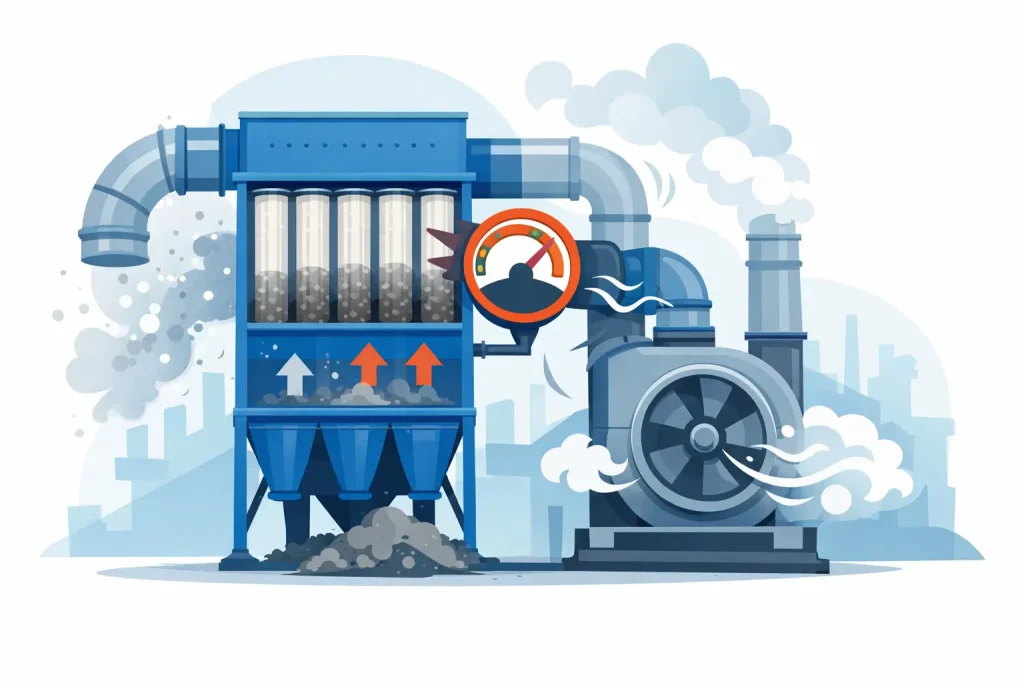
A dust collector that suddenly shows higher differential pressure is not just a maintenance nuisance. In most plants, it is an early warning that filtration resistance is rising, airflow is shifting, and compliance margin may be narrowing. If you are asking what causes high dust collector pressure drop, the correct answer is rarely a single fault. It is usually a combination of filter condition, cleaning performance, dust characteristics, airflow imbalance, and system design limitations.
For plant managers, EHS leaders, and maintenance teams, that distinction matters. Treating pressure drop as only a bag replacement issue can mask deeper problems that affect capture efficiency, energy use, and statutory performance.
What high pressure drop actually means
In a pulse-jet dust collector, pressure drop is the resistance to airflow across the filtration path. As dust accumulates on filter bags or cartridges, resistance increases. Some increase is normal and even necessary, because a stable dust cake often improves filtration efficiency. The concern begins when differential pressure rises beyond the expected operating range and does not return after cleaning cycles.
At that point, the collector fan may struggle to maintain design airflow. Pickup velocity at hoods and duct branches can fall, dust can settle in the ductwork, and emissions performance may become less predictable. In regulated facilities, this is not just an operations issue. It can become a compliance issue if the system no longer performs as designed during testing, commissioning verification, field auditing, or stack sampling.
What causes high dust collector pressure drop in real operations
Filter media loading beyond normal dust cake
The most common cause is simple overloading of the filter media. Over time, dust accumulates on the bag or cartridge surface faster than the pulse cleaning system can remove it. This creates a thicker, denser cake and higher resistance.
That can happen because production increased, the process changed, or dust generation is now heavier than the original design basis. It can also happen more gradually when the collector has been operating near its limits for months and the pressure trend was not reviewed closely enough.
Not all dust behaves the same way. Fine, sticky, hygroscopic, oily, or fibrous dust can blind the media faster than free-flowing particulate. In food processing, animal feed, metal finishing, and other variable-duty operations, this difference is often the reason a collector that worked well at startup begins showing elevated pressure drop later.
Inadequate pulse cleaning performance
If the pulse-jet cleaning system is weak, inconsistent, or mistimed, dust stays on the filter surface. The result is a steady rise in differential pressure even when the filters themselves are still serviceable.
Compressed air pressure is a frequent factor. If the pulse header pressure is too low, the air volume delivered to each blow tube is insufficient to flex the bag and release the dust cake. Solenoid valve failure, diaphragm wear, blocked nozzles, or poor sequencing can create the same outcome. Sometimes only one row is affected, which leads to uneven loading across the collector and makes diagnosis less obvious.
This is where a disciplined inspection matters. A collector may appear to be pulsing normally from the outside while several valves are underperforming internally.
Blinded, aged, or damaged filters
High pressure drop does not always mean filters are full of dust. It may mean the media pores are blocked or the surface has been permanently altered.
Blinding occurs when fine particulate, moisture, oil mist, condensable vapors, or chemical reactions clog the filter structure. Once the media is blinded, pulse cleaning cannot restore normal permeability. The pressure drop remains elevated even after aggressive cleaning.
Filter age also matters. Repeated pulse cycles, heat exposure, abrasion, and chemical attack change the media over time. Bags may harden, shrink, or lose release characteristics. Cartridges may show pleat packing, distortion, or internal loading. Aged filters often cause a slow but persistent increase in resistance before obvious failure occurs.
Excessive air-to-cloth ratio
A collector that is undersized for the actual process load will often run with chronically high pressure drop. This happens when the air volume per square foot of filter media, often called the air-to-cloth ratio, is too high for the dust type and operating duty.
At excessive filtration velocity, dust is driven into the media more aggressively, cleaning becomes less effective, and the collector spends its life fighting resistance. Even a new set of filters may show acceptable readings only briefly.
This is one reason system retrofits need engineering review. If a plant adds machines, increases line speed, or connects new pickup points without reassessing fan duty, duct losses, and collector capacity, the pressure drop issue may be structural rather than maintenance-related.
System conditions outside the collector
Ducting restrictions and poor airflow balance
When operators ask what causes high dust collector pressure drop, they often focus only on the collector housing. In practice, the upstream duct network can contribute significantly.
If ductwork is partially blocked by settled dust, if branch dampers are misadjusted, or if the transport velocity is too low, airflow distribution becomes unstable. Some branches may starve while others overload the collector. This can create unusual pressure behavior that looks like a filter issue but is really a system balance problem.
Long duct runs, unnecessary elbows, poor transition geometry, and leakage also change static pressure demand. The fan then operates away from its intended duty point, which can reduce effective suction at the source and increase stress across the system.
Fan performance problems
A worn, fouled, or incorrectly selected fan can distort the entire pressure profile of the dust collection system. Impeller buildup, rotation issues, belt slippage, motor problems, or VFD settings outside design intent can all affect airflow.
In some cases, measured pressure drop appears high because the fan is no longer pulling the system through its intended operating window. In others, an oversized fan can drive higher-than-expected velocity through the filters and accelerate loading. The correct interpretation depends on the full system data, not a single gauge reading.
Hopper discharge and dust evacuation issues
Dust that is not discharged properly from the hopper can re-entrain into the airstream or back up into the collector. Rotary valves, screw conveyors, and discharge points that bridge, leak, or stall can contribute to rising pressure drop.
This is especially relevant with cohesive dusts or when moisture enters the hopper. A collector can have healthy bags and acceptable pulse air, yet still run poorly because dust handling below the hopper is unreliable.
Process conditions that change pressure drop quickly
Moisture is one of the fastest ways to create high pressure drop. If gas temperature drops below dew point, condensation can form on the filters and turn dust into a sticky layer that does not release. Thermal swings during startup and shutdown are common triggers.
Product changes can do the same. A new raw material, different particle size distribution, or added oil content may alter how the dust cake forms and how easily it pulses off. In plants with variable campaigns, pressure drop trends should always be reviewed alongside process changes rather than treated as isolated maintenance data.
How to diagnose the real cause
The most reliable approach is to treat high differential pressure as a system investigation, not a baghouse-only event. Start with the trend. Was the rise sudden or gradual? Did it begin after a filter change, production increase, raw material change, or maintenance shutdown?
Then verify the basics: actual compressed air pressure at the manifold, pulse valve function, cleaning sequence, hopper discharge condition, fan speed, and damper positions. Inspect representative filters, not just the easiest ones to access. A visual and physical review often shows whether the problem is surface cake, blinding, abrasion, moisture, or mechanical damage.
It is also worth comparing current operating conditions with original design assumptions. Many high pressure drop cases trace back to facilities that have expanded throughput while keeping the same collector, fan, and duct arrangement. The system still runs, but not within a healthy margin.
For regulated facilities, this is where engineering support adds value. Pressure drop should be interpreted alongside capture performance, emission targets, testing and commissioning records, and, where relevant, Clean Air Regulations obligations and DOSH-LEV performance expectations.
Corrective action depends on the cause
There is no single fix that suits every case. If the issue is poor pulse performance, focus on compressed air quality, valve condition, and cleaning optimization. If filters are blinded, replacement is usually necessary, but media selection may also need to change. If the collector is undersized, a larger housing, added filtration area, or revised process ventilation strategy may be more effective than repeated bag changes.
Likewise, if moisture is driving the problem, the answer may involve insulation, pre-separation, inlet temperature control, or process changes upstream. If fan or duct losses are the real constraint, correcting those elements can restore stable pressure more effectively than any intervention inside the collector.
A properly engineered response should protect three outcomes at the same time: airflow performance, filter life, and compliance confidence. That is why many industrial operators prefer a one-stop solution provider that can review design, fabrication, servicing, field auditing, stack sampling, and ongoing monitoring as one accountable scope. Where operating risk is high, platforms such as the monitoring and lifecycle support offered by Master Jaya Group can help turn pressure drop from a reactive alarm into a controlled performance metric.
A high reading on the differential pressure gauge is not the problem by itself. It is the evidence. The real job is to identify which part of the system changed, and whether that change threatens capture, uptime, or compliance before the plant finds out the hard way.