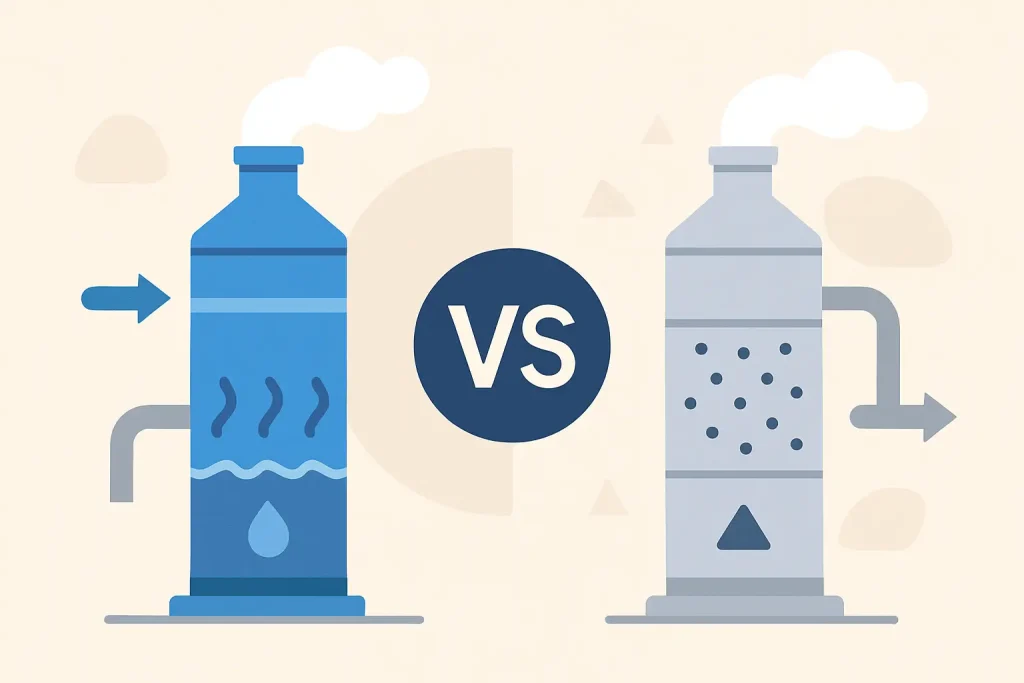
A wet scrubber that removes acid gas efficiently can still become your biggest headache if you do not have a clear plan for blowdown handling, corrosion control, and permitted discharge. A dry scrubber that looks simple on paper can disappoint if your particulate loading, temperature window, or reagent utilization assumptions are optimistic. For most plants, the real decision is not “wet versus dry” in isolation – it is which system produces defensible compliance results with the lowest lifecycle risk.
Wet scrubber vs dry scrubber differences that matter in real plants
At a high level, wet scrubbers capture pollutants by contacting the gas stream with a liquid (often water with chemical conditioning). Dry scrubbers capture pollutants through contact with a dry sorbent or reagent (often hydrated lime, sodium bicarbonate, or similar), typically followed by particulate collection in a baghouse.
The practical difference shows up immediately in what leaves the system. Wet scrubbers transfer contaminants into a liquid stream, which can create wastewater, sludge, and dissolved salts. Dry scrubbers transfer contaminants into a dry solid byproduct, which becomes spent sorbent and captured particulate for disposal. If you are accountable for emissions compliance and plant uptime, that single distinction drives most of the engineering and permitting implications.
How each technology removes pollutants
Wet scrubbers: mass transfer and chemistry in a liquid phase
Wet scrubbers rely on gas-liquid mass transfer. The pollutant has to reach the liquid surface, dissolve, and then react or stay captured in solution. Packed tower scrubbers, venturi scrubbers, and spray towers use different contact methods, but the governing theme is the same: more contact area and better mixing generally improve capture, as long as you stay within pressure drop and energy limits.
Acid gases such as HCl, SO2, and HF are strong candidates for wet scrubbing because they dissolve readily and can be neutralized with caustic or alkaline solutions. Some soluble VOCs and ammonia-type compounds can also be reduced, but performance depends heavily on solubility and reaction kinetics. For dust control, venturi scrubbers can be very effective on fine particulate when designed for the right pressure drop, but the operating cost can rise quickly.
Dry scrubbers: reagent reaction and downstream filtration
Dry scrubbing is primarily a gas-solid reaction. Reagent is injected and reacts with targeted gases to form salts, which are then captured as particulate. In most industrial designs, a fabric filter (pulse-jet dust collector/baghouse) becomes a core part of the system because the filter cake improves reaction time and capture.
Dry systems are frequently selected for acid gas control when wastewater is undesirable, when freezing is a concern, or when a plant wants a simpler liquid-free operation. That said, dry scrubbing is not “maintenance-free.” You are managing reagent feed systems, dust handling, filter performance, and often temperature and humidity conditioning to maintain reaction efficiency.
Pollutant fit: where wet wins, where dry wins, and where “it depends”
The cleanest way to compare is by pollutant category, because compliance outcomes are what will be measured.
Acid gases
Wet scrubbers are the traditional workhorse for high removal efficiency of soluble acid gases, especially where inlet concentrations fluctuate. They can handle high mass loading when properly designed, and control can be tuned by pH, oxidation-reduction potential, and liquid-to-gas ratio.
Dry scrubbers can also achieve strong acid gas reductions, but performance becomes more sensitive to reagent selection, stoichiometric ratio, residence time, and filtration conditions. If you need consistently high removal with variable inlet conditions, wet can be more forgiving. If wastewater is a hard constraint, dry can be the more practical path.
Particulate and fumes
Dry scrubbers are not particulate control devices by themselves – the baghouse does the heavy lifting. In applications where you already need high-efficiency particulate control (fine dust, metal fumes, nuisance dust limits), integrating dry scrubbing upstream of a fabric filter can be effective and operationally coherent.
Wet scrubbers can capture particulate, but your effectiveness depends on droplet size, pressure drop, and particle characteristics. They can be attractive where there is sticky dust, explosive dust risk reduction objectives, or where quenching and cooling are needed before further treatment. They also introduce visible plume and droplet carryover risks if mist eliminators and drainage are not properly engineered.
VOCs and odors
Neither wet nor dry scrubbing is a universal VOC solution. Wet scrubbing works best when the target compounds are soluble or reactive in the scrubbing liquor. Dry sorbent systems are generally not designed for broad VOC destruction; they may be paired with activated carbon or thermal oxidation where required.
If your compliance driver is VOC destruction rather than capture, a regenerative thermal oxidizer is often the reference technology, sometimes with scrubbing for acid gas byproducts depending on the process.
Water, wastewater, and byproduct management
This is where many projects succeed or fail.
With wet scrubbing, you must plan for blowdown rate, neutralization, solids removal, and disposal of sludge or high-salt water. Water quality affects scaling, nozzle plugging, and packing fouling. Corrosion control becomes an ongoing engineering discipline, not a one-time material selection.
With dry scrubbing, you avoid wastewater but you increase the volume of dry waste: spent reagent, reaction salts, and captured particulate. You also need reliable dust conveyance and storage, and you must consider whether the byproduct is classified in a way that affects disposal costs.
From a compliance perspective, wet systems often shift part of the environmental burden to water permits and waste handling. Dry systems concentrate it into solids management and dust control. Neither is “cleaner” by default – it depends on your site constraints and local regulatory pathways.
Energy, pressure drop, and operating cost drivers
Wet scrubbers can impose significant pressure drop, especially venturi designs targeted at fine particulate. Higher pressure drop means higher fan power and higher operating cost. You also have pump power, water make-up, chemical consumption, and periodic maintenance on mist eliminators, nozzles, and recirculation loops.
Dry scrubbers typically have lower liquid-related utilities, but the fabric filter pressure drop and compressed air for pulse-jet cleaning are ongoing costs. Reagent consumption is usually the dominant operating expense, and it is highly sensitive to inlet concentration variability and how conservatively the system is tuned to protect compliance.
If you are comparing proposals, insist on a clear basis of design: inlet pollutant loading, temperature and moisture assumptions, target outlet limits, and the control philosophy that will be used when conditions swing. Scrubbers are often sold on best-case performance, while operating budgets are spent in worst-case reality.
Reliability and maintenance: what your maintenance manager will care about
Wet scrubbers have rotating equipment (pumps), liquid distribution components, and internals that can foul. Packing can blind with solids. Mist eliminators can plug and drive pressure drop up. Cold weather protection, freeze prevention, and corrosion monitoring can become routine tasks.
Dry scrubbers depend on consistent reagent feed, leak-free ducting, and stable baghouse performance. Bags and cages wear. Hopper evacuation and screw conveyors can jam if moisture increases or if salts cake. If you are dealing with high-temperature streams, you must control the temperature window to protect filter media and maintain reaction efficiency.
In both systems, instrumentation is not optional if you want defendable performance. Differential pressure, pH (for wet), reagent feed rate (for dry), temperature, and flow measurement should be treated as compliance-critical signals, not “nice-to-haves.” Plants that add online performance monitoring typically reduce surprises because trend data exposes slow degradation before it becomes an exceedance.
CAPEX, footprint, and integration with existing equipment
Wet scrubbers often require more ancillary infrastructure: sumps, piping, chemical storage, spill containment, and potentially wastewater treatment tie-ins. They can also be larger depending on the contactor type and required residence time.
Dry scrubber systems require reagent storage and handling, injection equipment, and typically a baghouse sized for both particulate and reaction products. Footprint can be favorable compared to a wet system when you include the elimination of water handling infrastructure, but the baghouse can be substantial.
Integration matters as much as equipment selection. If you already have a pulse-jet dust collector and the process emissions are compatible, adding dry injection upstream can be a practical upgrade path. If your stream requires quenching or saturation for temperature control, a wet approach (or hybrid approach) can reduce overall complexity.
Compliance and documentation: designing for test results, not just design intent
If your facility is subject to formal stack testing, permit limits, or internal ESG targets, the question is: which approach produces repeatable, provable results under test conditions? Scrubber performance is not judged by the datasheet. It is judged by measured outlet concentration, visible emissions, and the operational records that prove control was maintained.
A compliance-first project typically includes field auditing of the source, a clear performance guarantee basis, and a commissioning plan that aligns with how stack sampling will be conducted. Many plants also benefit from operator competency building so day-to-day adjustments do not inadvertently push the system out of its control window.
This lifecycle approach is where a one-stop partner can reduce risk. Master Jaya Group, for example, supports industrial clients with engineered selection, in-house fabrication, testing and commissioning, stack sampling support, and ongoing monitoring as part of its clean-air delivery model (https://www.masterjaya.com.my).
Choosing between wet and dry without regret
The most reliable selection method is to start with constraints, not preferences. If you cannot discharge water or you cannot manage blowdown, a dry scrubber path becomes more compelling. If you need very high acid gas removal with variable inlet conditions and you can manage wastewater and corrosion, wet scrubbing is often the more forgiving and adjustable solution.
If your stream includes both acid gases and heavy particulate, you may find that hybrid designs or staged control – such as pre-separation (cyclone or multi-cyclone), followed by scrubbing and mist control, or dry injection paired with fabric filtration – best fits your reliability and compliance goals.
A helpful closing thought: the “right” scrubber is the one that your team can operate steadily on a bad day, not just one that meets a guarantee on a good day. Design for the reality of maintenance access, reagent or chemical logistics, monitoring, and testability, and you will spend less time explaining excursions and more time running the plant.