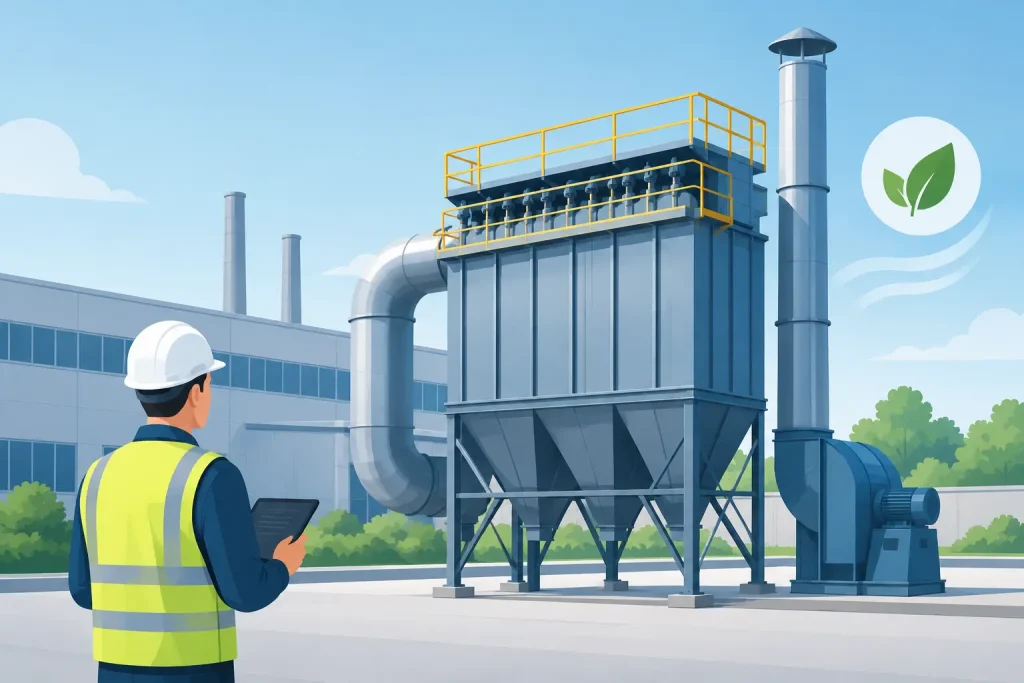
A dust collector can appear to be operating normally while the production floor tells a different story: dust settling on structures, operators reporting poor visibility, hoods losing capture at the source, or differential pressure rising beyond its intended range. These are not minor housekeeping concerns. They can signal worker-exposure risk, combustible-dust hazards, process inefficiency, and an emissions-control system that may not withstand regulatory scrutiny.
Dust Collectors Are Process-Control Equipment
Industrial dust collectors are often specified as a single item of equipment. In practice, they are part of a complete air-pollution-control system that begins at the point where dust is generated and ends at a compliant discharge point. The collector must work with extraction hoods, ductwork, fans, discharge arrangements, and the production process itself.
The central question is not simply how much air a collector can move. It is whether the system captures contaminants before they disperse, transports particulate without excessive deposition in the duct, separates the required particle-size range, and maintains stable performance over operating shifts. A correctly sized collector cannot compensate for poorly designed hoods, undersized ductwork, or an exhaust fan that cannot overcome actual system resistance.
For plant managers and EHS leaders, this distinction matters because compliance is judged by outcomes. Visible dust, failed stack-test results, excessive operator exposure, and recurring filter failures all point to a system performance issue, even when the collector itself is still running.
Capture at the Source Comes First
The most effective dust-control strategy is source capture. A hood should be positioned and shaped for the process, whether the emission source is a grinding wheel, transfer point, mixer, bag-dumping station, furnace charge area, or animal-feed handling line. The required capture velocity depends on the dust characteristics, the distance from the hood to the release point, cross-drafts, and how operators access the equipment.
Higher airflow is not always the answer. Excessive air volume can increase fan energy, accelerate filter loading, create unnecessary noise, and pull valuable product into the collection system. Insufficient airflow allows dust to escape before it reaches the hood. Engineering therefore requires a balanced assessment of contaminant generation, hood geometry, duct velocity, and fan static pressure.
Selecting Dust Collector Technology for the Process
Technology selection should follow the dust, not a catalog preference. Particle size, loading rate, abrasiveness, moisture content, temperature, explosibility, and chemical composition all affect the appropriate design.
Pulse-jet bag filters are widely used for high-volume industrial applications because they can maintain continuous operation while cleaning filter media with compressed-air pulses. They are suitable for many metalworking, casting, mineral-handling, feed-processing, and general manufacturing applications. Filter media selection is critical. Polyester, aramid, PTFE membrane, antistatic media, and other options perform differently under heat, moisture, fine particulate loading, and chemical exposure.
Cartridge collectors can be effective where space is limited and dust loading is moderate, particularly for fine, dry dust. Their compact footprint can be attractive, but they are not automatically the best choice for heavy or fibrous material. In high-loading applications, cartridge media may require frequent maintenance unless the system includes effective pre-separation and appropriate cleaning controls.
Cyclones and multi-cyclones are commonly used as pre-cleaners or primary separators for larger particulate. They can reduce the loading reaching downstream filters, extending filter life and reducing maintenance demand. However, cyclones are generally less effective for very fine particulate and may need to be paired with a bag filter or another final-control device when strict particulate limits apply.
Wet collection may be considered for certain sticky, hot, or spark-producing dusts, but it introduces wastewater, corrosion, and sludge-management requirements. For combustible dust, the assessment must go beyond collection efficiency. The system may require explosion venting, isolation, suppression, grounding and bonding, spark detection, or other safeguards based on the material hazard and the applicable code requirements.
Engineering Data Determines Collector Performance
A collector should be designed from verified process data rather than assumed airflow values. A field audit is often the most efficient starting point for an existing facility because it identifies practical constraints around equipment layout, duct routing, access for maintenance, and production operation.
The engineering review should establish the following operating conditions:
- Dust source locations, process schedules, and expected loading rates
- Required airflow at each hood and the total system air volume
- Duct diameters, transport velocities, pressure losses, and fan duty point
- Dust properties, including particle size, moisture, temperature, abrasiveness, and combustibility
- Required discharge performance and the regulatory standard governing the facility
These inputs determine filter area, air-to-cloth ratio, hopper design, screw conveyor or rotary-valve capacity, fan selection, motor sizing, and the differential-pressure range expected during normal operation. They also influence whether a system needs insulation, heat tracing, abrasion-resistant liners, weather protection, or corrosion-resistant materials.
A common failure is selecting a collector by nominal airflow alone. Two systems rated at the same airflow can perform very differently when one handles light powder and the other handles dense, abrasive dust with high loading. The latter may need a larger hopper, stronger casing, lower filtration velocity, and more reliable discharge equipment to prevent buildup and re-entrainment.
Compliance Must Be Demonstrable, Not Assumed
Environmental and occupational requirements vary by jurisdiction, industry, and process. For facilities operating under Malaysia’s Clean Air Regulations 2014, design and operating practices must support the applicable emission requirements and documentation expected by the Department of Environment. Local exhaust ventilation performance also requires attention to DOSH-LEV obligations. For U.S. facilities, federal, state, local, and OSHA requirements may apply alongside permit-specific limits.
The practical principle is consistent: compliance needs evidence. A defensible program may include field auditing, system inspection, airflow measurement, stack sampling, testing and commissioning records, maintenance logs, and corrective-action reports. Where continuous or online performance monitoring is appropriate, plant teams can identify rising differential pressure, fan underperformance, abnormal emissions trends, or equipment alarms before these conditions become a major operational issue.
A stated particulate target, such as discharge below 50 mg/m3, should never be treated as a universal design value. The required limit depends on the governing regulation and permit conditions. The collector, fan, ductwork, and monitoring approach must be engineered for the facility’s actual compliance obligation.
Commissioning Is Where Design Becomes Operating Performance
Installation alone does not establish that a dust collection system is ready for service. Testing and commissioning should verify that duct joints are sealed, hoods achieve intended capture, fan rotation and airflow are correct, pulse cleaning operates at the required pressure, discharge devices function properly, and the control panel responds to alarms and interlocks.
Baseline readings are particularly valuable. Record initial static pressure at key points, differential pressure across filters, fan amperage, airflow where measured, compressed-air pressure, and emission-test results where required. These values give the maintenance team a reference point. Without a baseline, gradual performance deterioration can remain hidden until a production complaint, visible emission, or inspection finding occurs.
Operator training should be included in commissioning. Personnel need to understand what normal differential pressure looks like, how to recognize hopper bridging, why compressed-air quality affects pulse cleaning, and when to escalate abnormal conditions. A control panel alarm is useful only when the responsible team knows what action it requires.
Lifecycle Service Protects Uptime and Compliance
Filters, valves, solenoids, diaphragms, bearings, fan components, gaskets, and level sensors all have service lives. A collector that receives only reactive maintenance will eventually create an avoidable shutdown or compliance concern. Planned servicing helps identify worn filter media, leaking valves, air leaks, corrosion, fan imbalance, damaged ductwork, and inadequate suction before plant conditions deteriorate.
Spare-parts readiness is equally important. A failed pulse valve or rotary valve can quickly turn a functioning collection system into a production constraint. Facilities should maintain critical spares based on equipment age, lead times, duty cycle, and the impact of downtime. After-sales support should also include performance reviews when production capacity, raw materials, or process temperatures change, because those changes can alter the dust load beyond the original design basis.
Master Jaya Group approaches dust collection as a full lifecycle responsibility: system design, in-house fabrication, installation, testing and commissioning, auditing, stack sampling, performance monitoring, and ongoing service. That approach gives plant teams a clearer chain of accountability than a standalone equipment purchase.
When dust appears outside the intended capture zone, treat it as operating data rather than a cleaning problem. A timely audit of airflow, hood performance, filter condition, and fan duty can protect production, employees, and the compliance record before the issue becomes more costly to correct.