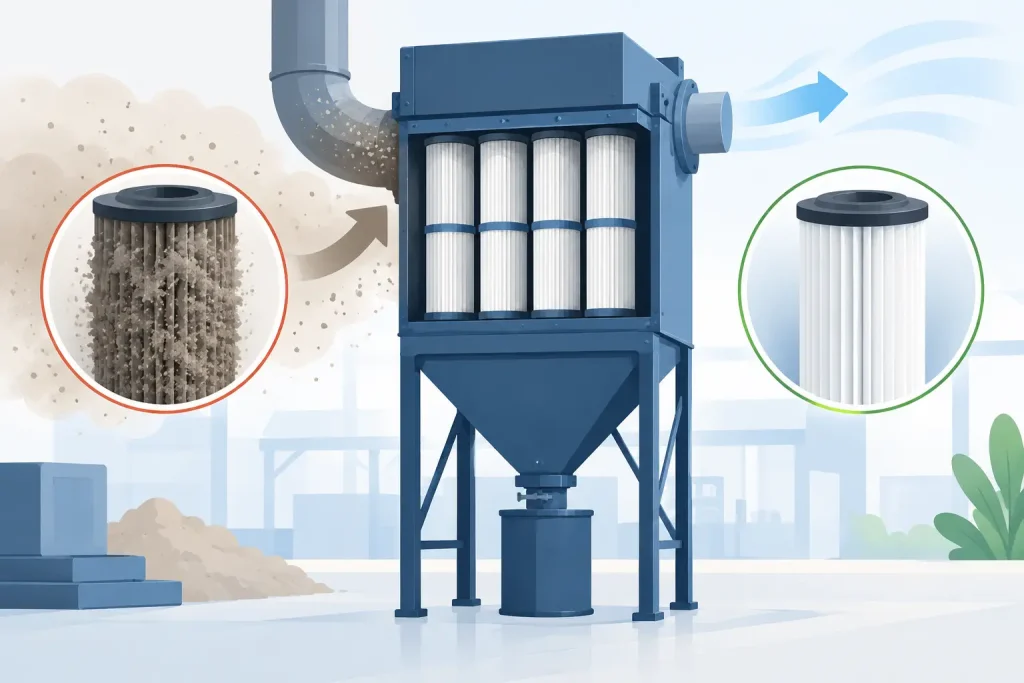
A dust collector can appear to be running normally while filter blinding quietly reduces suction, raises fan energy demand, and puts process emissions at risk. Knowing how to prevent filter blinding starts with recognizing that it is not simply a maintenance issue. It is usually the result of a mismatch between dust characteristics, filter media, cleaning settings, airflow, and operating conditions.
For plant managers, EHS leaders, and maintenance teams, a blinded filter is more than an expensive consumable. It can cause poor local exhaust ventilation performance, dust escape at transfer points, unstable process conditions, and difficulty demonstrating consistent emission-control performance. The correct response is not to increase pulse pressure or replace bags more frequently without investigation. It is to identify the mechanism causing the filter surface to close.
What Filter Blinding Means in an Industrial Collector
Filter blinding occurs when dust, moisture, oil, condensate, or chemical residue blocks the surface pores of a filter bag or cartridge. Air can no longer pass through the media efficiently. Differential pressure rises, airflow through the hood and ductwork falls, and the cleaning system may be unable to restore the filter to an acceptable pressure drop.
A normal dust cake is not necessarily a problem. Many pulse-jet collectors rely on a controlled dust cake to improve fine-particle capture. Blinding begins when that cake becomes dense, sticky, embedded in the media, or resistant to pulse cleaning. Fine hygroscopic dust, oil mist, resinous fumes, wet product, and poorly controlled temperature conditions are common contributors.
The distinction matters. Removing all dust from filter media is neither practical nor desirable. The engineering objective is to maintain stable airflow and differential pressure while preserving collection efficiency and filter life.
Identify the Blinding Mechanism Before Changing Filters
The first step in preventing filter blinding is to review operating data rather than relying on visual inspection alone. Differential pressure should be trended against production rate, fan speed, compressed-air pressure, ambient conditions, and cleaning-cycle frequency. A steadily climbing pressure drop after normal pulse cleaning indicates progressive loading or embedded contamination.
A rapid pressure increase following a process change may point to a new dust composition, increased moisture, or excessive dust loading. Conversely, fluctuating differential pressure can indicate poor pulse-valve performance, unstable airflow, or hopper discharge problems that allow re-entrainment.
Physical inspection of removed filters provides useful evidence. A hard, crusted surface often suggests moisture or condensation. A greasy or tacky deposit may indicate oil mist, lubricant carryover, or condensable organic vapor. Fine powder packed deep into the media can indicate unsuitable media finish, inadequate pre-separation, or excessive face velocity. The filter should be inspected together with the hopper, inlet section, ductwork, and compressed-air cleaning system. Replacing the filter alone treats the symptom.
Control Moisture, Condensation, and Sticky Contaminants
Moisture is among the most frequent causes of irreversible filter blinding. When warm, moisture-laden gas enters a collector and its temperature falls below the dew point, water condenses on the media. Dust then adheres to the wet surface and can form a cement-like layer that pulse cleaning cannot remove.
Maintain gas temperature above the relevant dew point throughout the ductwork and collector. This may require insulation, controlled dilution air, inlet-temperature monitoring, or a revised collector location. For thermal processes, avoid extended shutdown periods that allow the collector body to cool while humid process gas remains present. A controlled warm-up and shutdown sequence can reduce condensation events.
Oil mist and sticky fumes require the same discipline. A conventional dust collector is not automatically suitable for aerosols, condensable vapors, or resinous particulate. Where oil mist is present, evaluate mist collection or coalescing stages before the final filter. Where VOCs or condensable compounds are involved, source capture, gas temperature, and the selected control technology must be assessed as one system. Placing a cartridge collector after an unsuitable process stream can create repeated blinding and premature filter failure.
Select Filter Media for the Actual Dust, Not the Catalog Description
Filter media selection should be based on particle size, dust loading, temperature, moisture sensitivity, abrasiveness, chemical compatibility, and cleaning method. A general-purpose polyester bag or cartridge may perform well on dry, free-flowing dust but fail quickly on fine, oily, or hygroscopic material.
Surface-treated media can reduce particle penetration and improve pulse-cleaning release. PTFE membrane media, for example, keeps much of the dust cake at the surface and is often appropriate for fine powders where cleanability is critical. Antistatic media may be required for combustible dust applications, subject to a complete combustible-dust hazard assessment. High-temperature media must be selected not only for normal operating temperature but also for credible upset conditions.
There are trade-offs. Membrane media can improve cleanability but may require careful handling and may not solve a condensation problem. Heavier felt can tolerate abrasion but may retain ultrafine dust if the surface finish is unsuitable. The lowest initial filter cost is rarely the lowest lifecycle cost when downtime, labor, compressed air, fan energy, and compliance exposure are included.
Reduce Dust Loading Before It Reaches the Filters
A collector should not be expected to separate every particle directly at the filter surface. High dust loading, large chips, sparks, and abrasive particulate should be managed upstream where practical. A properly designed cyclone or multicyclone can remove coarse fractions before the final collector, reducing wear and extending filter-cleaning intervals.
Inlet design is equally important. Poorly distributed airflow can direct a concentrated dust stream onto a small group of bags or cartridges, causing localized blinding and uneven differential pressure. The inlet, baffles, hopper geometry, and internal air distribution should be reviewed when filters on one side of a collector fail earlier than others.
Hopper evacuation must also be reliable. If collected material bridges, accumulates, or is allowed to rise toward the filter section, particles can be re-entrained and repeatedly loaded onto the media. Rotary valves, screw conveyors, discharge aids, and level controls should be maintained as part of the dust collector system, not as separate equipment.
Set Pulse Cleaning for Stable Differential Pressure
Pulse-jet cleaning should be controlled by differential pressure whenever possible rather than by a fixed timer alone. Time-based cleaning can waste compressed air when production is low and still be inadequate when dust loading rises. Differential-pressure control cleans only when resistance reaches the selected set point.
Cleaning performance depends on more than pulse frequency. Confirm that compressed air is clean, dry, and supplied at the required pressure. Check pulse valves, solenoids, diaphragms, blowpipes, nozzles, and filter alignment. A leaking diaphragm may create a weak pulse; a blocked blowpipe hole may leave one filter untreated; moisture in the compressed-air supply can worsen media contamination.
Avoid the assumption that more pulse pressure is always better. Excessive cleaning can damage media, disturb the beneficial dust cake, and increase compressed-air consumption. The appropriate pressure and pulse duration depend on collector design and media type. Testing and commissioning should establish a stable operating range based on actual process conditions.
Maintain Airflow Within the Design Envelope
Excessive air-to-cloth ratio is a common but overlooked cause of filter blinding. When too much air is forced through too little filter area, dust is driven into the media faster than the cleaning system can release it. Differential pressure rises, airflow drops, and the collector enters a cycle of increasingly aggressive cleaning.
Review fan performance, damper positions, duct modifications, and any added pickup points. Production expansions often add hoods or branches without confirming whether the existing collector has sufficient capacity. A fan operating outside its intended range can also affect capture velocity at process hoods, creating worker-exposure and housekeeping issues before the collector alarm is noticed.
For local exhaust ventilation systems, airflow verification should include hood measurements, duct transport velocity, static pressure, fan performance, and collector differential pressure. This provides a defensible record that the system is maintaining its intended capture and control function.
Build Filter Blinding Prevention Into Routine Service
A practical preventive-maintenance program should include differential-pressure trend review, compressed-air quality checks, pulse-valve inspection, hopper-discharge verification, fan and damper checks, and periodic examination of representative filters. Maintenance records should connect each filter change to the observed failure mode rather than recording only the replacement date.
When recurring blinding is present, arrange a field audit that evaluates the entire air-pollution-control system from source capture through discharge. Stack sampling, airflow testing, and testing and commissioning data can establish whether the issue is affecting emissions performance as well as internal system reliability. This approach supports both operational decisions and compliance documentation.
Master Jaya Group applies this lifecycle approach through engineered collector design, field auditing, spare-parts support, and ongoing performance monitoring. The goal is not simply to keep filters in service longer. It is to maintain reliable suction, stable pressure drop, controlled emissions, and an air-control system that remains ready for regulatory review.
Filter blinding is best treated as an early warning that the process and collector are no longer operating in balance. Address that warning with measured data and targeted engineering, and the result is a cleaner filter system, more dependable production, and fewer compliance surprises.