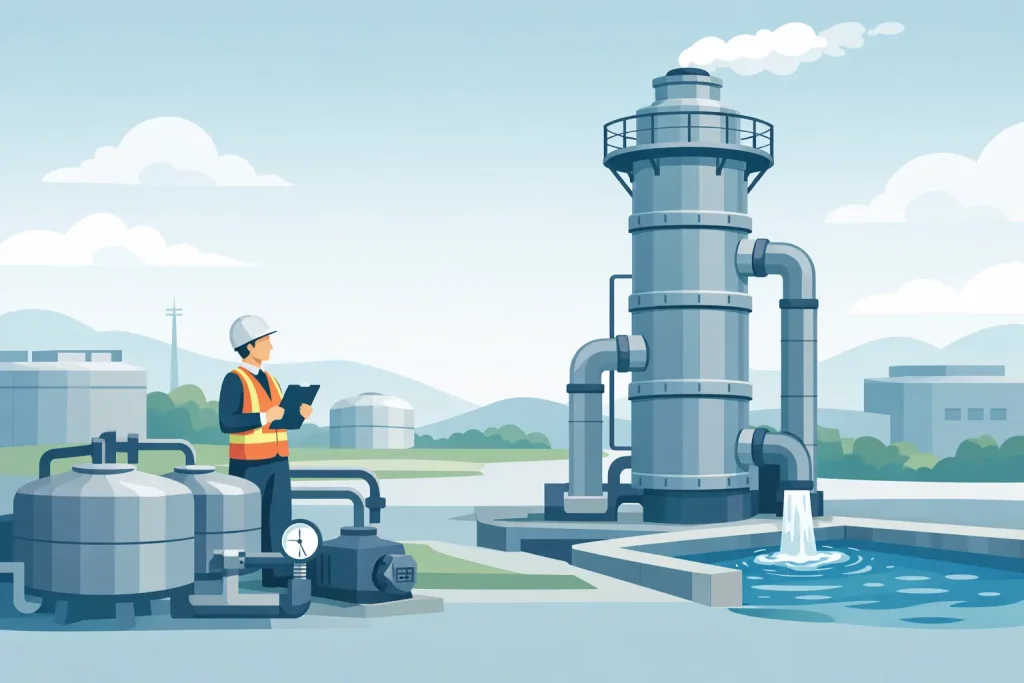
An air stripper can appear to be operating normally while its contaminant-removal efficiency is declining. A partially fouled packing bed, reduced blower output, poor water distribution, or an overloaded off-gas treatment unit may not trigger an immediate shutdown. It can, however, create elevated outlet concentrations, excessive energy use, odor complaints, and compliance exposure. Knowing how to maintain air stripper equipment means treating the unit as an integrated mass-transfer system, not simply a tower with a fan.
For plant managers, EHS leaders, and maintenance teams, the objective is clear: maintain stable air-to-water contact, verify removal performance, control emissions from the stripping off-gas, and retain records that demonstrate the system is being operated as designed.
Start With the Design and Operating Baseline
An effective maintenance program begins with the approved design basis and testing and commissioning records. Confirm the stripper type, such as a packed-tower air stripper, tray tower, or diffused-air system; its design water flow; air-to-water ratio; inlet contaminant range; pressure drop; blower capacity; and expected treated-water concentration. These values become the reference point for every inspection and performance review.
Do not rely on generic maintenance intervals alone. A groundwater treatment system stripping volatile organic compounds behaves differently from a process wastewater application with variable temperature, suspended solids, oils, or biological activity. High mineral content may promote scale formation. Water containing iron, manganese, or solids can foul distributors and packing. A process with fluctuating solvent loading can overwhelm the downstream vapor-phase carbon system even when the tower itself is mechanically sound.
Operators should record flow rates, inlet and outlet water quality, blower amperage, air flow or static pressure, tower differential pressure, recirculation pump status where applicable, and off-gas treatment readings. Trend data is more useful than a single reading because gradual deterioration is often the first warning that cleaning or adjustment is required.
Inspect the Air Stripper on a Planned Schedule
Routine field inspections should be organized by shift, weekly, monthly, and annual tasks. The exact frequency depends on water quality, contaminant loading, operating hours, and permit conditions, but visual checks must be frequent enough to identify change before performance is affected.
During routine rounds, check for abnormal vibration, noise, odor, water leakage, corrosion, and mist discharge around the tower, ductwork, blower, and treatment vessels. Verify that drain lines are clear and that sumps do not accumulate sludge or floating oil. Inspect access doors, flanges, flexible connections, and duct joints for air leaks, since uncontrolled air ingress can alter blower performance and create fugitive vapor release points.
At least monthly, compare actual process values with the operating baseline. A rising tower pressure drop can indicate fouled packing, a blocked mist eliminator, or restricted ductwork. A falling pressure drop is not always positive: it may result from channeling, damaged packing, a distributor failure, or reduced air flow. Review water flow and air flow together rather than interpreting either value in isolation.
Check Water Distribution and Packing Condition
Uniform water distribution is central to packed-tower efficiency. When water channels down one portion of the packing, much of the air bypasses effective contact with the contaminated water. The result can be poor removal even though the circulation pump and blower are running.
During planned shutdowns, inspect spray nozzles, distributor arms, troughs, and orifices for scale, sediment, biological growth, and physical damage. Clean or replace blocked components with materials compatible with the process water and chemicals used for cleaning. Verify that the distribution pattern covers the packing evenly before returning the unit to service.
Inspect packing through access ports or during internal entry under an approved confined-space procedure. Look for scaling, compaction, media movement, biofouling, chemical attack, and debris. Random packing that has settled or become clogged reduces the available surface area and raises pressure drop. Structured packing requires particular attention to orientation and support integrity. Replace damaged sections rather than accepting a compromised bed as normal operation.
Maintain Blowers, Pumps, and Instrumentation
The blower establishes the stripping air flow that drives contaminant transfer from water to vapor. Check motor current, bearing condition, belt tension where belt-driven, coupling alignment, lubrication requirements, vibration, inlet filters, silencers, and discharge dampers. A dirty inlet filter or slipping belt can reduce air flow enough to affect removal efficiency without producing an obvious mechanical alarm.
Confirm fan rotation after electrical work and verify that variable-frequency drive settings remain within the approved operating envelope. Increasing blower speed may improve removal in some cases, but it also increases energy consumption, noise, tower pressure drop, and off-gas loading. Any change should be evaluated against the design air-to-water ratio and the capacity of the downstream emission-control equipment.
Maintain feed pumps and recirculation pumps with equal discipline. Inspect mechanical seals, bearings, impellers, strainers, check valves, and flow controls. Pump cavitation, unstable flow, or a blocked strainer can cause uneven distribution at the top of the tower. Calibrate flow meters, pressure transmitters, pH instruments, level controls, and any online volatile organic compound monitoring equipment according to the manufacturer’s requirements and the facility quality system.
A failed instrument can be as damaging as a failed pump if operators use its reading to demonstrate compliance. Calibration certificates, as-found and as-left values, and corrective-action records should be retained with the environmental operating log.
Control Scaling, Fouling, and Corrosion
Cleaning methods must match the contaminant and construction material. Mechanical flushing may remove sediment, while chemical cleaning may be necessary for mineral scale. Biological fouling may require a controlled biocide program, provided it is compatible with downstream wastewater treatment and permitted discharge requirements. Do not introduce cleaning chemicals without reviewing material compatibility for the tower shell, packing, gaskets, pumps, and seals.
Corrosion inspection deserves special attention at wetted connections, support structures, nozzles, fasteners, drain points, and areas exposed to condensate. Small leaks can damage structural steel, create secondary contamination concerns, and allow untreated water to bypass the intended collection system. Repair coating damage early and investigate the root cause rather than repeatedly patching the same location.
If fouling returns quickly after cleaning, address the upstream cause. Pretreatment for solids, oil separation, pH adjustment, oxidation, or filtration may be more cost-effective than frequent internal tower cleaning. The right solution depends on the water chemistry and operating duty, not only on the stripper manufacturer’s standard maintenance manual.
Do Not Neglect Off-Gas Treatment
Air stripping transfers contaminants from water into an air stream. It does not eliminate them. The discharged vapor may require activated carbon adsorption, thermal oxidation, catalytic oxidation, condensation, or another treatment method based on contaminant type, concentration, flow rate, and regulatory limits.
For carbon vessels, track inlet concentration, outlet concentration, pressure drop, bed temperature where relevant, moisture conditions, and change-out dates. Carbon breakthrough can occur earlier than predicted when contaminant loading rises, humidity is high, or competing compounds occupy adsorption sites. Establish a conservative replacement trigger using sampling results and documented operating history, not odor alone.
Where off-gas is routed to an oxidizer, inspect duct integrity, temperature controls, burner safeguards, residence-time conditions, and interlocks. The air stripper and its off-gas control device should be evaluated as one compliance system. A tower meeting treated-water targets while releasing untreated vapors is not a complete environmental solution.
Verify Performance With Sampling and Records
Maintenance is confirmed by performance data. Develop a sampling plan that compares influent and effluent water concentrations at representative operating conditions. For regulated sites, align sampling methods, frequency, and laboratory reporting with permit requirements and applicable local, state, or federal obligations. Facilities operating under Malaysia’s Clean Air Regulations 2014 should also ensure off-gas monitoring and documentation support the relevant compliance requirements.
A meaningful review considers removal efficiency, not just an outlet result. For example, a low outlet concentration during a period of unusually low influent loading does not prove that the stripper will perform during peak production. Review laboratory results alongside flow data, operating parameters, maintenance events, and off-gas treatment status.
Keep an organized record set containing inspection sheets, cleaning reports, calibration certificates, spare-parts usage, fan and pump service records, sampling results, corrective actions, and testing and commissioning documentation. These records support internal audits, agency inspections, management review, and informed budgeting for upgrades.
Keep Critical Spares Ready
Extended downtime often results from a small unavailable component rather than a major failure. Stock critical spares based on lead time and consequence of failure. Typical items include blower belts or couplings, bearings, pump seals, nozzles, gaskets, pressure gauges, flow-meter components, level switches, packing retainers, and carbon vessel change-out materials where applicable.
Before ordering parts, confirm the material specification. A replacement gasket or seal that is unsuitable for the wastewater chemistry can fail quickly and create an avoidable release. Spare-parts readiness should be part of the facility’s preventive maintenance plan, not an emergency purchasing exercise.
A well-maintained air stripper protects more than equipment uptime. It gives operations teams defensible evidence that contaminant transfer, off-gas control, and environmental obligations are being actively managed. When trend data signals a change, arrange a field audit and performance assessment before a minor loss of efficiency becomes a permit, production, or community-impact issue.