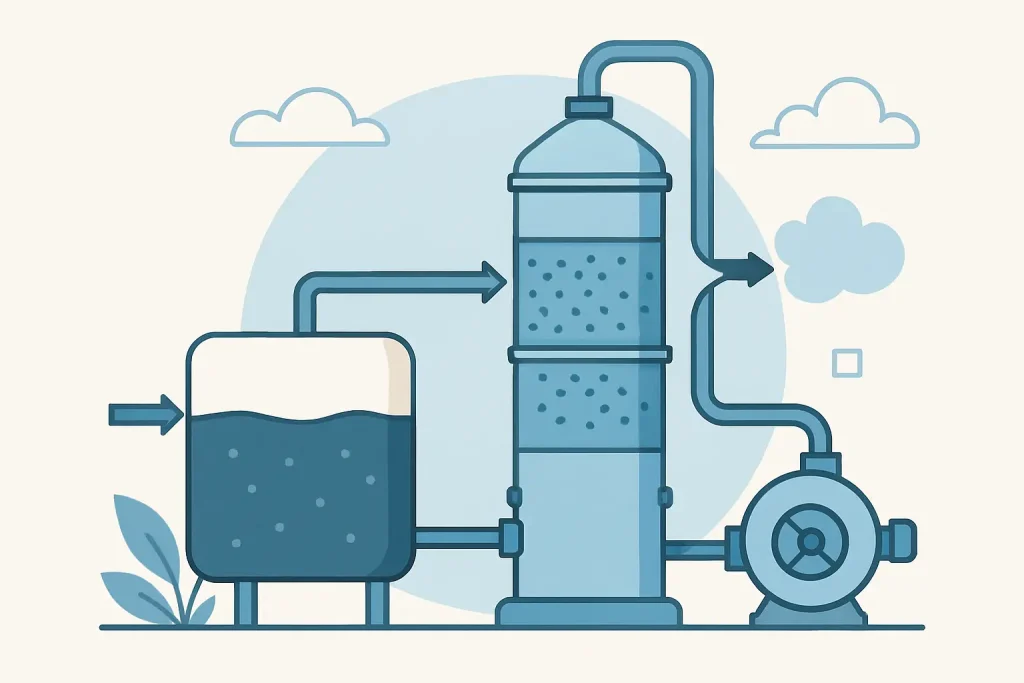
A plant can be “in spec” on effluent flow and still fail the day a tank farm odor complaint hits the hotline. That is the practical reality with VOCs in wastewater – volatile compounds move where pressure and temperature let them, and they do it quickly. For many industrial sites, the most defensible first step is not a chemical program or a last-minute carbon swap. It is engineering the phase transfer on purpose: an air stripper for wastewater VOC removal, designed as a system, not just a column.
When an air stripper is the right answer (and when it is not)
An air stripper is most effective when the target VOCs have meaningful volatility in water and will transfer to air under practical operating conditions. In plain terms, stripping makes sense for compounds that “want” to be in the gas phase – typical examples include many solvents and fuel-related constituents. It is also a strong fit when your constraint is throughput, because packed towers can treat high flows with predictable hydraulics when the pretreatment is right.
It is not a universal solution. If the wastewater contains VOCs that are highly soluble, strongly ionized, or otherwise resistant to mass transfer, you can strip all day and still carry residuals. Likewise, high oil and grease, heavy suspended solids, or scaling chemistry can turn a good design into a maintenance problem that erodes performance and documentation quality over time. In those cases, the air stripper may still be part of the train, but it needs upstream separation, pH control, or even a different primary technology.
The compliance lens matters here. Stripping removes VOCs from water by transferring them into air. That means you are not “destroying” mass – you are relocating it. If the site has air permitting obligations, odor constraints, or indoor exposure risk, the air-side control strategy must be defined at the same time as the wastewater target.
How air stripping actually removes VOCs
An air stripping tower drives mass transfer by increasing the contact area between contaminated water and clean air while maintaining a concentration gradient. Packed media provides surface area, and countercurrent flow (air up, water down) maintains driving force. The performance you can defend is fundamentally governed by mass transfer kinetics, equilibrium behavior, and how consistently you operate at the assumed temperatures and flow rates.
Two field realities often decide whether the system behaves like the design model. First is temperature. Warmer water generally strips better because volatility increases, but it can also increase overall VOC loading to the off-gas and make downstream air treatment work harder. Second is variability. Batch dumps, solvent changeovers, and cleaning cycles can spike influent concentrations well above the “average” used in proposals. If those spikes are not designed into the hydraulics and off-gas handling, plants end up with short-term breakthroughs that are hard to explain during audits.
Key design decisions that control performance
Packed tower vs tray tower
For most industrial wastewater VOC applications, packed towers are common because they provide high surface area per unit volume and can be sized compactly. The trade-off is sensitivity to fouling. Tray towers are sometimes chosen when fouling is unavoidable, but they often need more height for similar mass transfer.
Packing selection and wettability
Packing is not just a catalog item. Material selection and geometry influence pressure drop, wetting, and resistance to scaling. If your wastewater carries surfactants or oils, wetting behavior can change and reduce effective surface area. That shows up as reduced removal at the same air-to-water ratio, which becomes a troubleshooting challenge because the tower still “looks” like it is operating normally.
Air-to-water ratio (A/W)
A/W is the lever most operators recognize, but it is also where unintended consequences surface. Higher air rates can improve removal, but they increase blower energy, can increase foaming, and raise the VOC mass sent to the off-gas control device. If you plan to treat off-gas with activated carbon, for example, more air can mean faster carbon consumption even if water-side results improve.
Hydraulic loading and distribution
Many stripping towers do not fail because the equilibrium math is wrong. They fail because distribution is poor. Maldistribution causes channeling – parts of the packing do little work while other zones flood. A defensible design includes proper water distribution, mist elimination, and access for inspection and cleaning because the best-performing tower on day one can degrade quietly if you cannot confirm internal condition.
Materials of construction and corrosion control
VOCs often come with co-contaminants. Acidic wastewater, chlorinated solvents, or oxidants can drive corrosion choices. FRP, stainless steel, and lined carbon steel each have a place, but the right answer depends on chemistry, temperature, and maintenance practices. From a risk standpoint, an avoidable corrosion failure is not only downtime – it is a reportable event waiting to happen.
The off-gas question: compliance shifts from water to air
Because air stripping transfers VOCs into an air stream, the project must include an off-gas control decision. There are three common approaches, and the “best” one depends on VOC type, concentration, flow, and compliance obligations.
Activated carbon adsorption is often selected for moderate flow and lower concentrations, especially when odor control is a driver. The operational trade-off is media management: tracking bed life, preventing humidity-related capacity loss, and documenting change-outs. If the VOC mix includes compounds that are poorly adsorbed or if humidity is high, expected run time can shrink.
Thermal oxidation (including regenerative thermal oxidizers) is appropriate when VOC loading is high enough to justify destruction rather than capture, or when you need a clearer mass-balance story for regulators. The trade-off is fuel and temperature management, plus ensuring the system is engineered for the specific VOC mix and any halogenated compounds that may require acid gas handling.
Wet scrubbing alone is not typically a primary VOC control strategy for non-polar organics, but it can be part of a combined system for soluble compounds or for acid gas byproducts downstream of oxidation.
The practical point: do not treat the air stripper as a standalone “wastewater unit.” It is a cross-media control system, and your compliance documentation should reflect that.
What to specify so performance is auditable
Industrial buyers usually care about two things after commissioning: the unit hits targets, and the plant can prove it did. A specification that supports defensible compliance typically defines influent ranges, peak cases, removal targets, and verification methods.
Performance language should include the basis of design concentrations, flow rates, temperature range, and the required removal efficiency or outlet concentration. If the driver is odor, the spec should address nuisance conditions and not rely only on average ppm numbers.
From a commissioning standpoint, plan for testing & commissioning deliverables that match how your site is regulated: water sampling protocol, air-side measurement where applicable, and repeatable operating setpoints. For many facilities, that means integrating field auditing practices, clear calibration records for flow and pressure instruments, and an operations log that links changes in A/W ratio or recirculation to measured outcomes.
Operations that keep removal stable, not just “running”
Air stripping is often described as simple, but stable removal depends on disciplined operation. Fouling control is central. If scaling potential exists, a cleaning approach should be defined upfront, including inspection access, washdown provisions, and criteria for when to pull and clean distribution nozzles.
Foaming is another recurring issue, especially where surfactants or detergents enter the wastewater. Foam can carry droplets into the exhaust, overload mist eliminators, and create visible emissions or odor pulses. Mitigation can be pretreatment, antifoam dosing, or adjusting hydraulics – but each option affects cost and documentation.
Blower reliability matters more than many teams expect. Loss of air flow does not usually trip a dramatic alarm, but it directly reduces mass transfer and can cause silent non-compliance. Designing with instrumentation that shows differential pressure across packing, blower status, and air flow indication gives maintenance teams the ability to detect performance drift before it becomes a complaint.
Safety and worker exposure considerations
An air stripper concentrates VOCs into a controlled air stream, which is good engineering, but only if containment is real. Tower access points, sample ports, and maintenance hatches need to be treated as potential exposure points. If the tower is indoors or near work areas, capture and ducting design must align with industrial ventilation expectations.
For sites with regulated roles and formal EHS management systems, aligning the project with competent person responsibilities can reduce organizational risk. The strongest projects are those where the equipment design, operating procedures, and competency expectations are consistent, so corrective actions do not depend on tribal knowledge.
Choosing a partner: one throat to choke, one record to defend
Air stripping projects go sideways when design is separated from fabrication, and fabrication is separated from commissioning, and nobody owns the data trail. For compliance-driven plants, the value is in an accountable scope that covers engineering, in-house build quality control, installation, testing & commissioning, and the ongoing ability to support spare parts and service while maintaining performance visibility.
That is the lifecycle model Master Jaya Group typically executes – integrating engineered air strippers with downstream off-gas control, field auditing, and performance monitoring for plants that need consistent documentation and operational uptime. For teams that prefer a single accountable partner rather than coordinating multiple vendors, that structure reduces interface risk and makes post-commissioning troubleshooting faster because the design intent is traceable back to the build and the commissioning records. More details are available at https://www.masterjaya.com.my.
The design question that saves the most pain later
Before you approve any air stripper for wastewater VOC removal, ask one question that forces cross-media clarity: “Where does the VOC mass go, and how will we prove it month after month?”
If the answer includes water results, off-gas control capacity, instrumentation that detects drift, and a commissioning and audit plan that produces defensible records, you are not just buying a tower. You are buying predictability – which is what compliance and plant uptime actually run on.