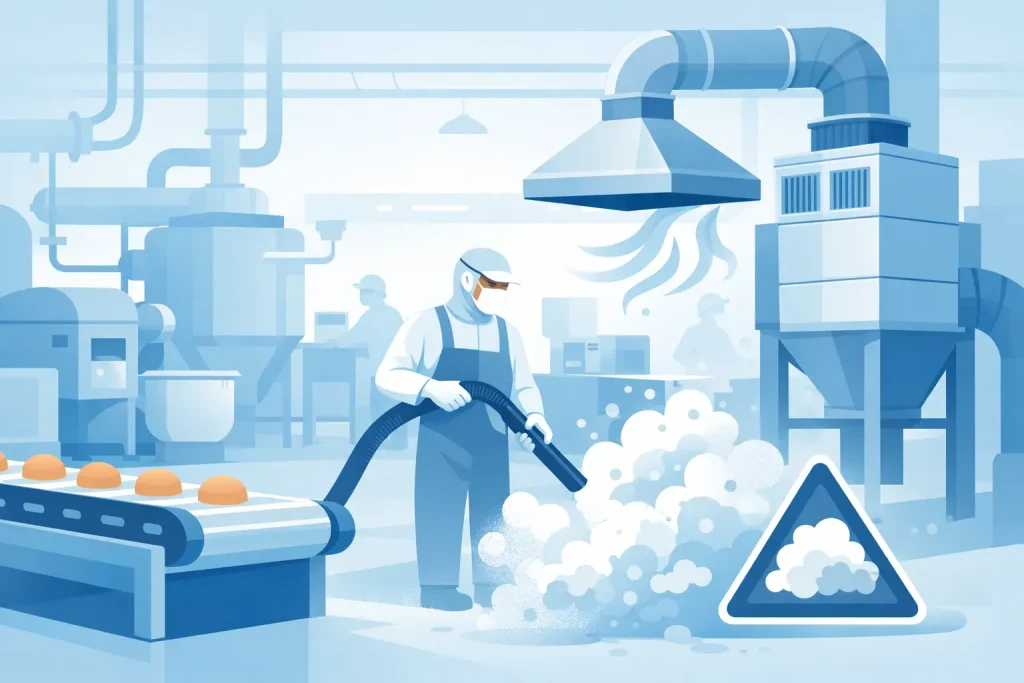
A spice line that looks clean can still be carrying an invisible compliance problem. Fine flour, sugar, starch, seasoning, and feed dust do not need dramatic clouds to create risk. In food plants, a practical food processing dust control guide starts with one fact: the most expensive dust issue is usually the one that went unmeasured until production, worker exposure, housekeeping, or regulatory performance was already affected.
Food processing facilities deal with a difficult mix of priorities. Production teams want throughput. Maintenance teams want stable suction and fewer breakdowns. EHS leaders need defensible exposure control and emissions performance. Management wants all of it without interrupting output. That is why dust control in this sector should never be treated as a single equipment purchase. It is an engineered system tied to process behavior, material characteristics, plant layout, cleaning practices, and compliance documentation.
Why food dust is a process risk, not just a housekeeping issue
In food manufacturing, dust is generated at transfer points, bag dumping stations, mixers, sifters, grinders, conveyors, dryers, weigh hoppers, and packaging lines. The particles may be light, sticky, hygroscopic, abrasive, or prone to buildup. A collector that performs well on dry powder can struggle badly once moisture, oil, or temperature shifts change the dust behavior.
This is where many projects go off track. Plants often specify airflow before they properly define the dust. Particle size distribution, moisture tendency, bulk density, explosibility, and product stickiness all affect hood design, duct velocity, filtration media, hopper discharge, and cleaning cycles. If those basics are missed, the result is familiar – poor capture at the source, repeated blinding of filters, dust settling on structures, and maintenance teams compensating with temporary fixes.
There is also a direct compliance dimension. Even where the main concern begins with housekeeping or worker exposure, the dust control system quickly intersects with local air regulations, industrial hygiene requirements, and formal testing expectations. Once a plant commits to a control system, it also commits to proving that the system performs as intended.
Food processing dust control guide: start with the dust source map
The best system designs begin with a source map, not a catalog. That means walking the line and identifying exactly where dust is liberated, how it travels, and when peak releases occur. A grinder may create a continuous fine load, while a bag tipping point may create short but intense bursts. A packaging station may release very little mass overall but still expose operators in the breathing zone.
A source map should answer five operational questions. Where is dust generated? When does it peak? Is the release enclosed, semi-enclosed, or open? What is the distance from source to operator? And what downstream issue matters most – worker exposure, plant cleanliness, product loss, emission control, or all of them together?
This is why field auditing matters. A desk-based design can miss the way operators actually work, the way access doors are left open, or the way cross-drafts from cooling fans disturb capture. In practice, effective dust control depends as much on observed plant behavior as on theoretical airflow.
Capture first, collect second
One of the most common mistakes in food plants is oversizing the collector while underserving the pickup point. Dust collection systems do not solve a capture problem if the hood design is wrong. If the source is not effectively enclosed or the airflow is not directed where the dust is released, the collector will simply pull air from the easiest path rather than the right path.
For bag dumping, weigh charging, and ingredient transfer, partial enclosures and backdraft or side-draft designs often perform better than open capture alone. For mixers and blenders, connection points, charging lids, and discharge points need special attention because these are usually where dust escapes during real operation. On conveyors and bucket elevators, the transfer point is often the real problem area, not the length of the conveying route.
The design target is simple to state but harder to execute: capture dust as close as possible to where it is generated, with enough airflow to contain it without disturbing the process or pulling valuable product out of the line.
Choosing the right dust control equipment
A practical food processing dust control guide should be honest about trade-offs. There is no universal collector for every product stream.
Pulse-jet dust collectors are often the preferred solution for dry, free-flowing particulate loads because they can handle continuous operation and relatively high dust loading. They are well suited to central systems serving multiple pickup points, provided the filtration media and cleaning logic are matched to the material. But sticky or moisture-sensitive dust can shorten filter life and reduce cleaning effectiveness if the collector is not properly configured.
Cyclones or multi-cyclones can be useful as pre-separation stages where particle loading is high or where larger particulate should be removed before final filtration. On their own, they are generally not the answer when fine particulate capture or tighter emission performance is required. Their value is often in protecting downstream filters and reducing maintenance burden.
Wet scrubbers have a place in selected applications, particularly when the dust is difficult, sticky, or associated with gases or odor concerns. The trade-off is that wet handling introduces wastewater considerations, corrosion risks, and a different maintenance profile. In food plants, that decision has to be made with full visibility on utilities, drainage, and operating discipline.
Portable collectors can help with isolated nuisance points or temporary process changes, but they should not replace a properly engineered fixed system where dust generation is structural to production.
Ducting, air balance, and filtration details decide performance
Plants sometimes focus on the collector housing and overlook the system that feeds it. In reality, poor duct design can undermine an otherwise capable unit. Duct velocity has to be high enough to keep particulate suspended but not so high that it creates unnecessary pressure loss, abrasion, or energy waste. Long runs, sharp elbows, and unbalanced branches often cause weak suction at the points that need it most.
Filtration media selection is equally critical. Food dust can be fibrous, oily, very fine, or prone to caking. The wrong media may show acceptable pressure drop at startup and fail within weeks under real production conditions. Cartridge, bag, and specialty media choices should be based on the actual dust profile and operating temperature, not simply on standard availability.
A compliance-led design also considers safe access for inspection, safe hopper discharge, and maintainability. If operators cannot easily inspect rotary valves, hoppers bridge repeatedly, or filter changeout is cumbersome, performance will degrade long before the next major review.
Dust control and compliance documentation
For industrial decision-makers, good performance is not enough if it cannot be demonstrated. Dust control projects in food processing should include a clear path for testing & commissioning, field auditing, and when required, stack sampling and documented performance verification.
That matters for two reasons. First, internal stakeholders need evidence that the system is capturing dust at the source and maintaining suitable operating conditions. Second, regulators and auditors increasingly expect records that show control equipment is not just installed but functioning as designed.
This is where a one-stop solution provider has a clear advantage. When the same partner supports system design, fabrication, installation, commissioning, and post-installation performance review, there is stronger accountability for outcomes. In regulated operating environments, that continuity reduces the gap between engineering intent and day-to-day plant reality.
Maintenance is where dust control succeeds or fails
Even a well-designed system can drift out of performance if maintenance is reactive. In food plants, differential pressure trends, pulse-cleaning performance, hopper discharge condition, duct leakage, and fan health should be reviewed as routine operating data, not as emergency indicators.
A collector that suddenly appears weak at the hood may not have a filter problem at all. It may have leaking duct joints, a worn fan, an air balance issue introduced by line modifications, or buildup at critical branches. That is why periodic inspections should be tied to actual system performance checks rather than visual housekeeping alone.
Online monitoring and IoT visibility can be especially useful for larger or multi-line facilities. They do not replace field service, but they do help identify pressure drop drift, abnormal operating cycles, and early failure patterns before they become production interruptions. For plants managing compliance exposure across several emission or exposure points, this kind of visibility supports both uptime and defensible recordkeeping.
Food processing dust control guide for upgrades and brownfield plants
Existing plants rarely have the luxury of a clean-sheet layout. Expansion, product changes, and line retrofits often create dust issues that were not part of the original design basis. A collector sized for one recipe mix may struggle after the plant adds finer powders or higher throughputs.
In brownfield situations, the right answer is often not total replacement. It may be hood redesign, selective duct rebalancing, a pre-separator, media change, fan upgrade, or improved enclosure at the source. The key is to avoid guessing. A proper technical review should establish whether the constraint is capture, conveyance, filtration, discharge, or maintenance practice.
This is also where training matters. Facilities with internal competency in environmental and boiler-related compliance functions are better positioned to sustain performance over time. Teams that understand not only how the system works but also how it is verified make better operating decisions when process conditions change.
A dust control system in a food plant should do more than remove visible particulate. It should support cleaner production, safer operator conditions, stable uptime, and documented compliance performance. If your current system only handles one of those well, it is time to treat dust control as an engineered plant function rather than a housekeeping accessory.