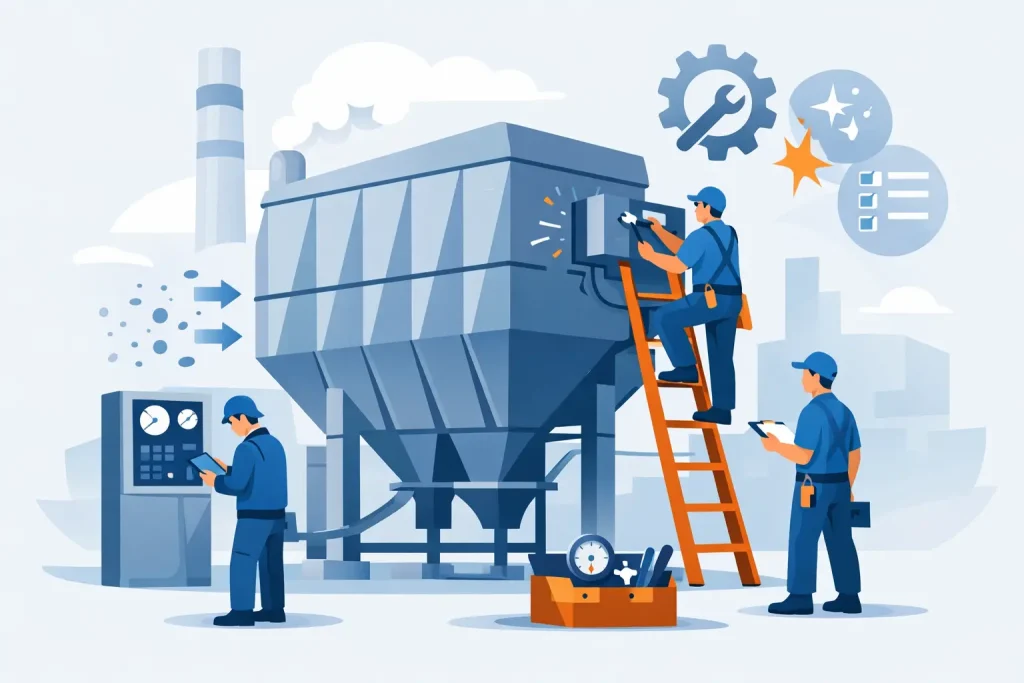
A high-voltage trip during peak production is rarely just a maintenance issue. It can become an emissions risk, a throughput problem, and a compliance exposure within the same shift. That is why electrostatic precipitator maintenance services matter well beyond routine upkeep. For plants that depend on stable particulate control, the quality of ESP servicing directly affects uptime, stack performance, and the ability to demonstrate regulatory control.
Electrostatic precipitators are durable systems, but they are not passive assets. Their performance depends on electrical integrity, gas distribution, rapper performance, hopper evacuation, plate alignment, and the condition of internal components that are not always visible during normal operation. When any one of these variables drifts, the result may be gradual efficiency loss or a sudden failure event. In both cases, delayed action usually costs more than planned intervention.
What electrostatic precipitator maintenance services should cover
Effective electrostatic precipitator maintenance services should be structured around both reliability and compliance. A basic inspection is not enough for facilities where particulate emissions are regulated and production continuity is critical. The service scope needs to connect equipment condition with measurable operating outcomes.
That starts with an assessment of the transformer-rectifier set, control panel behavior, insulator condition, discharge electrode integrity, collecting plate alignment, rapper mechanisms, and hopper discharge systems. Electrical readings alone do not tell the full story. An ESP can appear energized while underperforming because of misalignment, excessive dust buildup, poor rapping sequence, air inleakage, or hopper plugging.
A proper maintenance program also reviews process-side factors. Changes in fuel quality, gas temperature, particle resistivity, moisture levels, and upstream load can alter how the precipitator behaves. This is where field experience matters. The service team should be able to distinguish between a component failure and a process condition that is driving unstable collection efficiency.
Why ESP maintenance cannot be handled as a generic service call
An electrostatic precipitator operates at the intersection of electrical systems, mechanical systems, and emissions control. Treating it like a standard rotating-equipment maintenance job misses the failure modes that actually affect capture efficiency.
For example, a rapper motor may still run while delivering poor impact energy. A hopper heater may remain powered but fail to prevent condensation and buildup. A high-voltage control cabinet may show acceptable output trends, yet the internal field condition may be compromised by broken discharge electrodes or heavy ash accumulation. These are not theoretical issues. They are common reasons why plants see unexplained opacity increases, repeated sparking, or gradual loss of collection performance.
This is also why many facilities benefit from a service partner that can move beyond repairs into auditing, testing and commissioning, and performance verification. In practice, maintenance decisions are stronger when supported by field inspection findings, operating data, and emissions context rather than isolated component replacement.
Common failure points in electrostatic precipitator maintenance services
The most frequent ESP problems are rarely confined to one area. In many cases, one neglected fault triggers another. Hopper evacuation problems lead to dust re-entrainment. Poor rapping control increases buildup on plates and electrodes. Air inleakage changes gas conditions and promotes internal corrosion or reduced collection stability.
Electrical issues remain a major concern. Flashovers, unstable secondary current, damaged insulators, failed heater circuits, and degraded high-voltage components can reduce field strength and collection efficiency. Mechanical issues are just as significant. Misaligned collecting plates, warped internals, broken discharge frames, damaged shaft seals, and worn rapper linkages all affect how effectively particulate is removed from the gas stream.
The service response should therefore be diagnostic, not purely reactive. Replacing a failed part without identifying the root cause often leads to repeat shutdowns. If a rapper keeps failing because ash loading has increased beyond the original setting, the solution may require control adjustment, inspection frequency changes, and evaluation of upstream process changes.
The value of planned maintenance versus emergency repair
Emergency repair is sometimes unavoidable, especially after an electrical trip or sudden mechanical failure. But relying on emergency work as the primary service model is expensive and operationally disruptive. Planned maintenance gives the plant a chance to inspect internals safely, stage spare parts, and coordinate shutdown work around production schedules.
There is also a compliance advantage. A facility with a documented maintenance regime, inspection records, service reports, and performance checks is in a stronger position when demonstrating control over its air pollution systems. That documentation matters to plant leadership, EHS teams, and any stakeholder reviewing whether the control system is being responsibly managed.
The right interval depends on duty cycle, dust loading, process variability, and equipment age. Some ESPs need only periodic inspection and calibration support. Others, especially older units or systems exposed to aggressive process conditions, need more frequent internal review and staged refurbishment. It depends on the actual service environment, not a fixed calendar rule.
What a strong maintenance partner brings to the plant
The difference between a contractor and a lifecycle service partner is accountability. A contractor may replace damaged parts. A lifecycle partner looks at how the precipitator is performing, what evidence supports that assessment, and what actions will keep the system compliant and reliable over time.
That includes shutdown planning, internal inspection, spare parts readiness, repair or replacement of critical internals, electrical troubleshooting, and post-service verification. It may also include field auditing, stack sampling support, and recommendations tied to current operating demands. In more advanced programs, online monitoring and trend visibility can help identify deterioration before it becomes a shutdown event.
For industrial operators, this integrated model is practical. Maintenance managers need fewer handoffs. Project engineers get clearer technical scope. EHS leaders receive better documentation. Operations teams gain confidence that the ESP is not just running, but performing as intended.
A one-stop provider such as Master Jaya Group typically adds value here because the service is not separated from engineering knowledge, fabrication capability, compliance understanding, and after-sales support. That becomes especially useful when maintenance reveals the need for upgrades rather than like-for-like repair.
When maintenance should become an upgrade discussion
Not every ESP problem should be solved with another repair cycle. Some systems reach a point where repeated maintenance is treating symptoms rather than restoring dependable performance. This is common with aging internals, obsolete control systems, chronic sparking, inadequate gas distribution, or process loads that have increased beyond the original design basis.
In those cases, maintenance services should transition into a structured upgrade discussion. That might involve rapper modernization, plate and electrode replacement, hopper redesign, control panel upgrades, TR set refurbishment, or changes to access and inspection features that make future service safer and faster.
The decision is rarely just technical. It is a cost, risk, and compliance calculation. If repeated outages are affecting production, or if emissions performance has become difficult to stabilize, capital work may be the more defensible path. A credible service partner should be willing to say so when repair no longer offers good value.
Documentation, testing, and compliance assurance
For regulated facilities, maintenance is only part of the requirement. The plant also needs records that show what was inspected, what was found, what was corrected, and how system readiness was verified. Good service documentation should be detailed enough to support maintenance planning and credible enough to support compliance review.
That often means service reports with equipment condition findings, photographs, electrical readings, repair scope, parts used, and recommendations for follow-up action. Where relevant, this can be supported by testing and commissioning activities, field auditing, or stack sampling to confirm that restored equipment condition translates into acceptable emissions performance.
This compliance-led approach is particularly valuable in facilities where environmental and occupational obligations overlap. The plant is not only protecting the stack. It is also protecting the integrity of the process environment, reducing uncontrolled particulate risk, and strengthening internal accountability.
Choosing electrostatic precipitator maintenance services with confidence
If you are evaluating electrostatic precipitator maintenance services, the key question is not who can attend fastest. It is who can take technical ownership of the equipment and its performance. That means understanding ESP physics, knowing the failure patterns, working safely during outages, and being able to connect maintenance activity with operational and compliance outcomes.
Ask whether the provider can inspect, diagnose, repair, fabricate, recommission, document, and advise on upgrades when needed. Ask how they handle spare parts strategy, post-repair verification, and long-term monitoring. And ask whether their service model supports your plant only during failures, or throughout the asset lifecycle.
A well-maintained electrostatic precipitator does more than collect dust. It protects production stability, supports defensible emissions control, and gives plant teams fewer surprises when performance matters most. That is the standard maintenance should be held to.