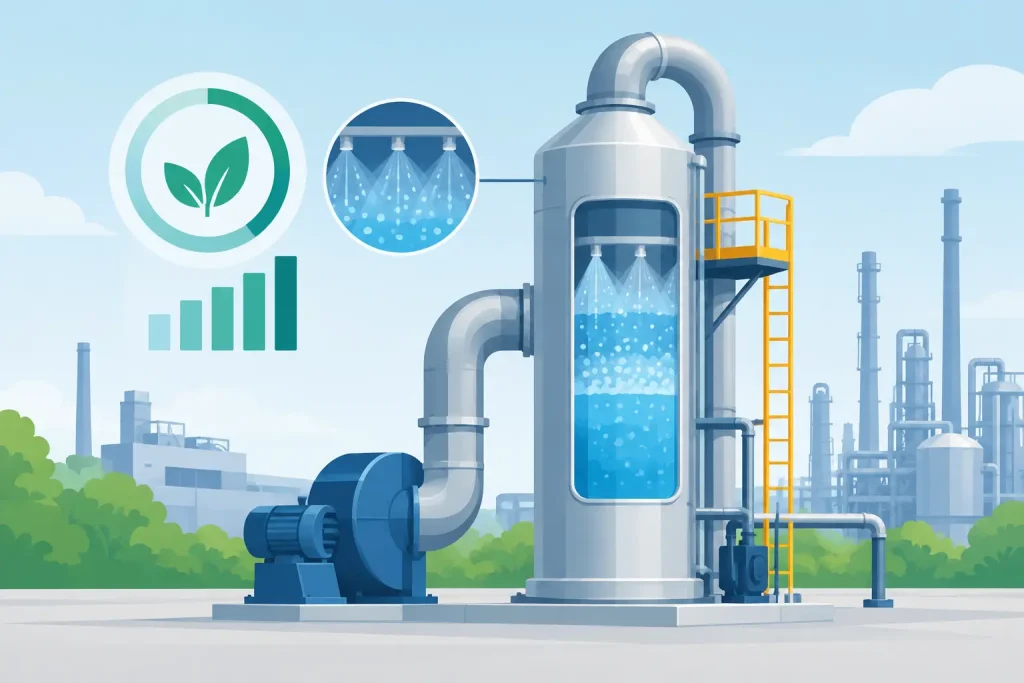
A packed tower scrubber can appear to be operating normally while its actual removal performance has declined materially. The fan is running, recirculation pumps are on, and no obvious alarm is present, yet rising outlet concentrations, poor liquid distribution, fouled packing, or incorrect chemistry may place the facility at compliance risk. A structured scrubber performance review determines whether the system is still achieving its design duty and produces the evidence needed for corrective action, stack sampling, and regulatory reporting.
For plant managers and EHS leaders, the purpose is not simply to confirm that equipment is energized. It is to establish that air volume, contaminant loading, liquid-to-gas contact, chemical conditions, and discharge performance remain within the operating window the scrubber was designed to handle.
What a Scrubber Performance Review Must Establish
A meaningful review compares current field conditions against the original design basis, approved drawings, equipment datasheets, and applicable emission limits. This distinction matters because many systems degrade gradually. Operators may adapt by increasing fan speed, adding more chemical, or running pumps continuously, without recognizing that the underlying system is losing efficiency or consuming excessive energy.
The review should first confirm the pollutant and duty. Acid gases, alkaline vapors, soluble VOCs, ammonia, odors, metal fumes, and particulate-laden exhausts do not respond to the same scrubbing arrangement. A packed tower designed for acid-gas absorption depends on appropriate reagent strength and packing wetting. A venturi scrubber managing particulate requires sufficient pressure drop to generate the droplet energy needed for capture. Applying a single inspection checklist to every wet scrubber can overlook the parameter that actually controls removal.
The reviewer should then verify whether the actual exhaust volume matches design airflow. Process expansions, new extraction hoods, modified duct branches, partially closed dampers, or fan changes can alter gas velocity through the tower. If velocity is too high, contact time may be reduced and liquid droplets can be carried downstream. If it is too low, the system may no longer provide effective capture at the process source. Neither condition should be judged by visual observation alone.
Start With the Design Basis and Compliance Requirement
Before field testing begins, assemble the documents that define acceptable performance: process flow diagrams, general arrangement drawings, fan curves, pump curves, scrubber datasheets, chemical safety information, previous service records, and prior stack sampling reports. These records establish what the equipment was intended to achieve at a stated flow rate, temperature, contaminant concentration, and pressure drop.
Compliance requirements must also be clear. Facilities operating under Malaysia’s Environmental Quality (Clean Air) Regulations 2014 may need to demonstrate that emissions meet the relevant prescribed limits and that air pollution control equipment is properly operated and maintained. Where local exhaust ventilation affects worker exposure, DOSH-LEV requirements and workplace monitoring obligations may also apply. In either case, a performance review should create defensible operating records rather than relying on assumptions made during routine maintenance.
A common issue arises when a scrubber was correctly sized for the original process but the process now runs hotter, longer, or with different raw materials. Increased acid concentration, higher moisture, oil contamination, or intermittent batch releases can all change the inlet loading. The equipment may require an upgraded recirculation system, revised packing depth, improved mist elimination, or an additional pre-treatment stage. A review identifies whether the gap is operational or whether it is a genuine design limitation.
Measure the Conditions That Drive Removal
The field assessment should measure conditions at the source, through the scrubber, and at the discharge point. Airflow and static pressure readings across hoods, ductwork, and the fan show whether the process is being captured effectively before contaminants reach the work area. At the scrubber, differential pressure across the tower, venturi, or mist eliminator helps identify fouling, flooding, dry sections, damaged internals, or restricted drainage.
Liquid flow is equally significant. A recirculation pump can be running while delivering less than its rated capacity due to worn impellers, blocked strainers, air ingress, valve position, or pipe scaling. Flow should be measured rather than inferred from pump noise or motor current. The distribution system should also be inspected for plugged spray nozzles, uneven spray patterns, damaged headers, and areas of packing that are not being wetted.
For chemically reactive systems, the review should examine pH, conductivity where relevant, reagent concentration, oxidation-reduction potential when used, make-up water rate, and blowdown control. The correct pH range depends on the contaminant and reagent chemistry. Excessive chemical dosing can increase operating cost and scaling; insufficient dosing can allow contaminant breakthrough. The objective is controlled chemistry, not the highest possible chemical consumption.
Temperature deserves close attention. Higher gas temperature can reduce absorption of certain soluble gases, accelerate evaporation, affect packing materials, and increase the risk of visible plume or mist carryover. If a process exhaust has changed materially, an upstream quench section, heat recovery consideration, or revised materials selection may be needed.
Inspect the Components That Commonly Cause Hidden Losses
Packing provides surface area for gas-liquid contact, but it can become fouled by dust, resinous material, scale, biological growth, or precipitated salts. This raises pressure drop and can create channeling, where gas follows paths of least resistance instead of contacting the liquid film across the packing bed. Inspection through access doors, supported by pressure and airflow data, is more reliable than judging the tower from external appearance.
Mist eliminators require the same discipline. A damaged or clogged eliminator can cause liquid carryover, downstream corrosion, visible emissions, or inaccurate stack test results. Conversely, a mist eliminator removed or bypassed to reduce pressure drop may improve fan airflow at the expense of discharge quality. The proper correction depends on the root cause, which may include poor upstream liquid distribution, unsuitable gas velocity, or inadequate washing arrangements.
Fans, ductwork, and dampers should be assessed as part of the same system. A scrubber cannot compensate for a fan operating off its curve, leaking duct joints, corroded transitions, or poor source capture. Performance responsibility extends from the process pickup point to the final stack discharge.
Use Stack Sampling to Verify Actual Outlet Performance
Operating data indicates whether the scrubber is functioning within an expected range. Stack sampling verifies what is actually leaving the stack. Both are needed when compliance performance is uncertain, when a facility is preparing for regulatory submission, or after a major repair or upgrade.
Sampling should be planned around representative production conditions. Testing a scrubber during low-load operation may create a favorable result that does not reflect routine emissions. The test plan should identify the process state, operating duration, fuel or raw-material condition where relevant, fan setting, recirculation rate, chemical parameters, and any parallel equipment operating during the test.
The results should be interpreted with the field data. If outlet emissions are elevated, the cause may be inadequate reagent, excess gas flow, packing damage, poor capture, an overloaded inlet stream, or a sampling condition that does not reflect normal operation. A credible report connects measured findings to corrective actions, responsibilities, and verification dates.
Turn Findings Into an Operating Control Plan
A review has limited value if it ends as a one-time inspection report. Each facility should establish operating limits for the parameters that affect its specific scrubber: airflow, pressure drop, recirculation flow, pH or reagent concentration, sump level, pump status, and inspection frequency. Operators need clear response actions when a reading falls outside its acceptable range.
For example, a sudden drop in tower differential pressure may indicate dry packing, an open bypass, or loss of recirculation. A steady rise may indicate fouling or flooding. The response should specify who checks the pump, strainers, spray system, packing, drainage, and fan performance, as well as when the event requires escalation to maintenance or EHS personnel.
Digital monitoring can strengthen this control plan by recording trends instead of isolated manual readings. Online performance monitoring makes it easier to identify gradual pressure-drop changes, chemical instability, or repeated pump interruptions before they become an emission event. It does not replace inspection, testing and commissioning, or stack sampling, but it gives the operating team earlier warning and better maintenance evidence.
When Repair Is Enough and When an Upgrade Is Needed
Not every poor result requires a new scrubber. Replacing nozzles, cleaning packing, repairing a pump, correcting fan rotation, restoring a mist eliminator, or recalibrating instruments can return a properly designed system to duty. These actions are often the most cost-effective route when the process has not changed.
An upgrade becomes more appropriate when measured conditions consistently exceed the original design basis. Common indicators include sustained increases in exhaust flow, new contaminant streams, recurring flooding, excessive pressure drop, inability to maintain required chemistry, or stack sampling results that remain unsatisfactory after maintenance. Engineering review may recommend revised packing, larger circulation pumps, improved liquid distribution, fan modification, an added pre-scrubber, or a different control technology.
Master Jaya Group approaches this work as a lifecycle responsibility: field auditing, system assessment, fabrication support, testing and commissioning, stack sampling coordination, and after-sales service should form one accountable process. The most useful scrubber performance review is the one that gives the plant a verified operating baseline, a practical correction path, and records that stand up to compliance scrutiny.
A scrubber should not be judged by whether it is running. It should be judged by measured capture, controlled operating conditions, verified discharge performance, and the plant team’s ability to sustain those results shift after shift.