A dust collector can show an acceptable stack reading while still creating costly problems on the production floor. Poor hood capture, unstable differential pressure, frequent filter failures, and difficult maintenance access can undermine worker protection and plant uptime long before a formal test identifies the issue. A proper pulse jet collector review must therefore assess the complete dust-control system, not simply the collector housing or its advertised airflow.
For plant managers, EHS leaders, and project engineers, the practical question is not whether pulse-jet technology works. It is whether the proposed collector is correctly engineered for the dust, process, operating schedule, regulatory obligations, and maintenance resources at your facility.
What a Pulse Jet Collector Review Should Cover
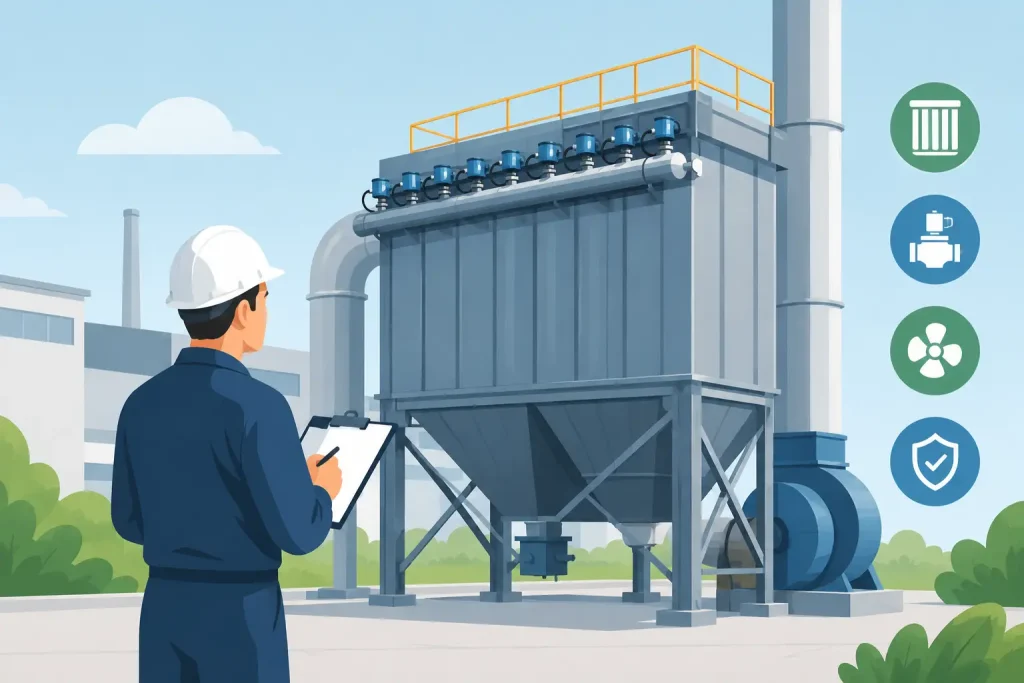
A pulse-jet dust collector uses compressed-air pulses to dislodge accumulated dust from filter bags or cartridges. The cleaning cycle allows the unit to operate continuously without taking the filters offline. This makes the technology suitable for demanding applications such as welding and metalworking, casting, powder handling, food and feed processing, wood dust collection, and many dry bulk material processes.
However, a pulse-jet collector is only one part of an effective local exhaust ventilation system. A meaningful review begins at the process source and follows the air path through hoods, ductwork, fan, collector, discharge arrangement, and exhaust stack. Each component affects the final result.
The review should establish whether the system can capture contaminants where they are generated, transport them without settling in the duct, filter them at a stable pressure drop, and discharge cleaned air in accordance with applicable permit conditions and workplace exposure requirements. It should also confirm that the system is safe to operate with the specific dust hazard present.
Start With the Dust, Not the Collector Size
Collector selection should be based on actual material characteristics, not only on a stated airflow requirement. Fine, sticky, hygroscopic, fibrous, abrasive, combustible, or high-temperature dusts behave differently on filter media and in hopper discharge systems.
For example, a fine metal powder may require attention to combustible dust risk, grounding, explosion protection, isolation, and dust disposal. A food or feed application may require media and construction details that support sanitation and prevent material buildup. A sticky process dust may blind filters quickly if the air-to-cloth ratio is too aggressive or if the selected filter finish is unsuitable.
A technical review should document particle size distribution where available, dust loading, bulk density, moisture content, temperature, chemical composition, abrasiveness, and any known ignition or explosibility data. If this information is missing, the project team should not assume a standard collector configuration will be sufficient. Field auditing and representative sampling are often necessary before final design.
Verify Airflow and Capture at the Source
A collector cannot correct a poorly designed hood. If fumes or dust escape the capture zone, increasing fan capacity may raise energy use without solving the exposure problem.
Review the hood location, process enclosure, operator work position, cross-drafts, and capture velocity needed for the contaminant and task. Welding fumes, grinding dust, bag dumping, transfer points, and open mixing operations each require different capture strategies. The design must also consider whether machinery guards, material movement, or operator access will interfere with airflow.
Duct velocity deserves the same scrutiny. If conveying velocity is too low, heavier particles can settle and restrict the system. If velocity is unnecessarily high, erosion, noise, fan power consumption, and filter loading can increase. Duct routing should limit sharp elbows, dead legs, and long horizontal runs where material can accumulate.
For an existing system, air volume measurements, hood face velocity readings, static pressure checks, and smoke visualization can reveal weaknesses that are not apparent during a visual inspection. This is where a field audit provides more value than reviewing equipment drawings alone.
Pulse Jet Collector Review: Filter and Cleaning Performance
Filter media and cleaning controls determine whether the collector can sustain performance between service intervals. The lowest initial equipment cost is rarely the lowest lifecycle cost if filters blind early, compressed-air consumption is excessive, or shutdowns are required for frequent maintenance.
Bag filters generally provide substantial filtration area and are commonly used for high-volume industrial dust applications. Cartridge filters offer compact arrangements and can be effective for fine, dry dusts, but they may be less suitable for every loading condition. The right choice depends on dust characteristics, space constraints, filtration velocity, and cleaning behavior.
A review should examine the selected media type, surface treatment, temperature rating, chemical compatibility, and expected emission performance. Pleated bags, membrane-laminated media, antistatic options, and oil- or water-repellent finishes may be justified in specific applications. They should not be treated as generic upgrades without understanding the process.
Differential Pressure Is a Critical Operating Signal
Differential pressure across the filters is one of the clearest indicators of collector condition. Low pressure differential may point to air leaks, damaged filters, or insufficient dust cake formation. A rising differential pressure can indicate filter loading, poor pulse cleaning, inadequate compressed-air quality, incorrect pulse settings, or a change in process dust.
Pulse cleaning should be controlled by differential pressure where practical rather than operating continuously on a fixed timer. Demand-based cleaning can reduce compressed-air consumption and avoid unnecessary wear on filters. At the same time, the pressure range must be set for the actual collector and process. There is no universal pressure setting that can be applied across all systems.
The review should also confirm that the compressed-air system provides adequate pressure, dry air, and sufficient receiver capacity. Wet or oil-contaminated compressed air can damage filter performance and interfere with diaphragm valves, solenoids, and pulse pipes. Maintenance teams should have access to gauges, alarms, and replacement components that allow problems to be identified before airflow is compromised.
Check Discharge, Safety, and Maintenance Access
Collected dust must leave the hopper reliably. A well-designed filter section can still fail operationally if the hopper bridges, the rotary valve leaks, or the disposal method exposes employees to dust during changeout.
Hopper slope, dust flow properties, rotary airlock selection, screw conveyor capacity, and bin level monitoring all deserve review. For light or cohesive dusts, vibration, bin activators, or alternate discharge arrangements may be required. The design should provide a controlled path from collector to final disposal or material recovery.
Safety evaluation must be specific to the dust and installation. Where combustible dust is possible, the project team should assess hazard data and applicable standards for explosion venting, suppression, isolation, grounding, bonding, and safe collector location. A collector placed indoors may require a different protection strategy than one installed outdoors. This assessment should be completed before procurement, not after commissioning.
Maintenance access is equally practical. Can filters be changed safely? Is there room to service pulse valves, inspect the clean-air plenum, empty dust containers, and access the fan? Does the design allow lockout procedures without creating lengthy production interruptions? Systems that are difficult to maintain tend to receive deferred maintenance, which eventually affects emissions, worker exposure, and equipment availability.
Demand Proof Through Testing and Commissioning
Factory documentation is useful, but site performance must be verified after installation. Testing and commissioning should include airflow balancing, fan rotation and motor checks, duct leakage observations, differential-pressure verification, pulse-cleaning checks, and confirmation of dust discharge operation.
Where required, stack sampling should demonstrate that the final installation meets applicable emission limits. The compliance file should also include equipment specifications, as-built drawings, operating parameters, maintenance requirements, inspection records, and any submissions required by the relevant authority. For facilities operating under Malaysia’s Clean Air Regulations 2014 or DOSH local exhaust ventilation requirements, these records support defensible compliance management. For U.S. facilities, the same discipline supports permit, OSHA, and corporate EHS obligations.
Online performance monitoring can add another layer of control. Tracking differential pressure, fan status, cleaning air pressure, and alarm events helps maintenance teams identify deterioration before it becomes a production or compliance event. Monitoring does not replace inspection, but it makes the system easier to manage across shifts and multiple facilities.
Evaluate the Supplier as a Lifecycle Partner
A pulse-jet collector is not a one-time purchase. Filters, valves, gaskets, rotary valves, fans, motors, controls, and ductwork will require inspection and service over the system’s life. The supplier should be able to explain who will support startup, train operators, provide spare parts, troubleshoot performance issues, and conduct follow-up audits.
Master Jaya Group approaches dust-control projects as an end-to-end engineering responsibility, combining equipment design and fabrication with installation, testing and commissioning, stack sampling, performance monitoring, and after-sales service. This model reduces the gaps that can occur when the hood designer, duct contractor, collector supplier, and compliance consultant operate independently.
The best collector review ends with a design basis that your operations and EHS teams can use for years: what the system is expected to capture, what normal operating readings look like, when maintenance is required, and how compliance performance will be demonstrated. That clarity is what turns a dust collector from a capital item into a dependable clean-air control system.