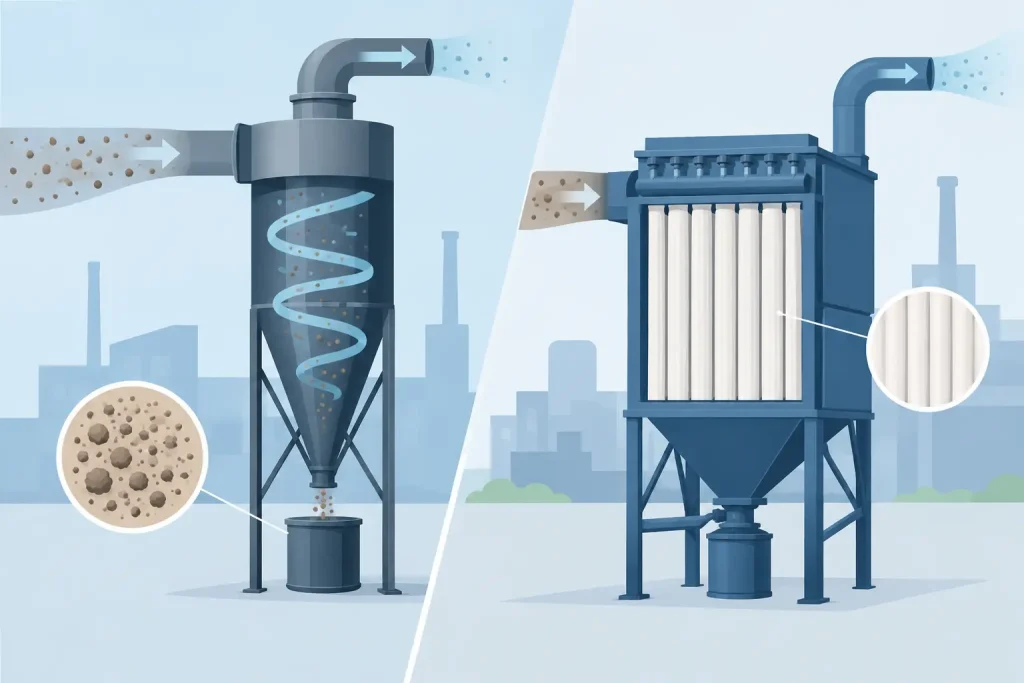
A cyclone versus bag filter decision is not simply a comparison of two dust-control products. It determines how reliably a facility controls emissions, protects workers, manages combustible dust risk, and maintains production uptime. The correct selection depends on particle size distribution, dust loading, gas temperature, moisture, required outlet concentration, and the plant’s ability to maintain the equipment over its full service life.
For many process facilities, the best answer is not cyclone or bag filter alone. A properly engineered cyclone can reduce the burden on a downstream pulse-jet baghouse, while the bag filter provides the final filtration performance needed for demanding emission and workplace air-quality targets. Selection should begin with field data, not equipment preference.
How a Cyclone Separates Industrial Dust
A cyclone separator uses centrifugal force rather than filter media. Dust-laden gas enters the cyclone body at high velocity and follows a spiral path. Larger and denser particles are pushed toward the cyclone wall, lose momentum, and fall into the hopper. The cleaned gas exits through the central outlet tube.
Because there are no bags, cartridges, or other primary media to clog, a cyclone is mechanically simple and highly suitable for coarse, abrasive, and high-temperature particulate. Foundries, woodworking operations, grain handling plants, mineral processing lines, boilers, and pre-cleaning applications commonly use cyclones where dust loading is substantial.
Cyclone collection efficiency improves as particles become larger, denser, and easier to separate by inertia. This is its principal limitation. Fine particles, particularly those below approximately 10 microns, may remain in the gas stream at levels that do not meet a facility’s stack permit, internal environmental target, or occupational exposure-control objective.
A cyclone also requires sufficient pressure drop to generate the centrifugal force required for separation. Oversizing the body to reduce pressure loss can weaken collection performance. Undersizing it can increase fan energy demand, erosion, noise, and wear. Correct gas volume, inlet velocity, dust characteristics, and hopper discharge design are therefore essential.
How a Bag Filter Captures Fine Particulate
A bag filter, often configured as a pulse-jet dust collector or baghouse, captures dust on fabric filter bags. As particulate accumulates on the media, the dust cake itself becomes part of the filtration mechanism. Periodic compressed-air pulses dislodge the collected dust into the hopper while the collector remains in operation.
This mechanism enables bag filters to achieve much higher removal efficiency for fine particulate than cyclones. A properly designed and maintained baghouse can control submicron and micron-scale dust that a cyclone is unlikely to capture consistently. For metal grinding, casting, food and animal feed processing, pigment handling, chemical manufacturing, and other fine-dust processes, this difference is often decisive.
The performance of a bag filter depends on more than the number of bags. Media selection must account for temperature, moisture, chemical compatibility, abrasion, dust explosibility, and cleaning behavior. Polyester, aramid, acrylic, fiberglass, PTFE membrane, and anti-static media each serve different operating conditions. A low-cost media selection that fails prematurely can quickly become a production and compliance problem.
Pulse-jet collectors also need stable compressed-air quality, correctly set cleaning sequences, dependable solenoid valves, and controlled air-to-cloth ratio. Excessive air-to-cloth ratio raises pressure drop and shortens bag life. Insufficient cleaning leaves dust cake in place until airflow falls below the capture requirement at the hood or process enclosure.
Cyclone Versus Bag Filter: Key Operating Differences
The practical differences between the two technologies are best viewed through plant operating requirements rather than initial equipment cost alone.
| Selection factor | Cyclone separator | Bag filter / pulse-jet collector | | — | — | — | | Primary collection mechanism | Centrifugal separation | Fabric media and dust-cake filtration | | Best particle range | Coarse, dense particulate | Fine through coarse particulate | | Typical efficiency potential | Moderate, dependent on particle size | High, including fine dust when correctly designed | | Filter media replacement | Not required | Required as part of lifecycle maintenance | | High-temperature capability | Strong with suitable construction | Depends on selected filter media and cooling approach | | Abrasive dust handling | Strong, though liners may be required | Requires abrasion-resistant design and inlet protection | | Pressure-drop behavior | Generally stable when clear | Varies with dust cake, cleaning, and media condition | | Common role | Primary collector or pre-cleaner | Final collector for emission and workplace control |
A cyclone is often attractive where a process releases heavy chips, coarse sawdust, sand, clinker, or other particles that can rapidly load a fabric collector. It can remove the bulk fraction before it reaches the baghouse. This reduces abrasive wear, lowers hopper loading in the final collector, and can extend filter bag service life.
A bag filter is usually the stronger choice when the emission limit is strict, the dust is fine, or the local exhaust ventilation system must maintain effective capture at multiple process points. It is also the more appropriate technology when compliance evidence requires demonstrably low particulate emissions through stack sampling and ongoing operating records.
When a Combined System Is the Better Engineering Answer
High dust loading does not automatically mean a cyclone should replace a baghouse. In many facilities, a cyclone-baghouse arrangement provides the more reliable lifecycle result. The cyclone removes coarse particles and sparks or hot fragments where applicable, while the downstream bag filter captures the remaining fine fraction.
This arrangement is particularly relevant for foundries, biomass-fired systems, wood processing, feed mills, and abrasive mineral applications. It can also improve maintenance planning because the final collector is exposed to a more manageable dust load. However, the combination adds capital cost, ductwork, controls, and fan-design considerations. It should be justified by measured loading, maintenance history, and required outlet performance.
Where combustible dust is present, the evaluation must also address explosion isolation, venting, grounding and bonding, dust discharge, housekeeping, and applicable fire and safety requirements. Neither a cyclone nor a bag filter should be selected without a documented dust-hazard review. Collection efficiency alone is not a complete safety design basis.
Evaluate the System, Not Only the Collector
A dust collector cannot compensate for poor capture design. A baghouse may have excellent filtration efficiency but still fail to protect operators if hoods are too far from the emission source, duct velocities are inadequate, or branch balancing is incorrect. Similarly, a cyclone can perform as designed while the overall system still produces visible dust because the fan does not provide the required airflow.
An effective evaluation starts with process mapping and field auditing. The engineering team should identify each emission point, quantify air volumes, inspect hood geometry, review existing fan curves, measure static pressure, and characterize the dust. Stack sampling may be required to establish baseline emissions and verify post-installation performance. Testing and commissioning should confirm actual airflow, pressure drop, cleaning performance, hopper discharge, and outlet conditions under normal production load.
Maintenance planning should be included at the design stage. Cyclones need periodic inspection for internal erosion, air leaks, hopper bridging, and rotary valve condition. Bag filters require differential-pressure trending, bag inspection, leak detection where applicable, pulse-valve servicing, compressed-air checks, and timely replacement of worn media. Spare parts readiness is a direct contributor to uptime, especially for pulse valves, diaphragms, cages, filter bags, and rotary airlocks.
Make the Selection Around Compliance and Lifecycle Cost
The lowest purchase price is rarely the lowest operating cost. A cyclone may require less routine replacement material, but it may not achieve the final particulate level required by the facility. A bag filter can deliver stronger fine-dust control, but it brings media, compressed-air, inspection, and maintenance obligations.
Plant managers should compare total lifecycle cost against the actual compliance objective. This includes fan energy, pressure drop, compressed-air consumption, replacement parts, shutdown risk, disposal requirements, labor, stack testing, and the cost of noncompliance. For facilities subject to Malaysia’s Clean Air Regulations 2014, or equivalent jurisdictional permit conditions, defensible operating records and verified emission performance should carry significant weight in the decision.
Master Jaya Group approaches this decision as an end-to-end engineering responsibility: process assessment, equipment design, in-house fabrication, installation, testing and commissioning, stack sampling, servicing, and performance monitoring. The objective is not to place a cyclone or bag filter in a duct line. It is to maintain a clean-air system that continues to meet process, worker-exposure, and regulatory requirements after startup.
The most useful next step is to review real operating data from the plant: dust type, production rate, airflow demand, temperature, pressure trend, maintenance history, and required outlet target. Those facts will show whether a cyclone, a bag filter, or a combined system gives the facility the most dependable path to clean air and stable operations.