A dust-control system can meet a stack test on commissioning day and still become a costly operational liability if it does not suit the process. The decision between ESP versus baghouse filters is not simply a choice between two collector types. It affects emissions performance, fan energy, shutdown planning, spare-parts strategy, worker exposure, and the quality of compliance records available when regulators or corporate auditors ask for evidence.
Electrostatic precipitators, or ESPs, and baghouse filters both control particulate emissions effectively when engineered for the correct duty. Their operating principles, however, are fundamentally different. A practical selection must begin with the gas stream, the dust, and the facility’s operating discipline – not with a preference for one technology.
ESP Versus Baghouse Filters: The Fundamental Difference
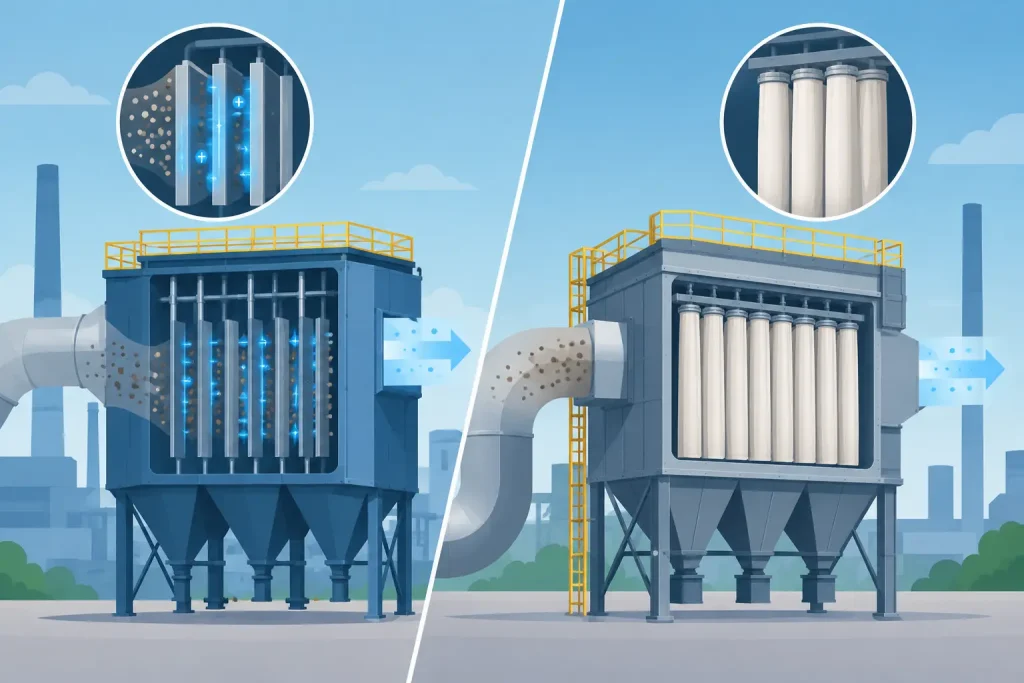
An ESP removes particles by applying a high-voltage electrical charge. As flue gas passes through the collector, discharge electrodes charge the suspended particles. Collection plates with the opposite electrical charge attract those particles. Mechanical or electromagnetic rappers then dislodge accumulated dust into hoppers for removal.
A baghouse, often configured as a pulse-jet dust collector, captures particles through fabric filter media. Dust forms a cake on the outside of the bags or cartridges, and that cake becomes part of the filtration mechanism. Compressed-air pulses periodically clean the media while the collector remains online, although cleaning effectiveness depends on pulse pressure, timing, bag condition, and dust properties.
The result is a meaningful distinction. ESP performance is highly sensitive to particle electrical resistivity and stable gas conditions. Baghouse performance is more dependent on proper air-to-cloth ratio, filter-media selection, pulse-cleaning control, and avoidance of condensation or excessive thermal exposure.
Where an ESP Is the Better Engineering Choice
ESPs are commonly considered for high-volume, continuous flue-gas applications. Thermal power generation, boilers, cement kilns, incineration systems, and certain mineral-processing operations may produce gas volumes where the physical footprint and pressure-drop advantages of an ESP are attractive.
Because gas passes through an ESP with relatively low resistance, the induced-draft fan may require less static pressure than a fabric filtration system. For very large and stable gas flows, that can translate to a material long-term energy advantage. ESPs also avoid routine replacement of large quantities of filter bags.
However, low pressure drop should not be mistaken for low maintenance. ESPs require disciplined inspection of high-voltage transformer-rectifier sets, electrodes, insulators, rappers, hopper evacuation equipment, and electrical controls. Poor hopper discharge can lead to re-entrainment. Misaligned electrodes, ash buildup, electrical tracking, or reduced power input can degrade collection efficiency without an obvious mechanical failure.
ESP selection becomes more challenging when dust resistivity is outside the preferred range. Highly resistive dust may hold its charge too strongly, creating back corona and limiting collection. Very low-resistivity dust can lose its charge after reaching the collection plate and re-enter the gas stream. Changes in fuel, process chemistry, sulfur content, temperature, or moisture can shift these conditions. An ESP that performs well at one operating point may not provide the same margin during process variability.
When Baghouse Filters Provide Better Control
For many manufacturing facilities, a pulse-jet baghouse offers a more dependable route to low outlet dust concentrations. Properly selected fabric media can capture fine particulate matter with consistently high efficiency, including dust that is difficult for an ESP to collect because of unfavorable electrical characteristics.
Baghouses are widely used in metalworking, casting, food and animal feed processing, woodworking, powder handling, chemical production, and general manufacturing. They can be designed as central systems serving multiple pickup points or as dedicated collectors for individual equipment. This flexibility is valuable where local exhaust ventilation must control worker exposure at hoods, enclosures, transfer points, or process machines.
The key condition is that the filter media and system design must match the application. A standard polyester bag may be unsuitable for elevated temperatures, abrasive particulate, oily mist, acidic gases, or moisture-laden streams. Depending on the duty, the design may require aramid, fiberglass, PPS, PTFE membrane media, anti-static treatment, or a different upstream process arrangement.
Baghouses also impose a higher and more variable pressure drop than ESPs. As the dust cake builds, differential pressure rises. Pulse cleaning restores permeability, but excessive cleaning can shorten bag life and waste compressed air, while insufficient cleaning can cause high fan load and poor suction at capture hoods. Differential-pressure trending is therefore an operating control, not merely a maintenance indicator.
Dust Characteristics Often Decide the Outcome
Particle size matters, but it is not enough to ask whether the dust is fine or coarse. The engineering review should establish particle-size distribution, bulk density, abrasiveness, moisture content, explosibility, stickiness, chemical composition, and electrical resistivity. Temperature and dew point must also be evaluated together.
For example, a dry, free-flowing mineral dust at high and steady gas volume may support an ESP case. A fine, variable, high-resistivity dust may favor a baghouse. A sticky or condensable stream can create serious problems for either technology: ESP plates may foul, while baghouse media may blind or cake irreversibly.
Combustible dust introduces another layer of design responsibility. A baghouse handling combustible particulate may require explosion venting, isolation devices, suppression, grounding and bonding, or other protective measures based on the dust hazard analysis and applicable codes. This assessment cannot be added as an afterthought after the collector footprint has been fixed.
Compare Total Operating Cost, Not Purchase Price
An ESP can involve substantial capital cost, steelwork, electrical equipment, and commissioning complexity. Its economic case usually strengthens as gas volume increases and operating conditions become more stable. Its lower pressure drop can reduce fan energy, but its electrical systems and specialized components require competent maintenance support.
A baghouse may have a lower initial cost for many medium-scale industrial applications and can be easier to adapt to changing process layouts. Yet lifecycle cost includes filter-bag replacement, cages, solenoid valves, diaphragms, compressed air, fan power, disposal of collected dust, and downtime for major maintenance. Inadequate inlet distribution or an undersized hopper can shorten media life regardless of how good the filter material appears on paper.
Plant managers should request a lifecycle comparison based on actual operating hours, gas volume, temperature range, dust loading, expected pressure drop, compressed-air use, electrical demand, spare-parts consumption, and planned shutdown windows. The correct comparison also includes the cost of an exceedance, production interruption, or failed inspection.
Compliance Depends on More Than Outlet Readings
A collector is only one part of the emissions-control system. Duct velocity, hood design, inlet distribution, fan selection, stack geometry, hopper discharge, and operating procedures all influence whether the system can maintain performance. A well-designed baghouse cannot compensate for inadequate capture at the source. Likewise, an ESP with adequate collection area cannot overcome unstable combustion or improper gas conditioning.
For facilities operating under Malaysia’s Clean Air Regulations 2014, or under comparable permit and occupational exposure requirements elsewhere, defensible compliance requires records as well as equipment. Baseline and periodic stack sampling, field auditing, preventive maintenance reports, differential-pressure or electrical-power trends, and documented corrective actions demonstrate that the control system is actively managed.
Continuous or online performance monitoring can add visibility between formal tests. For a baghouse, this may include differential pressure, compressed-air pressure, pulse count, fan current, and hopper level. For an ESP, useful indicators include transformer-rectifier voltage and current, spark rate, rapper operation, hopper level, and gas temperature. Alarms should be connected to a response procedure, not left as passive dashboard data.
Build the Selection Around the Full System
Before specifying either technology, conduct a site assessment that confirms the actual process conditions. Design data should be validated against production peaks, startup and shutdown conditions, fuel or raw-material changes, and foreseeable expansion. Testing and commissioning should verify capture performance, duct balance, fan duty, control logic, and emissions results under representative load.
A capable project partner should also define who will maintain the system after handover. Master Jaya Group approaches this through engineering, in-house fabrication, installation, testing and commissioning, stack sampling, after-sales service, spare-parts readiness, and performance monitoring. That lifecycle responsibility is particularly valuable where environmental teams need clear operating data and maintenance teams need timely technical support.
The best choice is the collector that keeps the air-control system stable when the plant is operating normally, heavily, and imperfectly. Start with verified process data, define the compliance margin required, and select the technology your team can maintain with confidence for the life of the facility.