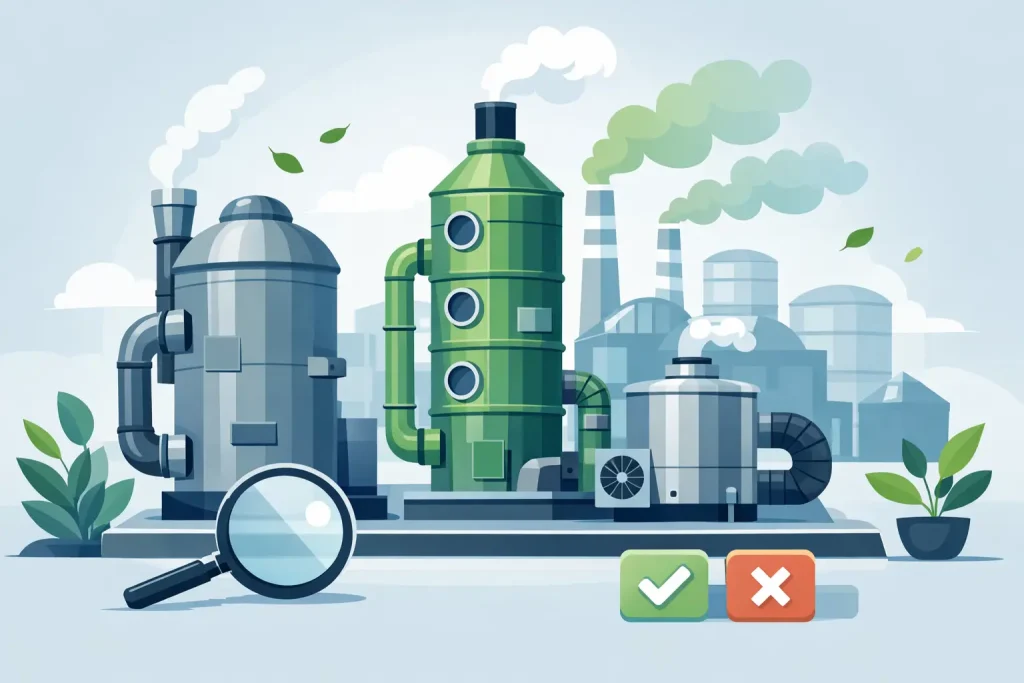
A scrubber that performs well on an acidic exhaust stream can fail to control a reduced-sulfur odor, even when airflow and pressure drop look correct. Selecting the best scrubbers for odor control plants starts with the odor compounds present, their concentration swings, and the operating discipline the plant can sustain – not with a generic equipment type.
For industrial facilities, odor control is rarely only a nuisance issue. Persistent odors can indicate uncontrolled process emissions, corrosive gases, fugitive releases, poor capture at the source, or a system operating outside its intended range. The right scrubber must provide defensible performance under normal production conditions, support permit obligations, and remain serviceable when process loads change.
Which Scrubbers Are Best for Odor Control Plants?
Packed-bed chemical scrubbers are usually the leading choice for continuous industrial odor control, particularly where odors contain hydrogen sulfide, mercaptans, ammonia, amines, chlorine compounds, or other water-soluble and reactive gases. A correctly designed packed tower provides high gas-to-liquid contact area, allowing the recirculating liquor to absorb and chemically neutralize target contaminants.
That does not make every packed tower the right answer. Some odor streams are poorly soluble, contain oil mist or particulate that will foul packing, or fluctuate too sharply for a single recirculating chemistry. In those cases, a pre-treatment stage, a two-stage scrubber, activated carbon polishing, or thermal oxidation may be more appropriate.
The best system is the one that controls the specific odor chemistry at the required airflow, while giving the maintenance team clear operating parameters and practical access for inspection, cleaning, and media replacement.
Caustic Packed-Tower Scrubbers for Acidic and Sulfur Odors
Caustic scrubbers use an alkaline solution, commonly sodium hydroxide, to absorb acidic gases. They are widely applied for hydrogen sulfide, mercaptans, sulfur dioxide, hydrogen chloride, and other acidic contaminants. For stronger odor-control duty, an oxidizing agent may be added so absorbed sulfides are converted into less odorous compounds rather than released again from the recirculation tank.
These systems are effective for wastewater treatment areas, rendering operations, chemical processing, and sulfur-bearing process vents. Their performance depends on stable pH control, oxidation-reduction potential where applicable, chemical dosing accuracy, and adequate liquid distribution across the packing. A low chemical feed rate or plugged spray nozzle can quickly reduce removal efficiency.
Caustic systems also create a wastewater management requirement. The blowdown stream must be evaluated for salts, pH, sulfides, and other reaction products before disposal. A lower equipment price is not necessarily a lower lifecycle cost if chemical consumption and effluent treatment have been underestimated.
Acidic Packed-Tower Scrubbers for Ammonia and Amines
Ammonia and amine odors require the opposite approach. Acidic scrubbing liquor, often controlled with sulfuric acid, converts alkaline gas compounds into nonvolatile salts. This arrangement is common in fertilizer-related operations, food and animal feed processing, composting, wastewater handling, and manufacturing processes that release amine-based vapors.
The central engineering question is not simply whether ammonia is detectable. It is how much ammonia is present, whether it arrives as a continuous load or batch release, and whether dust or oil mist is entering the system. High particulate loading can coat the packing and increase pressure drop, while excess water vapor can affect downstream ductwork and fan selection.
For facilities with mixed odors, an acid stage may be installed before an alkaline or oxidizing stage. The sequence must follow the gas chemistry. Installing stages in the wrong order can waste chemicals and leave the primary odor compound untreated.
Two-Stage and Multi-Stage Scrubbers for Mixed Exhaust Streams
A two-stage chemical scrubber is often the most dependable solution when one exhaust stream contains both alkaline and acidic odor compounds. A typical arrangement uses an acid stage to remove ammonia and amines, followed by a caustic-oxidizing stage for hydrogen sulfide, mercaptans, and related sulfur compounds.
Multi-stage systems require more capital equipment, instrumentation, and operator attention than a single tower. They also provide a broader treatment window and reduce the risk of trying to force incompatible contaminants into one recirculating solution. For plants with several process lines, separating streams before treatment can sometimes achieve the same result with less chemical use and simpler maintenance.
This is where field auditing and source characterization add value. Combining every duct into one common header may appear efficient, but it can create a complex gas mixture that is harder and more expensive to treat.
Venturi Scrubbers When Odor Is Carried With Dust or Mist
Venturi scrubbers are not usually the first choice for dissolved-gas odor control alone. They are valuable where odor-causing compounds are attached to fine particulate, condensed aerosol, sticky mist, or high-dust exhaust. The venturi throat creates intense contact between gas and liquid droplets, producing strong particulate capture before the gas moves to a packed tower or other polishing stage.
The trade-off is energy. Venturi systems operate at higher pressure drop than conventional packed towers, requiring greater fan power. They also need effective mist elimination and reliable slurry management. When a process generates greasy aerosol, resinous fumes, or dust that can blind packing, however, a venturi pre-scrubber can protect the downstream odor-control stage and preserve system uptime.
Biological Scrubbers for Consistent, Biodegradable Odors
Biological scrubbers and biotrickling filters use microorganisms to break down suitable odor compounds. They can be a good fit for large, steady air volumes with biodegradable contaminants, especially in wastewater, organics handling, and agricultural processing applications.
Their limitation is response time. Biological systems need stable temperature, moisture, nutrient conditions, and loading. They are less forgiving of solvent slugs, disinfectants, extreme pH, or sudden concentration spikes. A plant with intermittent batch emissions may need a chemical scrubber ahead of the biological stage, or a different control technology altogether.
How to Specify an Odor-Control Scrubber Correctly
A scrubber should be designed around measured process data, not only an odor complaint or a nameplate airflow figure. Odor thresholds can be extremely low, and a stream that appears minor in mass emission terms may still create an off-site impact.
Before selecting equipment, the project team should establish:
- contaminant species, concentration range, temperature, humidity, oxygen content, and particulate or aerosol loading;
- required airflow at each capture point, including diversity, future expansion, and fan static-pressure requirements;
- production cycles, batch releases, upset scenarios, and the expected duration of peak odor events;
- discharge limits, permit conditions, workplace exposure requirements, and wastewater constraints; and
- available utilities, chemical storage space, access for maintenance, and controls capability.
Gas sampling and laboratory analysis are especially valuable for sulfur compounds, amines, aldehydes, and mixed VOC odors. Where formal speciation is not practical, a field audit should still identify likely sources, capture deficiencies, and process conditions that correlate with odor events.
Do Not Treat Capture and Scrubbing as Separate Problems
An odor-control device cannot compensate for poor hood design or leakage from process equipment. If contaminated air escapes into the building before reaching the duct, employees may remain exposed even when stack emissions are acceptable. Conversely, pulling excessive dilution air through open hoods increases scrubber size, chemical demand, and fan energy without improving source control.
Effective projects review local exhaust ventilation, hood face velocity, duct transport velocity, fan performance, duct leakage, and stack discharge conditions as one system. Testing and commissioning should confirm actual airflow and pressure drop at each operating point, then document pH, oxidation-reduction potential, recirculation flow, chemical dosing, and emissions performance.
Reliability Depends on Instrumentation and Service Access
Odor scrubbers are chemical process systems, not passive tanks. They need sensors that operators can trust, including pH probes, level controls, recirculation-flow indication, pressure-drop monitoring, and dosing interlocks. For oxidizing systems, oxidation-reduction potential monitoring can provide an early warning that chemistry is no longer sufficient for the sulfur load.
Packing, spray nozzles, mist eliminators, pumps, and fan components should be selected for the chemical environment and inspected on a planned schedule. Corrosion-resistant materials, properly designed access doors, and spare-parts readiness reduce the likelihood that a minor fault becomes an extended shutdown.
For critical facilities, online performance monitoring helps turn operating data into actionable maintenance decisions. A gradual rise in differential pressure may indicate fouling. Unstable pH may reveal an unexpected process release. These trends should trigger investigation before odor complaints or compliance concerns arise.
Make the Selection Defensible
The right odor-control scrubber is not the unit with the highest claimed removal efficiency. It is the system supported by representative gas data, correct capture engineering, defined chemical controls, commissioning records, and a maintenance plan the facility can execute.
Master Jaya Group approaches odor-control projects as complete clean-air systems, from field auditing and engineered fabrication through installation, testing and commissioning, stack sampling, and ongoing service support. For plant leaders, the practical next step is to characterize the exhaust stream during real production conditions, then specify a treatment train that remains effective when the process is at its most demanding.