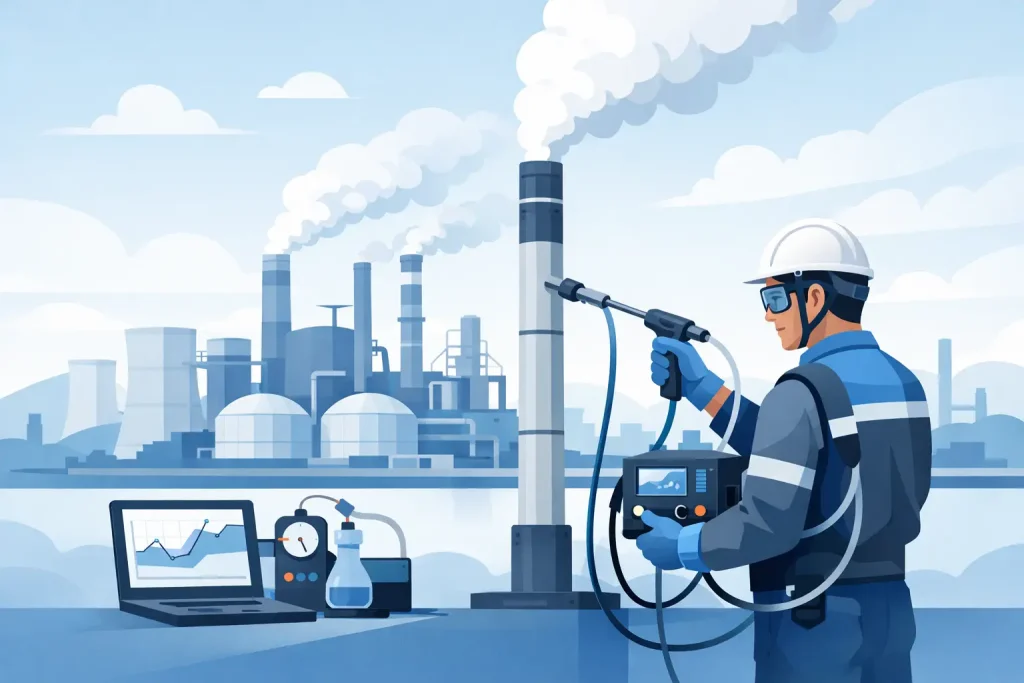
A dust collector can appear to be operating normally while a stack test tells a different story. A damaged filter bag, air leakage, poor pulse-cleaning performance, incorrect fan speed, or a process change can raise emissions without an obvious warning on the production floor. Industrial stack sampling services provide the measured evidence needed to verify actual discharge conditions, support compliance reporting, and direct corrective action before a minor issue becomes a regulatory or operational problem.
For plant managers, EHS leaders, and maintenance teams, stack sampling is not simply a report to file after testing. When planned correctly, it is a practical diagnostic tool for determining whether an air pollution control system is achieving its design duty under real operating conditions.
What Industrial Stack Sampling Services Measure
Stack sampling is the controlled collection and analysis of emissions from an industrial exhaust stack, duct, or vent. The work may measure particulate matter, dust concentration, gases, volatile organic compounds (VOCs), acid gases, metals, opacity-related parameters, moisture, oxygen, carbon dioxide, flow rate, temperature, and other permit-specific contaminants.
The required parameters depend on the process, fuel, control equipment, applicable permit conditions, and regulatory framework. A thermal oil-fired system may require a different testing scope than a metal casting line, feed mill, paint operation, chemical process, or activated carbon adsorption system. Testing should therefore begin with the emission source and compliance obligation, not with a generic sampling package.
For particulate sources, sampling often requires isokinetic techniques. In simple terms, the sampling rate must match the velocity of the gas moving through the stack at each traverse point. If the sampling rate is too high or too low, the collected dust may not represent the actual particulate loading. This is why sampling port location, stack geometry, velocity profiling, nozzle selection, and field calibration all matter.
A complete test program also establishes the exhaust gas flow rate. Concentration alone does not always show the full emissions picture. A low concentration at a very high gas flow can still produce a significant mass emission rate. Conversely, changes in airflow can affect the performance of collectors, scrubbers, cyclones, and electrostatic precipitators even when the process appears stable.
Why a Single Stack Test Is Not the Whole Answer
A compliant result is valuable, but it is a snapshot of a defined operating period. The result is only as representative as the plant conditions during sampling. If a line is operating at reduced production, a furnace is not at normal firing rate, or a dust collector has recently been cleaned or repaired, the measured result may not reflect typical worst-case conditions.
A defensible testing program records process throughput, fuel consumption, operating temperature, pressure drop, fan status, control-system settings, and relevant production conditions during the test. For a pulse-jet dust collector, this may include compressed-air pressure, pulse sequence, hopper discharge condition, differential pressure, and filter media history. For a packed tower scrubber, liquid circulation rate, pump condition, pH, pressure drop, and reagent control may be equally important.
This operating information turns a laboratory result into engineering evidence. If emissions are elevated, the plant can investigate likely causes rather than treating the report as an isolated compliance failure. If results are well within limits, the same data can support maintenance planning and provide a baseline for future performance reviews.
Preparing for Stack Sampling Without Disrupting Production
The best time to address sampling readiness is before a regulator, customer audit, permit deadline, or community complaint creates urgency. Facilities should confirm that the stack has suitable test ports, safe access platforms, electrical supply where required, adequate lighting, and clear access for field personnel and equipment. Sampling locations should be evaluated for flow disturbances caused by elbows, dampers, fans, transitions, or obstructions.
Safe access is not an administrative detail. Stack testing may require technicians to work at elevation for several hours while handling heated probes, glassware, pumps, filters, and measurement instruments. Inadequate platforms or restricted access can delay the work, increase safety risk, or compromise the ability to obtain representative samples.
Production planning is equally important. The operating team should identify a test window in which the emission source can run at normal, sustained load. If the applicable limit or permit condition requires a specific operating scenario, that condition should be incorporated into the test plan. The plant should avoid last-minute operational changes unless they are necessary for safety.
Before fieldwork begins, an experienced service provider will typically review the source configuration, historical test results, emission-control equipment, operating permits, expected pollutants, and required reporting format. This review helps determine whether the sampling scope is technically appropriate and whether corrective work is needed before testing.
When Results Point to a Control-System Problem
Stack sampling results should be assessed alongside equipment inspection and operating data. High particulate emissions from a baghouse do not automatically mean the collector is undersized. The cause may be torn filter bags, poor tube sheet sealing, worn venturis, ineffective pulse cleaning, a damaged rotary valve, excessive air-to-cloth ratio, unsuitable filter media, or dust bridging in the hopper.
For scrubber systems, elevated gas or particulate results can indicate inadequate liquid-to-gas ratio, blocked nozzles, pump degradation, poor packing condition, unstable chemistry, carryover, or incorrect fan performance. An electrostatic precipitator may require attention to electrical fields, rappers, insulators, gas distribution, or ash handling. Activated carbon filters require evaluation of bed life, breakthrough risk, inlet concentration, humidity, and adsorption suitability.
The trade-off is straightforward: corrective action based only on assumptions can consume maintenance budget without solving the source of noncompliance. Field auditing combined with stack data narrows the diagnosis. In some cases, adjustment and servicing are sufficient. In others, the facility may need duct modifications, fan balancing, collector refurbishment, filter-media replacement, a scrubber upgrade, or a new emission-control system designed for changed process conditions.
Compliance Documentation Must Be Defensible
A stack sampling report should clearly identify the emission source, test date, process operating conditions, sampling locations, methods, instruments, calibration records, analytical results, calculations, and applicable limits. This documentation allows plant personnel, auditors, regulators, and management to understand what was tested and whether the result represents compliant operation.
For facilities regulated under Malaysia’s Clean Air Regulations 2014, testing and reporting must align with the relevant regulatory requirements and permit obligations. Facilities in other jurisdictions should apply the methods, limits, and reporting procedures required by their local environmental authority. The principle remains the same: compliance records must be traceable, technically sound, and prepared for review.
Organizations should also retain results in a way that supports trend analysis. Comparing current results with prior data can reveal gradual deterioration before an exceedance occurs. This is especially useful where online performance monitoring, differential-pressure trends, fan amperage, process throughput, or scrubber operating data can be reviewed alongside periodic stack sampling.
Selecting Industrial Stack Sampling Services That Add Operational Value
The lowest-cost test is not always the lowest-risk choice. A provider should be able to explain the proposed method, sampling duration, number of runs, test conditions, laboratory analysis, quality-control steps, and reporting deliverables. Just as importantly, the team should understand the air pollution control equipment connected to the source.
An equipment-only vendor may identify a need for replacement hardware. A testing-only provider may issue results without examining why they occurred. A lifecycle partner can connect stack sampling with field auditing, system design, fabrication, installation, testing and commissioning, after-sales service, spare parts, and ongoing monitoring.
Master Jaya Group applies this integrated approach across dust collection, packed tower scrubbers, cyclones, electrostatic precipitators, regenerative thermal oxidizers, activated carbon filters, and air strippers. The objective is not merely to produce a test report, but to help facilities maintain a controlled, documented path to clean-air performance.
Schedule stack sampling around real production conditions, keep the control system properly maintained, and treat every result as a decision-making input. That discipline gives operations teams something more useful than a pass or fail result: clear evidence of how their emission-control system is performing when it matters most.