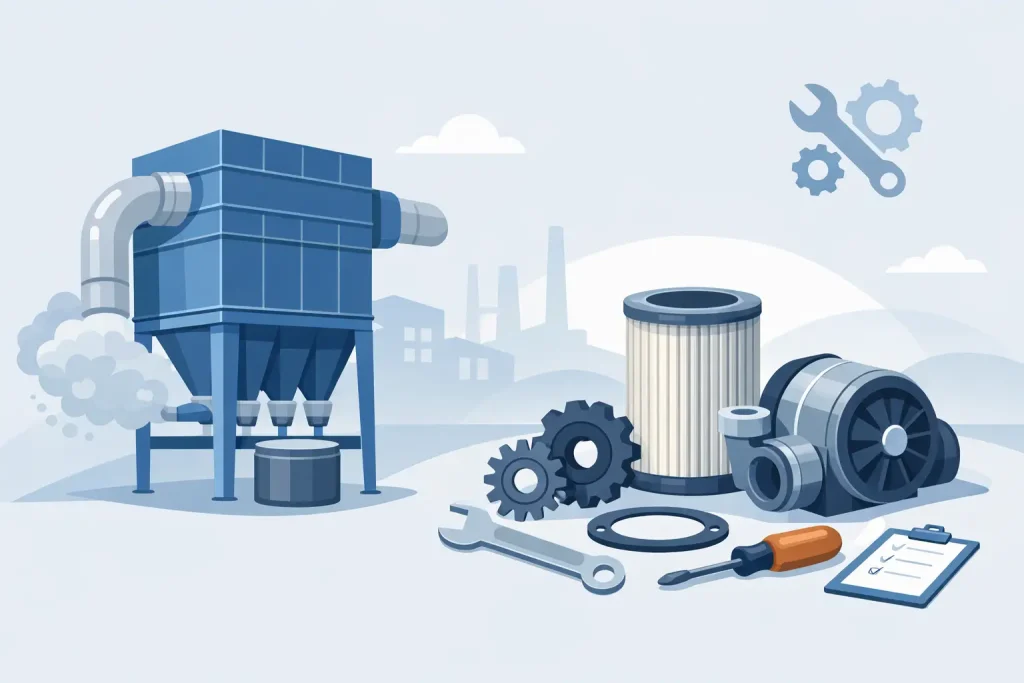
A dust collector rarely fails all at once. More often, suction drops a little, differential pressure drifts upward, hopper discharge becomes inconsistent, or compressed air use starts climbing without a clear explanation. By the time visible dust escapes or production is affected, the underlying issue has usually been developing for weeks. That is why dust collector service and spare parts should be treated as a compliance and uptime function, not a reactive maintenance purchase.
For plant managers, EHS leaders, maintenance teams, and project engineers, the real question is not whether a collector needs attention. It is whether service activity is aligned with process conditions, statutory obligations, and the actual wear profile of the system. A pulse-jet dust collector handling metal fines, a baghouse on feed processing duty, and a unit serving thermal process exhaust will not age in the same way. Service planning has to reflect that reality.
Why dust collector service and spare parts matter
Industrial dust collection systems sit at the intersection of production reliability, worker exposure control, and emissions compliance. When performance degrades, the consequences are not limited to poor housekeeping. Capture velocity can fall below what the process requires. Filter loading can increase fan demand. Leaks in access doors, tube sheets, or duct interfaces can allow untreated air to bypass the filtration path. In regulated environments, these are operational issues with compliance implications.
A proper service program does more than replace worn components. It verifies that the collector, fan, ducting, cleaning system, and discharge arrangement are still operating as an integrated system. If one element is out of specification, the rest of the equipment is forced to compensate. That is why a low-cost part change can sometimes become an expensive recurring problem when the root cause is never addressed.
Spare parts readiness matters for the same reason. Filters, valves, cages, gaskets, controllers, rotary valves, solenoids, and pressure instruments are not interchangeable by assumption. Material compatibility, temperature rating, dust characteristics, pulse cleaning logic, and mechanical fit all affect results. The wrong filter media or an underspecified diaphragm valve may appear acceptable at installation, then fail prematurely under actual operating conditions.
What a competent dust collector service program should cover
Service should begin with condition verification, not only replacement. A technician needs to review differential pressure trends, cleaning sequence performance, compressed air quality, fan behavior, hopper evacuation, and visible signs of leakage or abrasion. On a pulse-jet system, header pressure, pulse timing, and valve response are basic checks. On older units, corrosion, tube sheet flatness, and door sealing often need closer attention than the filter elements themselves.
Filter performance and media condition
Filter bags or cartridges are usually the first components people think about, but they are only one part of system performance. A filter can blind, tear, collapse, or chemically degrade depending on process temperature, moisture, particle loading, and dust abrasiveness. Fine powders in food or feed applications may plug differently from metal grinding dust or foundry particulate. Selecting replacement media without reviewing process duty can shorten life and reduce collection efficiency.
A proper inspection should assess wear patterns. Damage at the bottom of the bag may indicate abrasive loading or poor flow distribution. Top-end leakage can point to sealing faults. Uneven loading across rows may suggest pulse imbalance, air maldistribution, or duct entry problems. These findings matter because replacing media alone may restore pressure drop temporarily while leaving the failure mechanism untouched.
Pulse cleaning system integrity
Pulse-jet collectors depend on stable cleaning energy. If solenoid valves misfire, diaphragms harden, compressed air contains moisture, or the controller sequence is poorly tuned, filter cleaning becomes inconsistent. That typically shows up as rising differential pressure, shortened filter life, and avoidable fan loading.
This is where spare parts quality has a direct operating effect. A valve kit with incorrect response characteristics or poor elastomer durability can introduce repeat failures. In many plants, the cost of lost performance exceeds the cost of the valve itself. For that reason, spare parts should be specified to the collector duty, not bought as generic look-alikes.
Mechanical and structural checks
Dust collectors operate in demanding service conditions. Vibration, abrasive dust, thermal cycling, and outdoor exposure all affect structural reliability. Hopper walls can bridge or wear. Rotary airlocks can lose sealing performance. Access doors can warp. Duct transitions may thin at high-velocity impact zones. If these issues are missed, the collector may continue running while gradually losing containment and efficiency.
Mechanical service should therefore include checks on the housing, support steel, hopper evacuation, explosion protection interfaces where applicable, and fan alignment and balance. A collector that meets design intent on paper can still underperform if mechanical losses are allowed to accumulate.
Spare parts strategy is about risk control
Plants often approach spare parts in two extremes. One is overstocking components with no clear usage history. The other is holding almost nothing and relying on emergency sourcing. Neither is ideal for critical emission-control equipment.
A better approach is to classify parts by failure impact and lead time. Consumables such as filters and gaskets should be forecast against duty hours and process loading. Critical motion or cleaning components such as diaphragm valves, solenoids, controller modules, and rotary valve parts should be stocked based on consequence of downtime. Fabricated items, especially those tied to a specific collector geometry, need even more attention because replacement lead times can be longer.
For compliance-driven operations, this strategy also supports defensible maintenance planning. If a plant can show that critical emission-control components are identified, monitored, and available, it is in a stronger position during audits, investigations, and internal management reviews.
When service should move beyond maintenance into system correction
There are situations where repeated service calls indicate a design or application issue rather than normal wear. If filters fail too frequently, if pressure drop remains unstable after replacement, or if dust carryover persists, the answer may involve airflow redistribution, duct modification, fan resizing, hopper redesign, or media re-selection.
This is where engineering support becomes important. A service provider should be able to connect field symptoms to system causes. That may require auditing, testing and commissioning review, stack sampling, or process-side assessment. In regulated industries, the objective is not just to get the unit running again. It is to restore predictable performance with documentation that supports compliance obligations.
Facilities operating under frameworks such as clean air regulations and occupational exposure requirements should be especially careful here. A collector that runs but no longer performs to required capture or emission levels creates a false sense of security. The operational risk is obvious. The regulatory risk is often larger.
What buyers should expect from a service partner
A credible service partner should be able to support the full lifecycle of the collector, from inspection and diagnostics to spare parts supply, corrective work, performance verification, and upgrade recommendations. That matters because fragmented responsibility tends to slow down root-cause resolution.
For example, if one vendor supplies filters, another handles mechanical repair, and a third is asked to investigate emission issues, accountability becomes blurred. By contrast, a one-stop solution provider with engineering, fabrication, field service, and compliance support can connect the service event to the broader operating requirement. That is especially useful when the plant needs not only replacement parts but also field auditing, stack sampling, DOE-related documentation support, or ongoing monitoring.
Master Jaya Group works in this model because dust control equipment does not exist in isolation. It operates as part of a regulated plant environment where design, servicing, spare parts readiness, testing and commissioning, and monitoring all affect the final outcome.
Signs your current approach needs attention
If your team is changing filters too often, seeing recurring compressed air issues, managing unexplained pressure-drop swings, or waiting too long for essential parts, the service model likely needs review. The same applies if maintenance records focus only on what was replaced rather than why the part failed.
Another common warning sign is when plant teams treat every collector the same. Service intervals, media choice, and spare parts holding should reflect actual dust characteristics, temperature, moisture, and operating hours. Standardization can help procurement, but it should not override application-specific engineering.
A well-run dust collector is easy to overlook because it operates quietly in the background. That is exactly why disciplined service and the right spare parts matter. They protect uptime, keep performance measurable, and reduce the chance that a hidden maintenance issue becomes a production or compliance problem at the worst possible time.
The most effective plants do not wait for visible dust to tell them something is wrong. They build service around evidence, keep critical parts ready, and work with partners who can take responsibility for performance, not just delivery.