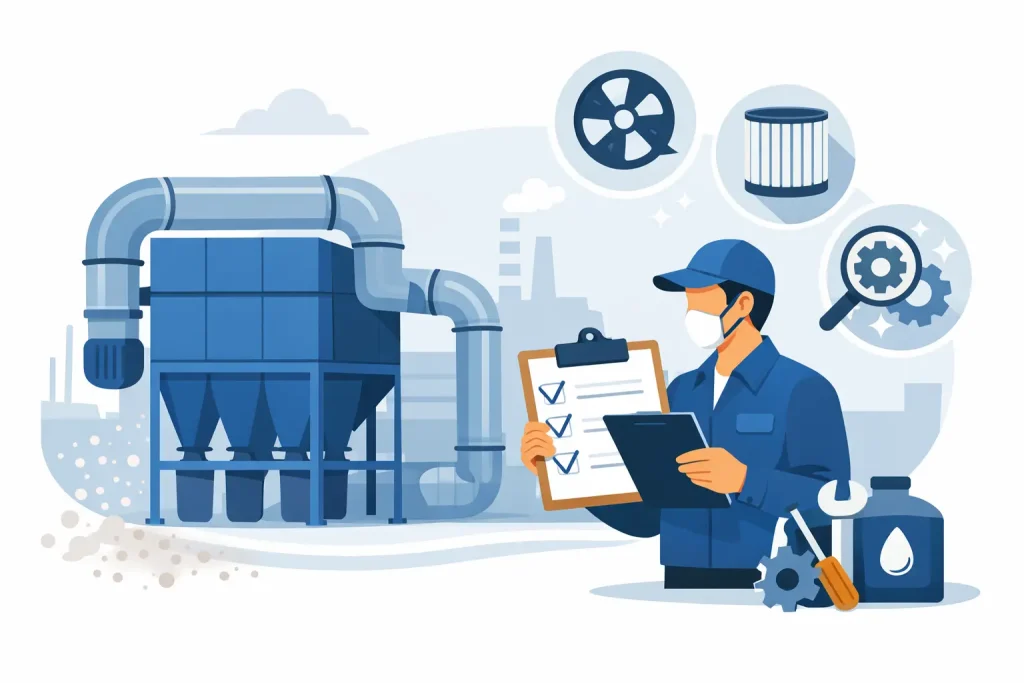
A dust collector rarely fails without warning. More often, the warning signs show up first as higher differential pressure, weak pickup at hoods, visible dust around discharge points, rising compressed air use, or stack results that start moving in the wrong direction. A proper dust collector preventive maintenance checklist gives plant teams a disciplined way to catch those signals early, before they become production loss, exposure risk, or a compliance issue.
For facilities managing combustible dust, nuisance dust, process fines, fumes, or mixed particulate streams, preventive maintenance is not a housekeeping exercise. It is part of system performance control. The collector, fan, ducting, hopper, valves, and instruments operate as one system, so a clean set of filters alone does not guarantee acceptable suction, emissions, or safe operation.
Why a dust collector preventive maintenance checklist matters
Most maintenance teams know the obvious tasks – inspect filters, empty hoppers, check pulse cleaning. The gap is usually consistency and documentation. When inspections vary by shift or depend on individual experience, recurring issues are missed. That is when a collector that appeared to be running normally begins carrying hidden risk.
A structured checklist improves more than equipment reliability. It supports defensible maintenance records, helps correlate performance changes with process conditions, and gives EHS and operations teams better evidence during internal audits, troubleshooting, and regulatory review. In plants where air pollution control equipment performance is tied to permit conditions or occupational exposure control, that record matters.
There is also a cost angle. Over-cleaning filters can shorten media life, while delayed cleaning can choke airflow and strain fans. Replacing parts too early wastes budget. Replacing them too late can trigger unplanned shutdowns, bag failures, or emissions excursions. Good preventive maintenance sits in that middle ground where condition, process duty, and compliance requirements are evaluated together.
The practical dust collector preventive maintenance checklist
The most useful checklist is organized by inspection frequency. Daily observations should be simple enough for operations to complete reliably. Weekly and monthly work can go deeper, with shutdown inspections reserved for internal access and component replacement.
Daily operating checks
Start with what the system is telling you during operation. Record differential pressure across the collector and compare it with the normal operating range established during stable production. A sudden drop can indicate torn filters or air leakage. A steady increase may point to blinded filters, ineffective pulse cleaning, or hopper evacuation problems.
Check fan performance indirectly through hood capture, branch line suction, and general dust behavior in the work area. If pickup at the source has weakened, do not assume the collector is the only cause. Damper position changes, duct blockage, or fan belt slippage can create the same symptom.
Observe the pulse-jet cleaning system if applicable. Listen for normal pulse timing and confirm compressed air pressure is within design range. Low pressure results in poor cleaning. Excess pressure may damage filter media or increase wear on diaphragms and valves.
Walk around the collector body, hopper, rotary valve, screw conveyor, and discharge points. Visible dust leaks, abnormal vibration, unusual noise, or product buildup around seals should be logged immediately. Small leaks often become the first sign of a larger containment or maintenance problem.
Weekly inspection points
Each week, inspect the compressed air system more closely. Drain moisture from receivers and check filters and regulators. Wet or contaminated compressed air can blind filter media and interfere with pulse valve performance. In humid or high-temperature processes, air quality has a bigger effect than many plants expect.
Examine differential pressure trends rather than single readings. If pressure increases only during certain products, shifts, or operating rates, the issue may be process-related rather than purely mechanical. That distinction matters because maintenance alone will not solve poor inlet distribution, sticky dust, or an oversized air-to-cloth ratio.
Review hopper discharge. Dust should move continuously out of the system. Bridging, rat-holing, or partial discharge allows dust to accumulate and re-entrain, which raises pressure and can damage filters. Check level sensors, rotary airlocks, screw conveyors, and access doors for proper function and sealing.
Inspect fan bearings, motor condition, belt tension, coupling alignment, and base integrity. A fan that drifts from design speed or develops vibration will alter the whole system curve. Plants sometimes replace filters repeatedly when the real issue is fan degradation.
Monthly and scheduled maintenance checks
Monthly inspections should include a more detailed review of filter condition. Depending on collector design, process hazard, and isolation requirements, this may involve opening access doors during a planned shutdown and inspecting for bag wear, cage damage, cartridge gasket failure, poor seating, abrasion, or evidence of moisture attack.
Look carefully for localized damage. If only filters near the inlet are failing, inlet velocity or baffle condition may be the driver. If failures cluster near doors or tube sheets, leakage paths or installation quality may be responsible. Random replacement without identifying the failure pattern usually leads to repeated outages.
Check the tube sheet, door gaskets, housing seams, and access panels for leakage. Dirty air bypass around the filters is a direct emissions risk and can distort differential pressure readings, making the collector appear healthier than it is.
Test pulse valves, solenoids, timers, and diaphragm condition. Cleaning systems often degrade gradually, so maintenance teams adapt to poor performance without realizing how far the collector has drifted from original design. Functional testing helps separate control faults from mechanical wear.
Verify instrumentation accuracy. Differential pressure gauges, transmitters, pressure regulators, level switches, and temperature devices should be inspected and calibrated according to site requirements. A maintenance program is only as good as the data it relies on.
Components that deserve special attention
Not every collector fails in the same way. Cartridge collectors in fine dry dust service behave differently from baghouses handling abrasive particulate, hot process streams, or sticky product. Still, a few components consistently deserve close attention.
Filters are the obvious one, but support components often drive filter life. Damaged cages, poor pulse performance, moisture in compressed air, and hopper retention all accelerate media failure. If filter replacement frequency is increasing, investigate the surrounding causes before changing media specification.
Rotary valves and discharge systems are another common weak point. When these components leak air or jam with material, hopper flow becomes unstable and the collector loses operating control. Likewise, ductwork should be checked for wear at elbows, dust accumulation in low-velocity runs, and loose connections that change airflow balance.
For facilities with explosion isolation, spark control, suppression, or other safety devices, include those items in the maintenance scope as separate critical systems. Preventive maintenance cannot stop at filtration efficiency if the process carries fire or explosion risk.
Documentation and compliance value
A checklist has limited value if it ends as an informal note on a clipboard. Maintenance records should show what was inspected, what readings were taken, what abnormalities were found, and what corrective action followed. That level of traceability supports internal reliability work and strengthens the site’s compliance posture.
For regulated plants, preventive maintenance records can help explain trends in stack sampling, support inspections, and demonstrate that air pollution control equipment is being actively managed rather than passively operated. This is especially relevant when performance verification, testing and commissioning records, field auditing, or official submissions are tied to ongoing plant obligations.
Plants using digital monitoring gain an additional advantage. Trending differential pressure, pulse frequency, fan current, vibration, and alarm history makes it easier to identify slow deterioration before it affects emissions or production. A checklist remains necessary, but monitoring adds context that manual rounds cannot always capture.
When the checklist should trigger outside support
There is a point where routine maintenance ends and engineered review is needed. If differential pressure remains unstable after filter and pulse system checks, if stack results worsen despite normal readings, or if capture at hoods cannot be restored through balancing and basic repairs, the problem may sit in system design rather than maintenance execution.
That can include incorrect fan selection, poor hood design, inadequate transport velocity, short-circuiting inside the collector, or process changes that increased dust loading beyond original design intent. In those cases, a service partner with auditing, testing and commissioning, stack sampling, and upgrade capability is more useful than a parts-only vendor. For many industrial operators, this is where a one-stop provider such as Master Jaya Group becomes operationally valuable, because troubleshooting can move from inspection to corrective engineering without handoff gaps.
A dust collector checklist works best when it is treated as a living control document, not a fixed form copied from a manual. As production changes, dust characteristics shift, and compliance expectations tighten, the checklist should be revised to reflect what the system actually needs to keep performing with confidence.