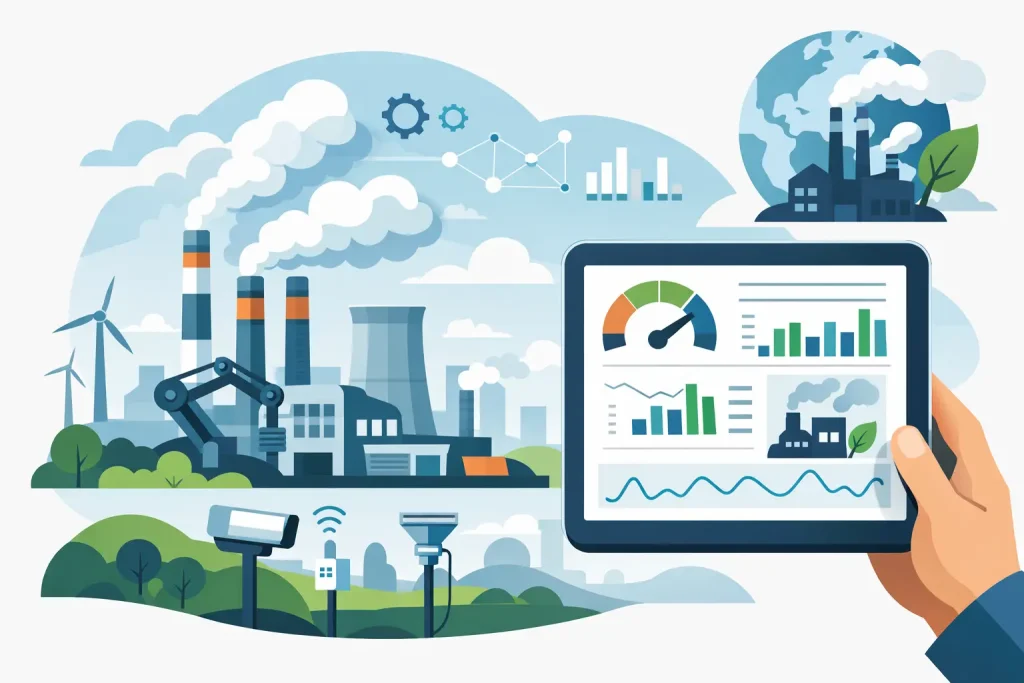
A bag filter differential pressure trend that drifts for three days is not just a maintenance note. In many plants, it is the early warning that separates controlled performance from an emissions exceedance, an unplanned shutdown, or a difficult conversation during an audit. That is where industry 4.0 emissions compliance monitoring moves from a nice-to-have dashboard to a compliance control layer.
For plant managers, EHS leaders, maintenance teams, and project engineers, the value is straightforward. You need more than a collector, scrubber, ESP, or thermal oxidizer that performs well on commissioning day. You need evidence that the system is still operating within design intent, that emissions risks are visible early, and that records can stand up to internal review and regulatory inspection.
What industry 4.0 emissions compliance monitoring actually means
In industrial air pollution control, Industry 4.0 is often reduced to connected sensors and online dashboards. That is only part of the picture. A compliance-led approach combines field instrumentation, equipment logic, data capture, alarm management, performance trending, and service response into one operating framework.
For emissions systems, this can include pressure drop across pulse-jet dust collectors, fan amperage, hopper status, scrubber pH, liquid circulation rate, oxidation chamber temperature, VOC indicators, stack parameters, and local exhaust ventilation performance signals. The objective is not to collect data for its own sake. The objective is to detect conditions that affect emissions performance, worker exposure, and statutory compliance before they become failures.
That distinction matters. A plant can be highly automated and still poorly monitored from a compliance standpoint. If data is not tied to permit conditions, operating limits, maintenance actions, and testing records, the plant may be digitally connected but operationally exposed.
Why emissions compliance monitoring is shifting from periodic checks to continuous visibility
Traditional compliance management depends heavily on scheduled inspection, routine servicing, stack sampling, and operator observation. Those remain necessary. Testing and commissioning, field auditing, and stack sampling still provide the defensible baseline for system performance and regulatory submissions.
The limitation is timing. A monthly inspection may confirm that a scrubber was acceptable on the inspection date, but it does not show what happened in the three weeks before. An annual stack test is essential, yet it does not explain a gradual drop in suction performance, a clogged spray header, or filter media degradation that developed between test intervals.
Industry 4.0 emissions compliance monitoring closes that gap. It gives operations teams a way to see trends, not just snapshots. It supports earlier intervention when pulse-cleaning performance deteriorates, when pressure loss indicates blockage, or when combustion conditions in a regenerative thermal oxidizer begin to drift away from target.
That does not eliminate manual compliance work. It makes manual compliance work more accurate, more targeted, and easier to defend.
Where connected monitoring delivers practical value
The strongest use case is not a generic smart factory initiative. It is the link between emissions control equipment behavior and compliance risk.
On a pulse-jet dust collector, continuous monitoring of differential pressure, compressed air performance, and fan loading can show whether bags are blinding, cleaning cycles are ineffective, or air-to-cloth conditions are moving outside design assumptions. On a packed tower scrubber, pH, recirculation flow, pressure drop, and dosing trends can indicate whether gas-liquid contact remains effective for the contaminant load. On an electrostatic precipitator, electrical behavior and collection efficiency indicators can reveal a performance shift long before visible issues appear downstream.
For VOC and odor control systems such as regenerative thermal oxidizers and activated carbon filters, monitoring chamber temperature, residence conditions, pressure, and bed loading supports both compliance and cost control. A system may still be running, but not running at the level required to deliver reliable destruction or adsorption performance.
This is where the business case becomes stronger than simple digitization. Better visibility reduces the chance of emissions drift, protects uptime, supports spare parts planning, and creates a record of operational discipline.
Industry 4.0 emissions compliance monitoring works best when tied to service and accountability
A common mistake is to treat monitoring as a software purchase. In practice, the monitoring layer only becomes useful when it reflects actual equipment design, actual site conditions, and the operating limits that matter for that specific process.
A dust collection system serving metal grinding behaves differently from a scrubber controlling acid fumes or a cyclone installed upstream of a thermal process. Alarm thresholds, trending logic, and maintenance triggers should be engineered around the duty, not copied from a generic template.
That is why many facilities now prefer a one-stop solution provider that can design, fabricate, install, test, commission, and continue supporting the system after startup. When the same partner also performs field auditing, stack sampling, troubleshooting, and after-sales servicing, the data has context. A pressure anomaly is not just a graph on a screen. It can be tied back to duct losses, fan condition, filter loading, scrubber chemistry, or process variation.
For regulated operations, that integration matters more than the interface design. The real question is not whether the dashboard looks modern. The question is whether the monitoring program helps the plant maintain compliance with less uncertainty.
What to measure, and what to avoid overmeasuring
Not every sensor adds value. Plants sometimes invest in broad instrumentation packages only to find that operators ignore half the data. Effective compliance monitoring focuses first on parameters that correlate directly with emissions performance or statutory control conditions.
For particulate systems, that usually means airflow-related indicators, pressure behavior, cleaning performance, and signs of leakage or blockage. For wet systems, liquid quality and circulation conditions are often central. For thermal systems, temperature integrity and process stability are critical. Depending on the application, stack monitoring data may also be relevant, but upstream equipment condition data is often what prevents the stack result from becoming a surprise.
There is also a trade-off between precision and maintainability. Highly instrumented systems can deliver valuable insight, but only if sensors are calibrated, communications are stable, and alarm logic is practical for shift teams. An elegant monitoring plan that produces frequent false alarms can weaken response discipline. In regulated environments, that is a real risk.
Compliance documentation improves when operations data is organized
One of the most overlooked benefits of industry 4.0 emissions compliance monitoring is documentation quality. During audits, inspections, and internal reviews, facilities often struggle not because the equipment failed completely, but because the evidence trail is incomplete.
A connected monitoring layer can support timestamped operating records, alarm history, corrective action references, servicing intervals, and performance trends leading up to stack sampling or formal inspections. That makes it easier to show that the plant was not relying on assumptions. It was monitoring, responding, and maintaining the control system with intent.
This is especially useful for facilities managing multiple risk areas at once – environmental emissions, worker exposure, local exhaust ventilation performance, and process continuity. When records are centralized and reviewable, technical teams spend less time reconstructing events and more time resolving causes.
Competency still matters. A monitoring platform does not replace trained personnel such as CePSO and CePBFO role-holders or site teams responsible for statutory duties. It gives those people better operating evidence and earlier signals.
How to evaluate a monitoring approach before implementation
The first step is to define the compliance objective clearly. Is the priority early warning for collector failure, defensible records for regulated review, improved maintenance planning, better uptime, or all of the above? The answer affects instrumentation scope, alarm hierarchy, and reporting structure.
Next, assess the control equipment itself. Older systems can often be monitored effectively, but sensor placement, panel upgrades, and data integration may need careful engineering. New installations are usually easier because monitoring can be built into the design from the beginning, including access points, control panels, and service logic.
It is also worth checking whether your vendor can support the full lifecycle. A monitoring system is only as credible as the partner behind it. If there is no capability for troubleshooting, spare parts, site servicing, performance verification, and compliance-oriented reporting, the plant may end up with more data but not more control. This is where a company such as Master Jaya Group can add value by connecting engineered equipment, auditing, testing, and online performance monitoring into a single accountable scope.
Finally, keep expectations realistic. Monitoring will not compensate for undersized equipment, poor hood design, damaged ducting, or neglected maintenance. It improves visibility. It does not erase engineering fundamentals.
The plants that benefit most are usually not the most digital. They are the ones that treat emissions control as an operating discipline, where every data point has a compliance purpose and every alarm leads to action.