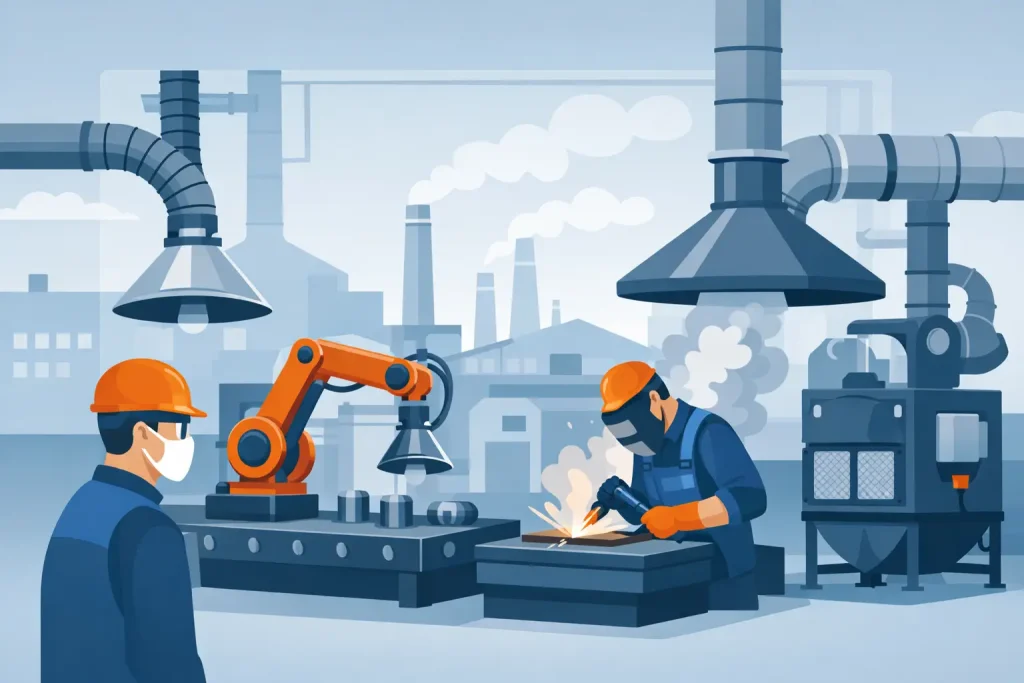
A grinding line that leaves fine dust on beams, a welding bay with visible haze at mid-shift, or a mixing room where operators can smell solvents before they open the door – these are usually early signs that the question is no longer theoretical. When does a factory need LEV? In practice, a factory needs local exhaust ventilation when contaminants are generated at the source and can expose workers, settle into equipment, affect product quality, or create a compliance risk that general ventilation cannot control.
LEV is not simply an air-moving system. It is an engineered control measure designed to capture dust, fume, mist, vapor, or gas before it spreads into the breathing zone or wider work area. For plant managers and EHS leaders, that distinction matters because many facilities already have wall fans, roof extractors, or make-up air systems and assume those are enough. Often they are not.
When does a factory need LEV in real operations?
The clearest answer is this: a factory needs LEV when a process releases airborne contaminants at a specific point and those contaminants must be captured close to where they are created. This typically applies to welding, soldering, grinding, cutting, sanding, bag dumping, powder conveying, mixing, spray operations, chemical dosing, plating, heat treatment, and oil-mist-generating machining.
The need becomes stronger when any of four conditions exist. First, workers are close to the source. Second, the contaminant is fine, hot, odorous, toxic, persistent, or combustible. Third, the process runs frequently or continuously. Fourth, the facility needs documented control performance for occupational or environmental compliance.
A broad supply-exhaust ventilation strategy can dilute some background heat or low-level room contamination, but dilution is a weak control for concentrated source emissions. If fumes rise directly into an operator’s face, or dust escapes each time material is transferred, the correct response is usually source capture rather than more room air changes.
The contaminants that usually justify LEV
Factories rarely ask for LEV because of one dramatic event. More often, the requirement builds from routine emissions that are treated as normal until exposure, housekeeping, or production issues become too visible to ignore.
Dust is one of the most common triggers. Metal finishing, food and feed handling, chemical powder charging, woodworking, mineral processing, and packaging lines can all release particulates that remain airborne or settle throughout the plant. Fine dust is especially difficult because it does not behave like coarse debris. It can travel, re-entrain, contaminate products, and increase the cleaning burden on motors, sensors, and electrical panels.
Fume is another major category. Welding, thermal cutting, and furnace-related processes generate very small particles that can penetrate deep into the respiratory system. Heat also creates buoyancy, which means contaminants may rise fast unless the hood design is properly matched to the process.
Mist and vapor often require a different engineering approach but still point to LEV. CNC machining with coolant, degreasing, chemical baths, solvent use, and process tanks can release oil mist, acid mist, or VOCs that are not effectively managed by comfort ventilation alone. In these cases, capture velocity, hood placement, duct material selection, and downstream treatment become critical.
General ventilation versus LEV
This is where many projects go wrong. General ventilation is designed to condition or refresh room air. LEV is designed to control a hazard at the point of generation. They can work together, but they are not interchangeable.
If the contaminant source is diffuse, low-toxicity, and spread over a large area, room ventilation may help. If the source is localized, repetitive, and close to people, LEV is usually the more defensible control. That is particularly true where regulations, industrial hygiene findings, or internal corporate standards require a clear hierarchy of controls.
There is also an operational issue. Increasing general exhaust without proper balance can pull conditioned air out of the building, affect process temperatures, and increase energy use without actually solving exposure. A correctly engineered LEV system often delivers better control with less wasted airflow because it captures contaminants where they start.
Process examples where LEV is typically required
In metalworking plants, LEV is commonly needed at welding stations, robotic welding cells, polishing benches, abrasive cutting stations, shot blasting interfaces, and machining centers that produce oil mist. The exact hood arrangement varies. A canopy hood may suit some thermal processes, while enclosing hoods, extraction arms, backdraft benches, or machine-mounted capture points may be more appropriate elsewhere.
In food, feed, and ingredient handling, the issue is often nuisance dust, allergen control, hygiene, and housekeeping rather than visible smoke. Bag tipping stations, weigh hoppers, mixers, sieves, and packaging points frequently need extraction tied to dust collectors such as pulse-jet systems or cyclones, depending on particle loading and process characteristics.
In chemical and surface treatment operations, LEV is often needed at tanks, dosing points, drum decanting areas, and solvent-use stations. Packed tower scrubbers, activated carbon systems, or other treatment technologies may be required downstream depending on the contaminant stream.
This is why the question when does a factory need LEV cannot be answered by process name alone. The same grinding task may need minimal control in one plant and a fully engineered enclosure with filtration in another, depending on material, throughput, operator position, and compliance limits.
The compliance and risk signals to watch
A factory should seriously assess LEV before an enforcement issue develops. Visible haze, recurring worker complaints, odor migration, excessive dust deposition, frequent filter loading in room HVAC units, and residue on rafters or lighting are practical warning signs. So are unstable stack readings, failed internal audits, and customer concerns about contamination.
For regulated facilities, the bar is higher than visual cleanliness. You need evidence that the control system was selected appropriately, installed correctly, and maintained to perform. That usually means exposure assessment, process review, design calculations, testing and commissioning, and periodic verification rather than a fan-and-duct purchase made on price alone.
Facilities operating under strict environmental and occupational requirements should also consider the interface between LEV and end-of-pipe emission control. Capturing a contaminant at source is only half the job. The collected air stream may require dust filtration, scrubbing, thermal oxidation, electrostatic precipitation, or carbon adsorption before discharge. A one-stop solution provider can coordinate those layers and reduce the gap between worker protection and stack compliance.
Why system design matters more than the fan size
Poorly designed LEV often creates false confidence. The arm is installed, the fan is running, and the contaminant still escapes. That usually comes down to hood geometry, capture distance, transport velocity, pressure losses, or process variability.
Effective LEV design starts with the source. How is the contaminant generated? Is it hot, buoyant, heavy, sticky, explosive, or corrosive? Does the operator need open access? Can the source be partially enclosed? These questions drive the right combination of hood type, airflow rate, duct routing, filtration technology, and fan specification.
There are trade-offs. High airflow can improve capture but increase noise, energy use, and conditioned air loss. Tight enclosures improve control but may affect operator ergonomics or maintenance access. Wet scrubbing can suit some corrosive streams but adds wastewater considerations. Dry dust collection may be efficient for particulates but requires proper filter selection and fire-risk review.
Testing, maintenance, and proof of performance
LEV is not a fit-and-forget asset. Plant conditions change. Production rates increase, ducts accumulate residue, blast gates are adjusted, filters age, and hoods get moved. A system that performed at commissioning can drift away from its design point if there is no inspection and service discipline.
That is why competent auditing, airflow verification, static pressure checks, filter monitoring, and operator training matter. Documentation matters too. Maintenance managers need baseline readings. EHS teams need records that stand up to internal review and external scrutiny. Operations teams need a system that supports uptime instead of becoming another unreliable utility.
This lifecycle view is where experienced engineering support makes a measurable difference. An LEV project should not end at installation. It should include design review, fabrication quality, testing and commissioning, performance verification, and practical after-sales servicing with spare parts readiness and, where needed, online monitoring.
So, when does a factory need LEV?
A factory needs LEV when airborne contamination is generated at a specific source and the business needs reliable control of worker exposure, plant cleanliness, product integrity, or regulatory risk. If your current approach relies on opening doors, adding wall fans, or cleaning up settled dust after the fact, you are already treating symptoms rather than controlling the source.
The better time to evaluate LEV is before a failed audit, a worker complaint trend, or a production upset forces the issue. A structured field assessment that looks at process emissions, hooding options, airflow requirements, and downstream treatment will usually show whether simple capture is enough or whether a full engineered system is required. For plants that need accountability from design through commissioning and long-term servicing, that assessment is the start of a more defensible clean-air program.
Clean air in a factory is rarely the result of one piece of equipment. It comes from making the right control decision at the right stage, then proving that it keeps working.