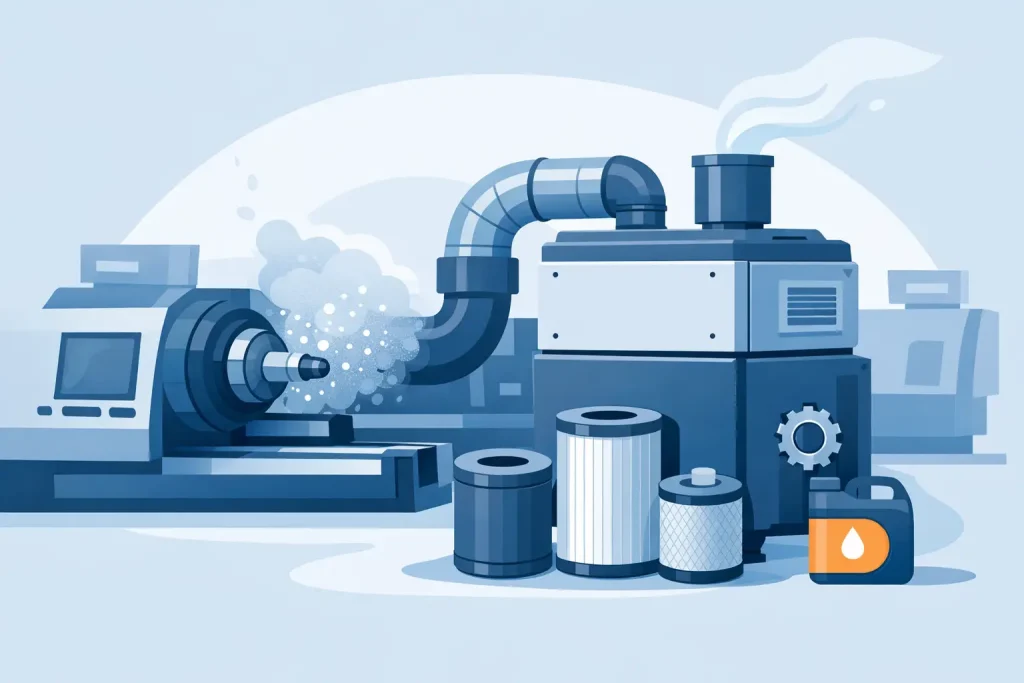
A machining line that looks clean can still be carrying a serious oil mist problem. Fine coolant aerosols often stay suspended long after visible smoke disappears, spreading across CNC enclosures, duct runs, electrical cabinets, and breathing zones. That is why selecting the best oil mist filters for machining is not just a housekeeping decision – it is a control measure that affects worker exposure, machine reliability, fire risk, and compliance performance.
In practice, there is no single “best” unit for every plant. The right answer depends on particle size distribution, coolant chemistry, enclosure design, airflow balance, machine duty cycle, and whether the objective is source capture, ambient cleanup, or both. For plant managers, EHS leaders, and project engineers, the more useful question is this: which filtration technology is best suited to your machining process and operating risk?
What makes oil mist difficult to control
Oil mist generated during machining is rarely uniform. A high-speed turning center using straight oil produces a different aerosol profile than a machining center running water-soluble coolant under high-pressure delivery. Some applications create larger droplets that coalesce easily. Others generate submicron particles that behave more like smoke and pass through basic media without meaningful separation.
Temperature also changes the problem. Warmer processes can shift the distribution toward finer aerosols, while turbulent enclosure leakage can push mist into operator areas even when nominal extraction is installed. This is why low-cost collector selection based only on CFM often leads to disappointing results. Air volume matters, but capture velocity, static pressure, filter staging, and contaminant character matter just as much.
Best oil mist filters for machining by filtration type
When buyers compare the best oil mist filters for machining, they are usually comparing technologies rather than brands. That is the right place to start, because the filtration mechanism determines performance, maintenance burden, and long-term operating stability.
Mechanical media filters
Mechanical media systems are common for general machining applications, especially where mist loads are moderate and droplet sizes are large enough for staged filtration to work efficiently. A typical configuration uses a pre-filter for larger droplets, a coalescing stage for fine mist, and a final filter for residual particulate.
These systems can perform well on enclosed CNC machines, grinding stations, and multi-machine manifolds if they are properly sized. Their strengths are familiar maintenance practices, predictable separation, and straightforward integration into central systems. The trade-off is pressure drop. As loading increases, airflow can fall unless the fan and controls are designed for the real operating range. Plants that only look at day-one airflow often miss this issue.
Centrifugal oil mist collectors
Centrifugal systems use rotational force to separate larger droplets from the airstream. They are often effective where coolant carryover is heavy and where users want to reduce frequent media replacement. For some machine tools using oil-rich aerosols, centrifugal separation offers a practical first stage with relatively low consumable cost.
The limitation is that very fine mist and smoke-like fractions may not be captured efficiently without downstream filtration. In other words, centrifugal units are often part of a solution, not always the full solution. They are best evaluated based on actual particle distribution, not brochure claims.
Electrostatic precipitators for oil mist
Electrostatic precipitators are among the strongest candidates for fine oil mist and smoke generated by high-speed machining, hard turning, and certain thermal metalworking operations. They charge airborne particles and collect them on oppositely charged plates, making them particularly useful for submicron fractions that challenge conventional media.
Where applied correctly, they can deliver high collection efficiency with relatively low pressure drop. That can support energy performance and stable airflow over time. However, they require disciplined cleaning and servicing. If washing intervals are neglected or if conductivity and contaminant characteristics are not properly considered, performance can deteriorate. For facilities focused on defensible clean-air performance, electrostatic systems should be specified together with maintenance access, washing procedures, and testing & commissioning criteria.
Hybrid systems
In many machining plants, the best answer is a hybrid design. A mechanical pre-separation stage may remove larger droplets, followed by high-efficiency media or electrostatic polishing for the fine fraction. Hybrid systems are especially relevant where production varies by shift, multiple machine types share a common header, or the plant must balance indoor air quality with external discharge expectations.
This approach is often more stable than trying to force one technology to handle every condition. It also allows engineered redundancy in environments where uptime matters as much as filtration efficiency.
How to judge the best oil mist filters for machining in real operations
The wrong buying criteria tend to show up quickly in machining environments. If the collector is undersized, mist escapes from door gaps and maintenance points. If the filtration stage is mismatched, filters blind early or the finest aerosol passes through. If the system is difficult to service, preventive maintenance slips and the plant starts treating performance decline as normal.
A better evaluation starts with the process itself. What machines are generating mist? Are they enclosed or semi-open? What coolant is used? Is this neat oil, semi-synthetic, or fully synthetic fluid? What is the average and peak duty cycle? Is there visible smoke at startup, under full load, or after tool wear increases? These details affect collector selection more than catalog rankings.
Airflow should also be validated at the enclosure, not just at the fan. Effective capture depends on hooding, duct velocity, machine leakage paths, and pressure balance across the whole system. A collector that looks sufficient on paper may still fail if the duct design allows condensate accumulation or if branch balancing is poor.
For regulated facilities, compliance should be part of the selection criteria from the beginning. That means considering inspection access, measurable performance parameters, and whether the supplier can support field auditing, stack sampling where required, and documented testing & commissioning. A system is easier to defend when it has been engineered as a compliance asset rather than purchased as a standalone box.
Selection factors that matter more than brand claims
Efficiency ratings matter, but they should never be read in isolation. A high nominal efficiency is less impressive if it drops under real loading, or if maintenance complexity causes operators to bypass the system. The best oil mist filters for machining are the ones that remain effective after months of actual plant use.
Drainage design is one example. Collected oil must return safely and consistently without re-entrainment. Poor drainage can saturate filters, increase carryover, and create housekeeping problems around the machine. Serviceability is another. If access panels are cramped or cleaning is messy, maintenance intervals tend to stretch.
Noise, electrical classification, fire risk, and floor layout also deserve attention. A compact collector mounted directly on a CNC machine may suit one cell, while a centralized ducted system is more appropriate for a high-volume machining department. Neither is universally better. The right choice depends on expansion plans, maintenance resources, and whether the plant wants isolated control or centralized oversight.
Monitoring should not be overlooked. Differential pressure, fan status, and performance alerts provide early warning before operators begin noticing visible mist. In larger facilities, adding online monitoring improves maintenance planning and gives EHS and operations teams stronger documentation for ongoing compliance management.
Common mistakes when specifying oil mist filtration
One common mistake is choosing by machine horsepower alone. Horsepower does not define aerosol behavior. Another is assuming all coolant mist can be handled by a simple media filter. Fine smoke generated under extreme cutting conditions may require electrostatic or multi-stage treatment.
A third mistake is separating filtration from the rest of the environmental control scope. Oil mist systems interact with room pressurization, makeup air, fire protection, and operator exposure controls. When those disciplines are treated independently, plants often solve one problem while creating another.
This is where an engineered, one-stop approach has practical value. Companies such as Master Jaya Group typically assess source conditions, design the control system, fabricate equipment, install, commission, and support after-sales servicing with performance visibility in mind. For industrial buyers, that reduces the risk of owning a collector that technically runs but does not deliver the clean-air outcome the facility actually needs.
When one filter is not enough
Many facilities ask for a single “best” solution because procurement prefers standardization. That is understandable, but machining emissions are rarely standardized across an entire plant. A grinding line, a precision turning cell, and a transfer line using different fluids may each require a different control strategy.
The better path is often standardization at the engineering level rather than at the product level. Use the same compliance framework, service model, monitoring philosophy, and commissioning protocol across the facility, while allowing filtration technology to match each process. That approach usually delivers better uptime and fewer corrective retrofits.
The right oil mist filter is not the one with the strongest marketing claim. It is the one that captures the actual aerosol generated by your process, holds performance over time, fits your maintenance reality, and gives your team confidence when air quality, worker exposure, and compliance are under scrutiny. Start with the process, verify with engineering, and expect the system to perform as part of your plant infrastructure – not as an accessory.