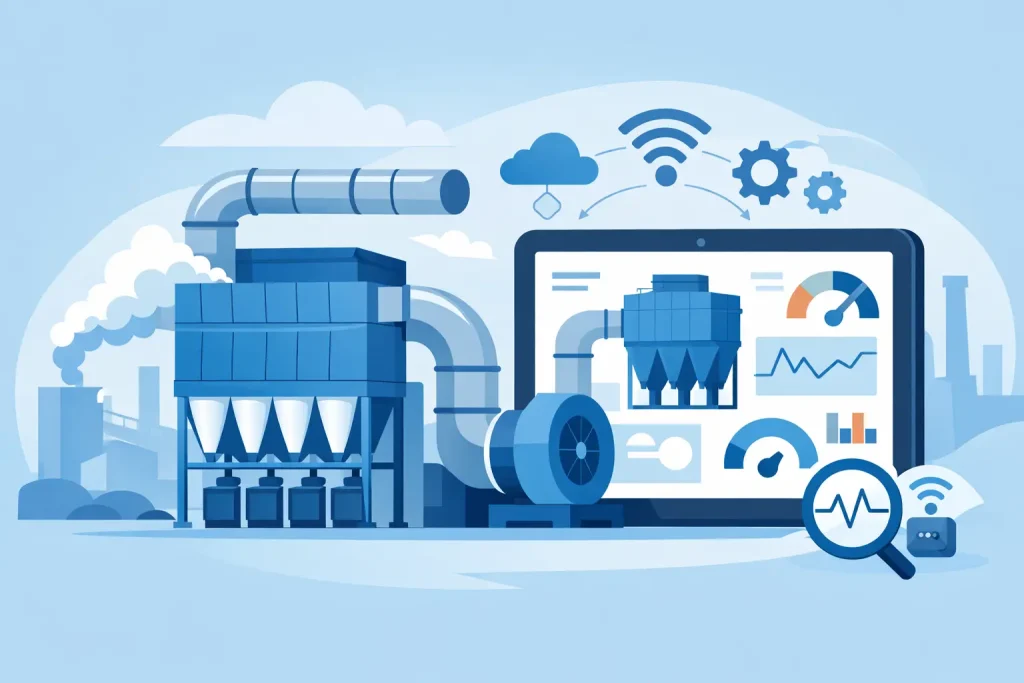
A dust collector rarely fails all at once. More often, the warning signs show up weeks earlier – rising differential pressure, weaker suction at pickup points, unstable compressed air use, or a fan that is working harder to move less air. Industrial dust collector IoT monitoring turns those signals into usable operating data, so plant teams can act before production, housekeeping, or compliance is affected.
For facilities managing combustible dust, nuisance dust, process fines, or particulate emissions, this is not a convenience feature. It is an operating control. When monitoring is set up correctly, it gives plant managers, EHS leaders, maintenance teams, and project engineers a clearer view of collector performance between inspections, servicing visits, testing and commissioning, and stack sampling activities.
What industrial dust collector IoT monitoring should actually measure
The value of IoT monitoring depends on what is being measured. A dashboard with attractive charts is not useful if it is not tied to actual collector behavior and compliance risk. For most pulse-jet and cartridge dust collectors, the priority signals are differential pressure across filters, fan current or power draw, hopper discharge status, compressed air pressure, cleaning pulse activity, and airflow-related indicators.
Differential pressure is usually the first place to look. If it trends upward steadily, filters may be loading prematurely, cleaning may be ineffective, or dust characteristics may have changed. If it drops suddenly, that can indicate filter damage, leakage, or instrumentation error. Neither condition should be evaluated in isolation. A pressure reading only becomes meaningful when it is viewed alongside fan behavior, process loading, and maintenance history.
Airflow is equally critical, although it is often inferred rather than directly measured. Poor capture at hood level can still occur even when the collector is technically running. That is why some plants pair collector monitoring with suction checks at key extraction points, especially where DOSH-LEV performance obligations or internal worker exposure controls are involved.
Compressed air data also matters more than many teams expect. In pulse-jet systems, unstable pulse pressure can lead to poor filter cleaning, accelerated media loading, and unnecessary filter replacement. An IoT layer that records pulse frequency and header pressure can help maintenance teams separate a true filter problem from a valve, solenoid, or compressor-side issue.
Why a connected collector improves compliance control
A dust collection system sits at the intersection of environmental performance and plant reliability. If it underperforms, the problem does not remain inside the equipment. Dust escapes into work areas, capture velocity falls below what the process needs, and emission performance can drift away from target conditions.
That is why industrial dust collector IoT monitoring is especially useful in regulated plants. It creates a time-stamped operating record that supports a more defensible maintenance and compliance position. When a facility is reviewed internally or by external parties, it is far better to show trends, alarm records, service actions, and operating responses than to rely on verbal statements that the system was “working normally.”
This does not replace formal compliance activities such as field auditing, stack sampling, or testing and commissioning. It strengthens them. Monitoring helps teams understand whether a collector was operating consistently before the test, whether cleaning cycles were stable during the reporting period, and whether any decline in suction performance was addressed promptly.
For plants operating under Malaysia’s Clean Air Regulations 2014 or managing LEV-related obligations, that operating visibility can be highly practical. It supports faster internal escalation, clearer servicing decisions, and better preparation for technical review.
The operational case is often stronger than the technology case
Many plants first approach IoT monitoring as a digital upgrade. In practice, the stronger justification is usually operational. Unplanned collector downtime can interrupt production lines, create housekeeping burdens, increase fire and explosion risk in dust-sensitive environments, and force maintenance teams into reactive work.
A connected system helps plant teams move from calendar-based assumptions to condition-based decisions. Filters are not changed simply because a date has arrived. Pulse valves are not ignored until operators complain about weak extraction. Fan issues are not discovered only after dust escapes at the pickup point.
There is, however, a trade-off. More data does not automatically create better decisions. If alarm thresholds are poorly set, teams get nuisance alerts and start ignoring them. If instrumentation is not calibrated or protected for the actual industrial environment, the data becomes questionable. A good monitoring program is therefore less about adding sensors everywhere and more about selecting the few parameters that directly indicate collector health.
Where industrial dust collector IoT monitoring delivers the most value
The highest returns usually appear in plants where dust loading is variable, where uptime matters, or where compliance documentation must be defensible. Metalworking and casting operations are a good example because process conditions can shift with material, throughput, and extraction demand. Food and animal feed plants also benefit because dust migration affects both hygiene and housekeeping, not only emissions.
Facilities with thermal processes often see another benefit. When dust collection performance changes, it can influence adjacent ventilation balance and process stability. In these cases, IoT monitoring is not just protecting one asset. It helps protect the broader air pollution control and plant ventilation strategy.
Multi-site operators can gain additional value if they standardize the same monitoring logic across similar collectors. That makes it easier to compare differential pressure behavior, servicing frequency, and alarm events between plants. Still, standardization should not become rigid. A collector handling fine, adhesive dust should not be judged by the same thresholds as one handling coarse particulate with lower loading.
What good implementation looks like on the plant floor
Successful implementation starts with a baseline. Before enabling alarms and trend analysis, the collector should be operating correctly. Filters, pulse valves, dampers, fan rotation, hopper discharge, and instrumentation points should all be verified. If the system is already unstable, the IoT layer will only document confusion more efficiently.
From there, the monitoring design should match the system type and plant objective. A pulse-jet bag filter serving a high-load process may need close attention on differential pressure bands, pulse effectiveness, and fan load trends. A cartridge collector in a cleaner application may focus more on airflow consistency and filter life. The right setup depends on dust properties, production pattern, and risk profile.
Alarm philosophy also needs discipline. There should be clear distinctions between advisory alerts, maintenance alerts, and shutdown-critical conditions. If every deviation generates the same level of notification, operations teams lose confidence quickly. Escalation paths should be defined in the same practical language used for servicing and after-sales support: inspect, verify, replace, clean, isolate, or schedule shutdown.
This is where a one-stop solution provider has a real advantage. When the same engineering partner supports design, fabrication, installation, commissioning, servicing, spare parts, auditing, and online monitoring, the data can be interpreted in the context of the actual equipment supplied. That shortens troubleshooting time and reduces the common problem of software teams and field teams diagnosing the same issue from different assumptions.
Common mistakes plants make
One common mistake is treating IoT monitoring as a substitute for maintenance. It is not. Sensors can show that differential pressure is rising, but they do not replace inspection of filter condition, pulse diaphragm wear, hopper bridging, or duct leakage. Monitoring should guide maintenance, not excuse its delay.
Another mistake is monitoring the collector but ignoring the process side. If pickup hoods are poorly positioned, branch ducts are blocked, or operators leave access points open, collector data may look acceptable while actual capture is poor. Dust control performance must still be checked where exposure and escape occur.
A third mistake is separating monitoring from compliance documentation. Trend data should feed into service reports, internal EHS reviews, and planning for stack sampling or regulatory submissions where required. If the information stays trapped in a dashboard, much of its value is lost.
A practical path forward
For most facilities, the best first step is not a full digital overhaul. It is a focused review of which collectors are operationally critical, which ones support regulated emission control, and which parameters would provide early warning of failure. Start there, establish normal performance bands, and build alarm logic that reflects actual plant response times.
At Master Jaya Group, this approach aligns with how industrial air pollution control should be managed – as a full lifecycle responsibility that includes engineering design, testing and commissioning, servicing, field auditing, stack sampling, spare parts support, and online performance monitoring through https://www.masterjaya.com.my.
The real benefit of industrial dust collector IoT monitoring is not that it makes equipment look more advanced. It gives responsible plant teams earlier visibility, better records, and more time to correct a small performance drift before it becomes a production issue or a compliance problem.