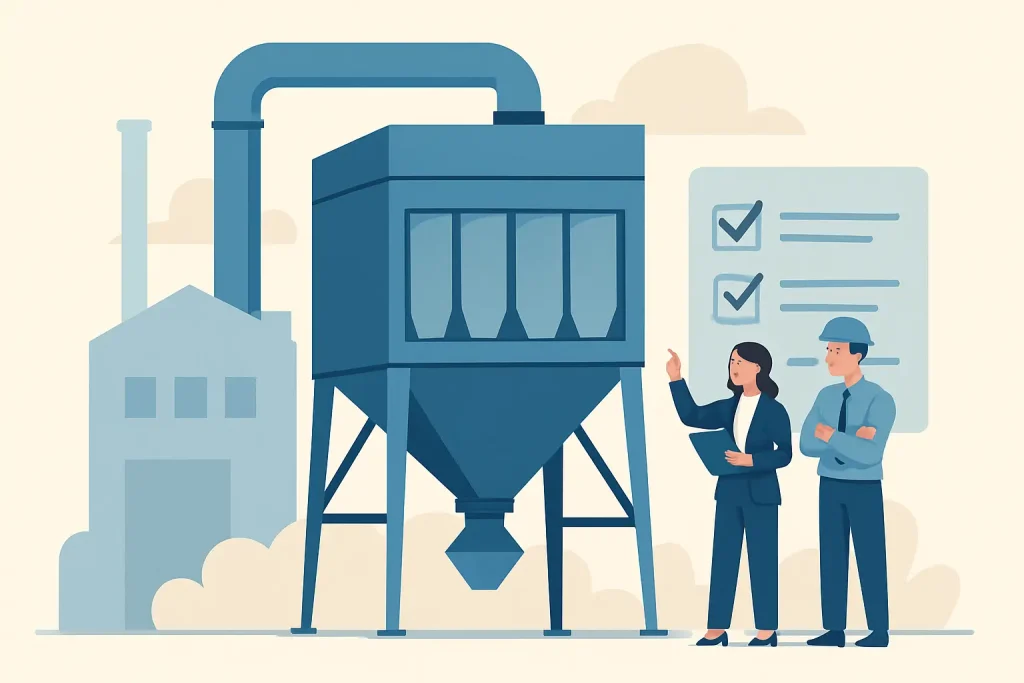
The fastest way to lose confidence in your emissions program is a dust collector that looks fine on paper but fails the moment production ramps up – high differential pressure, dust carryover, housekeeping complaints, and a stack test that turns into a corrective action plan. Good industrial dust collector system design prevents that spiral by treating collection as an engineered system, not a single piece of equipment.
This is a practical guide written for plant managers, EHS leaders, maintenance teams, and project engineers who need reliable capture, defendable compliance documentation, and predictable operating costs. The core theme is simple: design around the dust, the process, and the proof you will be asked to show.
Start with what regulators and auditors actually measure
Dust collection decisions often get framed as “baghouse vs cartridge” or “how many CFM.” In the field, the pass-fail questions are more concrete. Can you demonstrate adequate capture at the source (industrial hygiene and LEV expectations)? Can you demonstrate stack performance within permit limits (mass concentration like mg/m3, opacity, or permit conditions)? And can you show the system is maintained and operating as designed (records, alarms, and verification)?
Even in jurisdictions where the specific rules differ, the engineering approach holds: define performance requirements, design to meet them at worst case, then build a verification plan that survives scrutiny.
Define the dust and the duty cycle before you size anything
Every design parameter depends on what is in the airstream. Dust is not “dust.” It is particle size distribution, bulk density, abrasiveness, moisture behavior, explosibility, and chemical compatibility.
Particle size drives filter media choice and expected emission performance. Very fine dust may need higher-efficiency media and tighter attention to re-entrainment. Sticky or hygroscopic dust changes the cleaning strategy and hopper design. Abrasive dust pushes you toward heavier wear protection in ducts and inlets. Corrosive dust or acid mist pushes stainless or coated construction and careful media selection.
Duty cycle matters just as much. A system that runs intermittently for a batch dump can often tolerate different air-to-cloth ratios and cleaning setpoints than a continuous grinder line. If you only design for average loading, peak events will define your maintenance burden.
If you have multiple sources, avoid assuming they are identical. A laser table, a bag dump, and a shot blast machine can share a header, but they rarely share the same particulate behavior or capture velocity needs.
Airflow is not a guess – it is capture engineering
A collector cannot fix poor pickup. The first sizing step is establishing the airflow required at each hood, enclosure, or pickup point to capture dust without pulling product, sparks, or excessive ambient air.
Enclosures and partial enclosures are your best friend because they reduce required airflow and make performance more stable across operator behavior and cross drafts. When you must use open hoods, you are designing against plant reality: doors opening, forklifts moving, fans and make-up air patterns, and seasonal temperature differences.
Once source flows are defined, add diversity only when it is defensible. If the process can run simultaneously, design for simultaneous operation. This is where many systems get underbuilt.
Ductwork design decides whether your collector stays clean
Industrial dust collector system design fails quietly in ducting long before the collector is “too small.” The duct system has to maintain conveying velocity to prevent settling, but not so high that elbows and transitions become erosion points.
Long horizontal runs, oversized ducts, and poorly placed branches create low-velocity zones where dust accumulates. That increases static pressure, destabilizes balancing, and can turn into a fire risk depending on the material.
Aim for smooth flow paths, controlled branch entries, and accessible cleanout where settling is possible. Use long-radius elbows and consider wear liners or heavier gauge in high-erosion locations. Then balance the network with proper dampers and a commissioning plan – not by closing random blast gates until the complaints stop.
Fan selection should be driven by total system pressure, not nameplate CFM
Fans get selected by the intersection of airflow and total static pressure at design conditions. Total pressure includes hood losses, duct friction, fittings, dirty filter pressure drop, and stack discharge losses.
Two “identical” collectors can behave very differently depending on duct layout and filter loading assumptions. If you select a fan using clean-filter pressure drop, you will lose airflow as the filters load, and capture performance will degrade exactly when dust loading is highest.
Variable frequency drives can help maintain target airflow, but they are not a substitute for correct sizing. A VFD can only speed up within motor and fan limits, and higher speed raises noise and energy cost. A stable design typically sets a realistic dirty-filter DP and still meets capture targets.
Collector type and filter media: choose for dust behavior and verification needs
Pulse-jet baghouses and cartridge collectors both have a place. The right choice depends on loading, particle characteristics, required outlet concentration, and maintenance strategy.
Baghouses tolerate heavier dust loading and higher temperatures, and they offer broad media options. Cartridge collectors can provide high filtration efficiency in a compact footprint, often with easier element handling. However, sticky dust, fibrous dust, or heavy loading can blind cartridges quickly if pre-separation or process controls are not addressed.
Media choice is where compliance and operating cost intersect. Standard polyester may work for general dust, but fine or hazardous particulates may drive you toward treated media, membrane laminates, or higher-temperature fibers. If moisture is present, media that resists blinding and a hopper/heater strategy may be necessary.
Do not ignore pre-cleaning options when the dust load is high. Cyclones or multi-cyclones upstream can reduce loading to the main collector, extending filter life and stabilizing differential pressure. The trade-off is added pressure drop and space, but the lifecycle cost can be better, especially where dust is abrasive.
Hopper, discharge, and conveying: where “good filtration” goes to fail
Many dust collectors meet emission targets but fail operationally because dust handling was treated as an accessory. If dust cannot discharge consistently, it will re-entrain, cake filters, and show up as erratic DP and visible emissions during cleaning pulses.
Design the hopper for the dust’s flow characteristics. Steeper hopper angles, proper sealing, and an airlock or rotary valve sized for the dust volume matter. If the dust is light and fluffy, expect bridging. If it is sticky, expect buildup. If it is hot, manage condensation.
If you are conveying to a silo or bin, coordinate the collector discharge rate, conveying velocity, and receiver venting. A dust collector that is perfect in isolation can become unstable when tied into an undersized conveying line.
Controls, instrumentation, and alarms are part of compliance
A collector is easier to defend when its performance is visible. Differential pressure monitoring across the filters is the baseline. Set alarm thresholds that signal filter blinding, broken bags, or cleaning system failure early enough to act before emissions increase.
Pulse-jet cleaning should be set up to match dust loading. On-demand cleaning based on DP typically reduces compressed air use compared to constant timer-only pulsing, but it depends on how variable your process is. Compressed air quality also matters – wet air and oil carryover shorten valve and diaphragm life and can foul media.
For plants that need audit-ready evidence, trending is more useful than single readings. When you can show DP, fan speed, and operating hours over time, troubleshooting becomes engineering instead of guesswork.
Commissioning and testing: design with proof in mind
If you wait until a stack test to discover maldistribution, leaks, or inadequate airflow at the hood, the project is already late. Build commissioning into the design scope: duct traverse points, balancing dampers that are accessible, and clear acceptance criteria.
A practical commissioning sequence includes mechanical inspection, leak checks, airflow verification at key pickups, balancing, and then performance verification under representative production conditions. Where emission limits apply, plan stack sampling with adequate straight runs and safe access.
This is also where documentation matters. Operating parameters, filter media specifications, fan curves, and maintenance intervals should be compiled into a turnover package that can be handed to EHS and maintenance without interpretation.
Safety and special cases: combustible dust, hot work, and mixed contaminants
Industrial dust collection often intersects with fire and explosion risk. If the dust is combustible, you may need isolation, venting, suppression, and careful attention to ignition sources like grinding sparks. This is not an area for “standard” assumptions.
Hot processes can require spark arrestors, refractory sections, or temperature-rated media. Mixed contaminants matter too. If you have dust plus VOCs or acid gases, a dust collector alone may not address the permit requirement, and you may be looking at a combined train such as a cyclone plus baghouse, or dust collection plus activated carbon, or wet scrubbing depending on the pollutant.
Trade-offs are real: wet collectors can reduce fire risk in some cases but introduce wastewater handling and corrosion concerns. Dry systems avoid wastewater but may require stronger ignition control and explosion protection.
What a one-stop delivery model changes in real projects
Dust collection performance is rarely limited to a single discipline. It is hood design, duct fabrication quality, fan selection, controls integration, and field commissioning – then ongoing service, spares, and periodic verification. That is why many plants prefer a partner that can take responsibility from design through testing and long-term performance monitoring.
For facilities that operate under strict compliance expectations and want engineered systems plus auditing, testing, commissioning, and ongoing visibility, Master Jaya Group provides end-to-end clean-air delivery, including engineered dust collectors and an IoT performance monitoring layer through https://www.masterjaya.com.my.
The practical benefit is continuity: the same engineering assumptions used to size the system can be checked against field data and corrected early, before the next audit forces a rushed upgrade.
A closing thought to keep designs honest
If you want an industrial dust collector system design that holds up under real production, write down your worst-case assumptions in plain language – highest dust loading, maximum simultaneous sources, dirtiest filter DP, and the acceptance test you will use to prove it. When those assumptions are explicit, the design becomes defendable, commissioning becomes faster, and compliance stops feeling like a gamble.