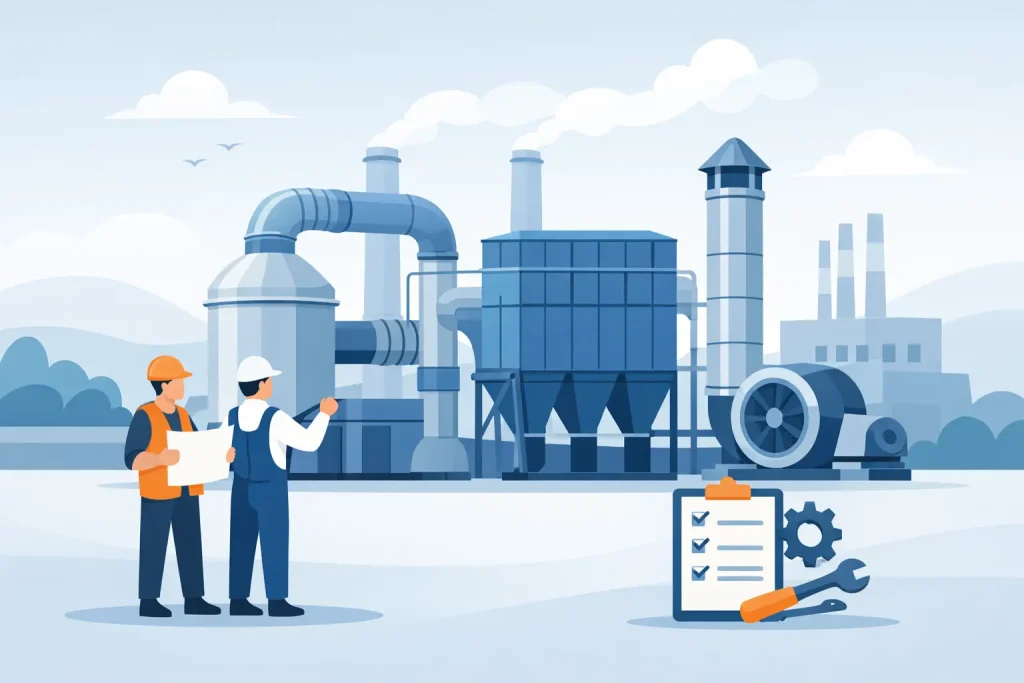
When an emissions-control project slips, the root cause is rarely the collector, scrubber, or fan alone. More often, it is the handoff between design, fabrication, civil work, ducting, electrical integration, controls, testing, and compliance documentation. For plant teams managing production targets and regulatory exposure at the same time, that gap is where cost, delay, and risk usually grow.
A turnkey air pollution control installation is intended to remove that gap. Instead of buying equipment from one party, hiring another for installation, and relying on internal teams to coordinate commissioning and compliance, the plant appoints one accountable partner to take ownership from engineering through startup and after-sales support.
What turnkey air pollution control installation really means
In industrial practice, turnkey does not simply mean equipment supply with a startup visit. It means the system is engineered around the actual process, manufactured to the required duty, installed with the right utilities and duct arrangement, tested under operating conditions, and handed over with the documentation needed for operation and regulatory review.
That scope usually begins with site assessment. Dust loading, gas temperature, moisture, particle size, corrosive content, VOC concentration, airflow balance, and process variability all affect the right technology choice. A pulse-jet dust collector may be appropriate for dry particulate from handling or grinding operations. A packed tower scrubber may be required for acid gas or soluble contaminants. Cyclones and multi-cyclones can serve as pre-cleaners where loading is high. Electrostatic precipitators fit some fine particulate duties, while regenerative thermal oxidizers, activated carbon filters, and air strippers address different organic or odor control needs.
The point is not to force a catalog item into the plant. The point is to match technology selection, sizing, and system layout to the actual emissions profile and operating duty.
Why industrial plants choose a single accountable partner
For plant managers and EHS leaders, the value of turnkey delivery is accountability. If capture velocity is weak, if pressure drop is outside design, if the stack result does not support the intended compliance outcome, there is no practical benefit in hearing that the issue belongs to a different contractor.
A one-stop project model reduces that fragmentation. Mechanical, electrical, instrumentation, controls, steel fabrication, duct routing, support structures, and testing & commissioning are managed as one integrated scope. That matters because air pollution control systems do not fail only at the equipment level. They fail at interfaces.
A dust collector with correct filter media can still underperform if hood design is poor. A scrubber can miss expected removal efficiency if recirculation chemistry, pump duty, or mist elimination is not controlled properly. An activated carbon system can lose service life quickly if upstream moisture or particulate is not addressed. Turnkey execution allows these dependencies to be handled early, not discovered after startup.
The engineering work behind a successful installation
The most valuable part of a turnkey air pollution control installation often happens before fabrication starts. Front-end engineering defines whether the system will be stable in real operation, not just acceptable on a drawing.
This stage typically covers process review, field auditing, airflow calculations, hood and duct design, fan selection, equipment sizing, utility requirements, structural considerations, controls philosophy, and maintenance access planning. In facilities where compliance obligations are strict, engineering should also align with stack sampling requirements, occupational exposure controls, and local clean air regulations.
That compliance alignment is where many projects either gain strength or create future problems. If the design basis does not reflect permit conditions, likely operating ranges, and testing requirements, the final installation may look complete while still leaving the owner exposed. A compliance-led contractor will treat auditing, sampling strategy, and documentation as part of engineering, not as an afterthought.
Fabrication, installation, and site coordination
Once the design is fixed, execution quality becomes the next risk point. In-house steel fabrication can improve schedule control and fit-up accuracy, especially for support structures, skids, ductwork, hoppers, access platforms, and equipment casings. It also shortens the feedback loop if site conditions require modification.
Installation itself has to be planned around plant realities. Shutdown windows may be limited. Existing process lines may restrict crane access. Tie-ins for fans, pumps, dampers, or controls may need night work or phased cutovers. In brownfield plants, the best technical design on paper can still fail if site coordination is weak.
This is why installation management matters as much as equipment quality. A proper turnkey scope includes method statements, safety planning, sequencing, utility coordination, and close control of subcontract interfaces. It should also include practical details that operations teams notice immediately after handover, such as access for filter change-out, hopper discharge arrangement, washdown points, instrumentation readability, and spare parts readiness.
Testing, commissioning, and proving performance
A system is not complete when it is mechanically erected. It is complete when it has been tested and commissioned against its intended duty.
Testing & commissioning should verify airflow, static pressure, motor rotation, vibration, interlocks, pressure drop, capture performance, control logic, alarm function, and process integration. Wet systems require additional checks on recirculation, pH control, nozzle performance, liquid distribution, and carryover prevention. Thermal oxidizer systems require careful confirmation of temperature control, residence time, burner operation, and safety permissives.
Then comes the part procurement teams sometimes underestimate: proving that the installation supports compliance. Stack sampling, field auditing, and operating data review help establish whether the system is performing under realistic production conditions, not just ideal startup conditions. If optimization is needed, this is the right point to adjust dampers, fan speeds, pulse-cleaning parameters, scrubber chemistry, or control settings.
A serious turnkey partner will stay engaged through that optimization stage. Handing over a running fan is easy. Handing over a defensible result is harder, and more valuable.
Compliance is not separate from operations
Many plants still treat emissions control as a side utility. In practice, it is part of production reliability. If extraction is unstable, dust accumulates. If VOC control drifts, odors and emissions complaints rise. If local exhaust ventilation underperforms, worker exposure and process housekeeping both deteriorate.
That is why a turnkey air pollution control installation should be built around both compliance and uptime. The system must support required environmental performance while remaining maintainable in daily operation. High theoretical efficiency means little if media blinds early, nozzles plug repeatedly, or instrumentation is too limited to identify drift.
For facilities operating under frameworks such as Malaysia’s Clean Air Regulations 2014 and DOSH-LEV requirements, this balance is especially important. Plant teams need more than hardware. They need records, testing, competent operating practices, and the ability to show that the system is being managed correctly over time.
This is where ongoing monitoring and training add real value. IoT-based performance monitoring can track pressure, flow, differential pressure, fan status, and operating trends before failures become compliance events. Competency development, including CePSO and CePBFO training where relevant, helps internal teams operate the system with better discipline and awareness.
When turnkey is the better choice, and when it may not be
Turnkey is usually the right model when the project is compliance-critical, technically specialized, or operationally difficult to coordinate across multiple vendors. It is particularly effective for new process lines, plant expansions, retrofit work in constrained spaces, and upgrades where existing emissions systems are clearly underperforming.
It may be less necessary for very simple replacement scopes where the plant already has strong in-house engineering, established installation resources, and a clear design basis. Even then, the trade-off is responsibility. Lower initial contract scope can mean higher internal coordination burden, and that burden often surfaces later during startup or compliance review.
For most regulated industrial sites, the practical question is not whether equipment can be bought separately. It is whether the plant wants to own the integration risk.
What to ask before awarding the project
Before appointing a contractor, buyers should look past nominal airflow and equipment price. The better questions are about design basis, regulatory familiarity, testing scope, fabrication control, site supervision, commissioning ownership, and after-sales capability. If the provider cannot explain how stack sampling, auditing, control logic, spare parts, and service response fit into the project, the installation is not truly turnkey.
This is also the point to assess long-term support. Air pollution control systems are not static assets. Filter media ages, dampers drift, fans wear, scrubber internals foul, and process conditions change. The best project partner is the one that can continue with servicing, upgrades, replacement parts, monitoring, and compliance support after handover.
At Master Jaya Group, that lifecycle approach is central to how industrial clean-air systems are delivered. The same discipline that shapes design and commissioning should still be available when the plant needs field auditing, stack sampling, service intervention, or system upgrading years later.
A well-executed turnkey project does more than install equipment. It gives the plant a cleaner operating margin – technically, operationally, and from a compliance standpoint – and that is what decision-makers should be buying.