Boiler operators usually notice the problem the same way: a plume that looks “normal” until the wind changes, ash that coats the stack base, and a compliance file that is suddenly harder to defend. If you are firing solid fuels or handling high ash loading, a multicyclone is often the first piece of equipment that brings order back to your particulate control – not because it is the most efficient device available, but because it is predictable, rugged, and forgiving when combustion quality varies.
What a multicyclone dust collector for boiler service actually does
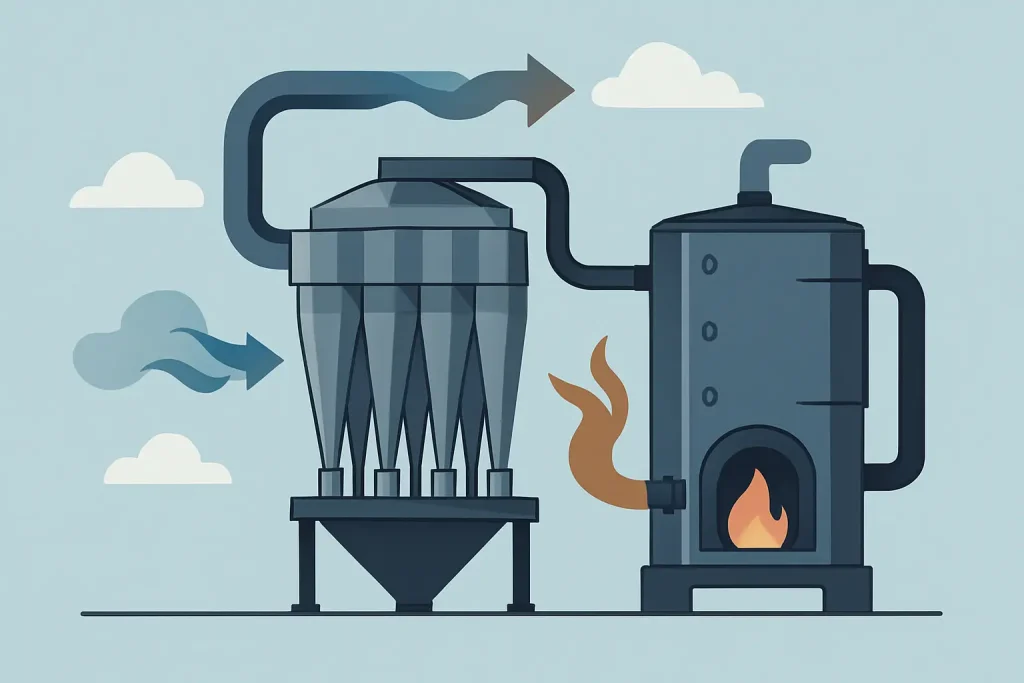
A multicyclone dust collector for boiler applications is a bank of small cyclones arranged in parallel inside a common housing. Each small cyclone creates a strong centrifugal field that drives heavier particles to the wall, where they lose momentum and drop into a hopper. The cleaned flue gas then exits through the vortex finder.
The key difference versus a single large cyclone is stability. Boiler flue gas flow rates move with load changes, sootblowing events, fuel moisture shifts, and draft fan behavior. Multiple small cyclones spread the duty across many tubes, so collection performance is less sensitive to turbulence and short-term transients.
This is why multicyclones are widely used as a front-end particulate control stage for boilers: they remove a meaningful fraction of fly ash and grit before the gas reaches downstream equipment, and they do it with low complexity.
Where multicyclones fit – and where they do not
Multicyclones are best at removing coarse to medium particulate, typically the fraction that causes visible emissions, erosive wear, and ash handling issues. If your goal is to control very fine particulate (PM2.5 range) to tight limits on its own, a multicyclone alone may not be sufficient. That is not a weakness of the brand or the fabrication – it is a physics constraint.
In practical plant terms, a multicyclone makes the most sense when:
You have high dust loading and want a durable primary separator.
You need a low-maintenance option with minimal instrumentation.
Your downstream device (pulse-jet baghouse, wet scrubber, or electrostatic precipitator) benefits from reduced inlet loading, reduced spark risk, or lower abrasion.
The trade-off is efficiency on ultrafine particles. Many facilities use a multicyclone as the first stage and then add a fabric filter or ESP to reach stringent stack targets. That combination is often easier to operate than forcing a single device to do everything.
Why boiler applications are a special case
Boiler flue gas is not a steady lab stream. It carries ash with variable size distribution and density, and it arrives at temperatures that can stress seals, expansion joints, and discharge valves. Boilers also create operational events that can temporarily spike dust loading – startup, shutdown, fuel feed interruptions, and sootblowing.
A multicyclone tolerates these “real plant” behaviors because there is no filter media to blind and no electrodes to trip. As long as the hopper discharge is reliable and the tubes stay intact, the device keeps separating.
That said, boilers are also unforgiving to poor layout. If the multicyclone is installed with uneven inlet distribution, excessive air leakage, or inadequate ash discharge capacity, performance drops quickly and operators start chasing symptoms at the ID fan or stack.
The engineering variables that decide performance
A multicyclone’s collection efficiency is primarily driven by particle size, inlet velocity, cyclone diameter, and pressure drop. Those are controlled by design choices you can specify and verify.
Gas flow and load turndown
Designing for one operating point is a common procurement mistake. Boilers rarely run at a single stable load. If you operate at 50-100% load throughout the week, the multicyclone must maintain acceptable separation across that range.
Too low a velocity at turndown reduces centrifugal force and allows more carryover. Too high a velocity at full load increases pressure drop and can cause re-entrainment in the hopper if discharge is weak. Good design is a balance: stable velocity distribution and a hopper arrangement that prevents ash from being pulled back into the gas stream.
Temperature and condensation control
Flue gas temperature affects density and therefore velocity, and it also determines whether you risk condensation. If acidic or moisture-driven condensation occurs in the multicyclone, ash can cake and bridge in the hopper, creating chronic discharge failure.
This is not only a maintenance issue. A plugged hopper increases carryover and can lead to stack opacity problems. In severe cases it drives forced shutdowns because draft conditions change.
Erosion and tube integrity
Boiler ash can be highly abrasive. Multicyclone tubes and inlet scrolls must be designed with wear in mind – proper material selection, replaceable wear plates where needed, and access for inspection.
If erosion creates pinholes or tube deformation, gas bypass occurs. Bypass looks like “mystery” performance loss because the unit still has the same pressure drop, but separation collapses due to short-circuiting.
Hopper discharge and airlock selection
A multicyclone is only as good as its ash discharge. If the discharge valve leaks air, the unit can draw secondary air into the hopper, stirring dust and carrying it back up. If the discharge mechanism cannot keep up with ash rate, the hopper fills and re-entrainment increases.
For boilers, rotary airlocks, double dump valves, and screw conveyors are common, but selection depends on ash characteristics (temperature, particle sharpness, and whether it tends to sinter). It also depends on whether you are returning ash, sending to a bin, or integrating with an existing ash handling system.
Meeting emission targets: “it depends” in a controlled way
A frequent question from EHS leaders is whether a multicyclone can meet a specific mg/Nm3 or opacity limit by itself. The honest answer is: it depends on fuel, ash PSD, boiler design, and limit stringency.
If you are firing a relatively clean fuel with coarser ash and your compliance limit is moderate, a well-designed multicyclone may be adequate. If you are facing tighter particulate requirements or your ash is fine and light, a multicyclone is more appropriately treated as a pre-cleaner, followed by a pulse-jet dust collector or ESP.
What should not be negotiable is verification. Regardless of the selected configuration, a defensible compliance position requires proper testing and commissioning, and stack sampling that ties actual results to operating conditions. Without that, you are relying on assumptions that do not hold up during audits or investigations.
Common failure modes seen in boiler installations
Most underperforming multicyclones fail for practical reasons rather than theoretical ones.
Uneven inlet distribution is a major culprit. If gas flow favors one side of the tube bank, some tubes are overloaded while others are underutilized. The “average” pressure drop can look acceptable while overall collection is worse than expected.
Another issue is poor access and inspection planning. Multicyclones live in hot, dusty zones. If you cannot safely inspect the tube bank, hopper, and discharge valves, erosion and plugging progress until there is an outage.
Finally, operators often underestimate the impact of upstream combustion and draft control. If the boiler runs with unstable excess air, carryover can increase and the particle size distribution can shift finer, which is harder for cyclonic separation. Emission control starts at combustion stability.
Selecting a multicyclone as part of a compliance-first system
Procurement should treat the multicyclone as one element of an emission control chain: boiler, ducting, multicyclone, fans, downstream control (if required), and the measurement plan.
If your driver is regulatory compliance, specify performance in a way that can be tested. Define the operating window, fuel conditions, and expected dust loading. Specify pressure drop limits that align with fan capacity and allow margin for fouling. Confirm that expansion joints, access doors, and insulation are part of the scope, not “nice to have” items that get value-engineered away.
If you need ongoing visibility, plan instrumentation and monitoring early. Even basic differential pressure trending, hopper level indication, and discharge motor status can prevent the slow drift into non-compliance that happens between annual tests.
For facilities that want an end-to-end approach that includes engineered design, in-house fabrication, testing and commissioning, stack sampling support, and performance monitoring aligned to regulated expectations, Master Jaya Group positions these projects as lifecycle systems rather than stand-alone equipment deliveries.
Practical questions to ask before you approve the design
Before you sign off on a multicyclone package for a boiler, insist on answers that connect equipment sizing to real operating behavior.
Ask what the collection efficiency assumption is based on: your fuel data and expected particle size distribution, or a generic rule-of-thumb. Ask how inlet distribution is handled inside the casing. Ask what wear protection is included and what is considered a consumable item.
Also ask how ash is discharged under hot conditions and what happens during short-term upsets like sootblowing. A multicyclone that works only at “perfect steady state” is not a boiler solution.
The best projects treat the multicyclone as a reliability device as much as an environmental device: it protects downstream equipment, stabilizes emissions, and reduces the number of variables that can trigger opacity events.
A useful way to frame the decision is simple: choose a multicyclone when you want rugged, predictable pre-separation and you can articulate what will handle the fine fraction. Choose a different primary technology when your limit is tight enough that a pre-cleaner alone cannot get you there.
The closing thought that tends to save the most time is this: do not wait for a failed stack test to “discover” your ash behavior. Characterize it early, size the multicyclone for your real operating window, and treat discharge reliability as part of emissions control, not just housekeeping.