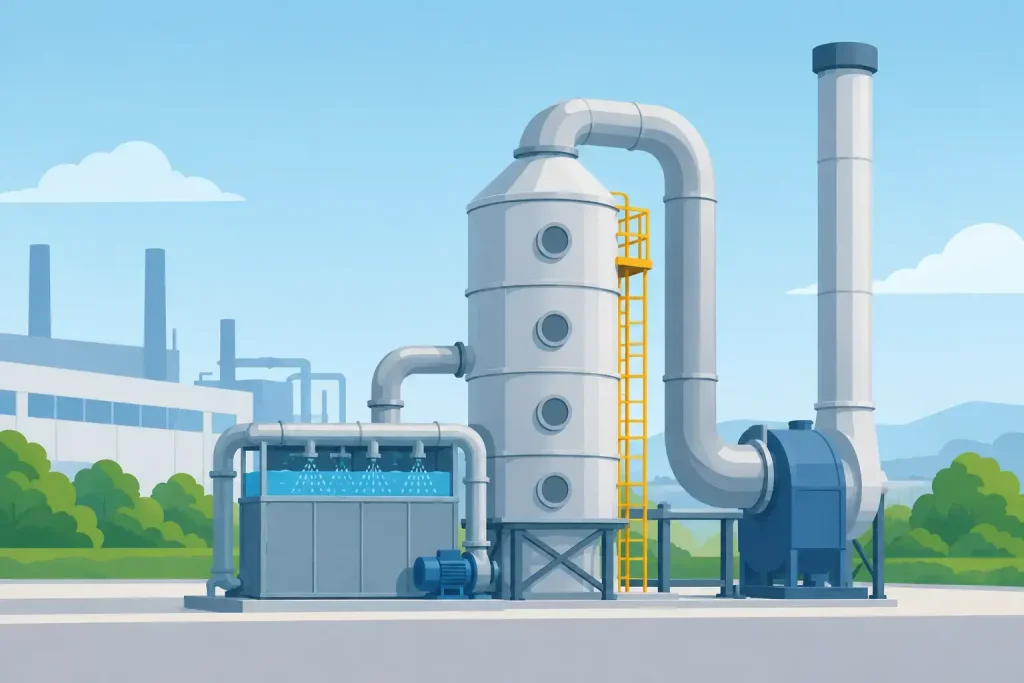
A scrubber that performs well on a supplier data sheet can still fail at the stack if the gas stream, liquid chemistry, ductwork, and operating discipline were not assessed together. Industrial scrubbers are not simply vessels that spray water into an exhaust line. They are engineered air pollution control systems that must capture the contaminant, create sufficient gas-liquid contact, prevent carryover, and produce defensible compliance results under actual production conditions.
For plant managers, EHS leaders, and maintenance teams, the real decision is not whether to install a scrubber. It is whether the selected system will continue meeting emission obligations while production rates, raw materials, temperatures, and operating schedules change. That requires a design-and-lifecycle approach that begins with process data and continues through testing, commissioning, stack sampling, servicing, and performance monitoring.
What Industrial Scrubbers Are Designed to Control
Wet scrubbers remove pollutants by bringing contaminated gas into contact with a liquid, usually water or a chemically treated recirculating solution. Depending on the scrubber configuration and chemistry, the liquid can absorb soluble gases, neutralize acidic or alkaline compounds, capture particulate matter, or suppress odors and process fumes.
The technology is especially relevant where a dry collector alone is not suitable. Metal finishing, chemical processing, fertilizer handling, thermal processes, food and feed operations, and facilities with corrosive or sticky emissions often require wet treatment. A packed tower scrubber, for example, is commonly selected for acid gas, ammonia, odor, and other gas-phase contaminants that need absorption or chemical reaction. Venturi scrubbers are more appropriate when fine particulate capture is the principal duty and a higher pressure drop is acceptable.
The contaminant determines the treatment method. Hydrogen chloride requires a different liquid chemistry from sulfur dioxide, ammonia, oil mist, or combustible dust. Particle size also matters. Large, wet particles may be removed effectively with a simpler wet collector, while submicron particles demand higher energy contact or a different technology altogether.
A scrubber should therefore be specified from measured conditions, not from the nameplate capacity of a fan or a generic airflow estimate. Field auditing and stack sampling establish the basis for an engineered decision.
The Design Conditions That Determine Performance
A reliable system begins with a clear process and emission profile. Airflow is necessary, but it is only one part of the design basis. Engineers must understand gas temperature, humidity, pressure, contaminant concentration, particle characteristics, chemical solubility, corrosion potential, and expected production variability.
Gas flow and contact time
Gas velocity must be high enough to distribute flow properly through the scrubber, but not so high that droplets or packing are carried downstream. In a packed tower, the packing depth, surface area, liquid distribution, and gas residence time directly influence mass transfer. Poor distribution creates channeling, where exhaust takes the easiest path through the bed and bypasses effective contact with the scrubbing liquid.
Duct design has equal importance. Unbalanced branches, unnecessary elbows near the inlet, air leakage, and undersized ducts can change the actual gas flow reaching the scrubber. A well-designed vessel cannot compensate for a poorly performing capture hood or an extraction system with inadequate suction at the source.
Liquid-to-gas ratio and chemistry
The liquid-to-gas ratio must support the pollutant loading and the selected removal mechanism. More water is not automatically better. Excess circulation increases pumping energy and wastewater volume without necessarily improving removal efficiency.
Where chemical absorption is required, pH and reagent strength must be controlled within a defined operating range. Acid gas scrubbing may require alkaline dosing, while ammonia or alkaline fume treatment may require acid dosing. The correct set point depends on the pollutant, concentration, reaction rate, and permit requirement. Without routine monitoring, a scrubber can look active while its absorption capacity has been exhausted.
Materials and corrosion control
Industrial scrubbers operate in aggressive environments. Mist, elevated temperature, chlorides, acids, alkalis, and abrasive solids can degrade unsuitable materials quickly. The selection of FRP, polypropylene, PVC, coated carbon steel, stainless steel, or specialized alloys should be based on the actual gas and liquid chemistry, not initial equipment cost alone.
Mist eliminators also require careful selection. Their role is to remove entrained droplets before treated gas reaches the fan and stack. If they plug, degrade, or are installed without adequate access for cleaning, pressure drop rises and emissions performance can deteriorate. Access doors, drainage, instrumentation connections, and maintenance clearances are engineering requirements, not optional extras.
Selecting the Right Scrubber Configuration
There is no universal scrubber design. The correct configuration depends on what must be controlled and how consistently the process operates.
Packed tower scrubbers provide extensive gas-liquid contact and are commonly used for soluble gases and chemical fume. They can deliver high removal efficiency when packing, liquid distribution, chemistry, and pressure drop are maintained. Their limitation is sensitivity to solids loading, scaling, and poor liquid quality. If the exhaust contains significant particulate matter, pretreatment or a different first-stage collector may be necessary.
Venturi scrubbers use high gas velocity and liquid atomization to capture fine particles. They are effective for difficult dust and fume applications, but the energy requirement is higher because pressure drop can be substantial. Fan capacity, electrical consumption, pump duty, and wastewater management must be considered before selecting this option.
Spray towers are simpler and may suit gases that are highly soluble or applications with modest removal requirements. They generally offer lower pressure drop but less intimate contact than packed towers. They are rarely the best choice for demanding gas absorption duties without adequate tower height and liquid distribution.
For complex emissions, a train of equipment may be more reliable than a single device. A cyclone or multi-cyclone may remove coarse solids ahead of a wet scrubber. An activated carbon filter may be considered for residual VOC or odor control after other treatment stages. The design should address the whole emission pathway, from source capture through discharge, rather than treating each device as an isolated purchase.
Commissioning Is Where Compliance Becomes Verifiable
Installation completion is not the same as system acceptance. Testing and commissioning should confirm that fans rotate correctly, pumps deliver the intended flow, dampers are set properly, duct velocities support capture, and instruments provide usable readings. It should also verify that pH controls, dosing equipment, level switches, alarms, and interlocks function under operating conditions.
A practical commissioning record documents baseline pressure drop, recirculation rate, pH, conductivity where relevant, fan current, motor loading, and airflow. These values become reference points for maintenance teams. If pressure drop falls unexpectedly, liquid distribution may have failed or packing may be damaged. If pressure drop rises, scaling, solids accumulation, or a blocked mist eliminator may be developing.
Stack sampling provides independent evidence of discharge performance. For facilities operating under permit conditions or regulations such as Malaysia’s Clean Air Regulations 2014, documented sampling and system records are central to demonstrating compliance. The applicable limits, sampling method, operating load, and reporting format should be agreed before testing begins. Sampling a scrubber while the process is idling does not prove performance at normal or maximum production.
Operating Discipline Protects the Investment
Most scrubber failures develop gradually. A dosing pump loses prime. A pH probe drifts. Blowdown is delayed until dissolved solids cause scaling. Operators respond to odor complaints by increasing water flow, even though the real issue is exhausted reagent or inadequate source capture. These problems are preventable when the system is treated as a controlled process.
An operating program should define daily observations, routine water-quality checks, calibration intervals, chemical handling procedures, and clear escalation points. Maintenance personnel need spare nozzles, pump seals, mist eliminator components, sensors, and critical reagents available before an urgent shutdown. After-sales service and spare parts readiness reduce the time between identifying a problem and restoring control.
Online monitoring can add meaningful operational visibility when it is connected to a disciplined response process. Tracking pressure drop, pump status, pH, flow, fan operation, and alarm events helps identify abnormal conditions early. Data alone does not ensure compliance, but it gives EHS and maintenance teams a record they can investigate, trend, and act on.
A Lifecycle Partner Reduces Compliance Uncertainty
Industrial air pollution control projects often fail at the handoff between design, fabrication, installation, and long-term operation. A one-stop delivery model reduces that risk by maintaining accountability across field auditing, system engineering, in-house fabrication, installation, testing and commissioning, stack sampling support, and servicing.
Master Jaya Group applies this lifecycle approach to scrubber projects and related emission-control systems, with compliance requirements considered from the design stage. The value is not limited to supplying a packed tower or pump skid. It lies in confirming that the capture system, treatment equipment, documentation, operating practices, and ongoing monitoring work together.
A scrubber should give a facility more than a visible exhaust treatment unit. When it is engineered for the real process and supported through its operating life, it gives plant leadership a clearer basis for protecting people, maintaining uptime, and standing behind every compliance record.