A failed stack test rarely starts at the stack. It usually starts months earlier – with incomplete source mapping, oversized assumptions, underperforming capture hoods, poor maintenance access, or a control device selected for the wrong contaminant profile. That is why an industrial emissions compliance roadmap guide matters most before procurement, not after a notice, complaint, or production disruption forces action.
For plant managers, EHS leaders, maintenance teams, and project engineers, compliance is not a single deliverable. It is a chain of engineering, documentation, operating discipline, and verified performance. If one link is weak, the whole system becomes difficult to defend during an inspection, audit, or regulatory submission. The practical question is not whether a facility needs air pollution control. It is whether the facility has a workable path from risk identification to stable, measurable compliance.
What an industrial emissions compliance roadmap guide should cover
A useful roadmap starts with reality on the plant floor. That means identifying every significant emission source, the contaminant type, the process condition, and the compliance obligation attached to it. Dust from material handling, fume from thermal processes, VOCs from solvent use, oil mist from machining, and acid gases from chemical operations do not behave the same way. Treating them as one problem usually leads to the wrong control strategy.
The roadmap also needs to separate environmental emissions from worker exposure issues while recognizing that the two often overlap. A facility may have stack compliance concerns under clean air regulations while also facing local exhaust ventilation performance issues tied to worker health and safety requirements. In practice, capture efficiency at the source, duct velocity, pressure loss, and filter condition can affect both outcomes.
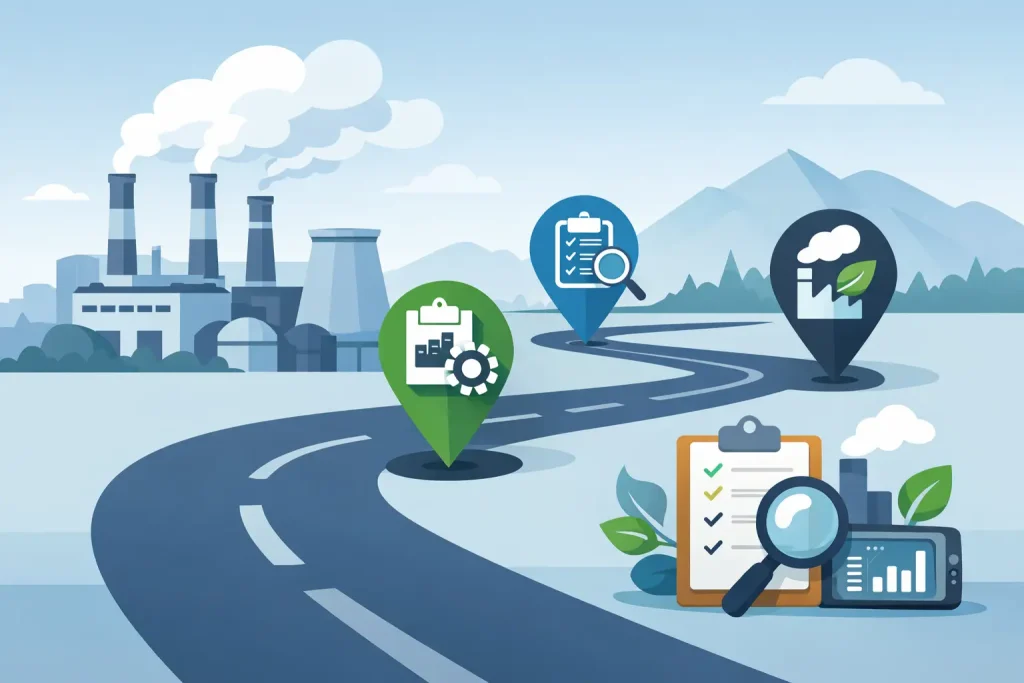
That is why the best compliance plans are built around five connected stages: baseline assessment, engineering design, installation and commissioning, performance verification, and ongoing monitoring and servicing. Skipping a stage may reduce short-term project cost, but it often increases operational instability and compliance risk later.
Step 1: Build the compliance baseline
Before any equipment is specified, the facility needs a clear baseline. This includes process review, field auditing, existing equipment condition, utility constraints, operating hours, production variability, and current documentation quality. If the plant runs multiple shifts, batch processes, or seasonal product changes, those factors need to be reflected in the design basis.
A baseline is also where many projects reveal hidden constraints. A dust collector may be technically suitable but difficult to maintain because of tight access. A packed tower scrubber may control the pollutant, but wastewater handling or chemical dosing may become the operational bottleneck. An electrostatic precipitator may fit the load profile well, yet power quality and maintenance discipline can determine whether it performs consistently.
At this stage, stack sampling, airflow checks, hood evaluations, and system audits provide the evidence needed for decision-making. Assumptions should be limited. Measured data is what supports a defensible equipment selection and a more accurate compliance plan.
Documentation matters early
Plants often focus on equipment first and paperwork later. That order creates problems. Permits, source inventories, process descriptions, testing history, maintenance records, and operating procedures should be reviewed at the start. If a facility cannot explain what each emission source is, how it is controlled, and how performance is verified, compliance becomes harder to prove even if hardware is installed.
Step 2: Match the control technology to the emission profile
There is no universal air pollution control system. The right technology depends on particle size, gas composition, temperature, moisture, explosivity, corrosiveness, loading fluctuations, and required outlet performance. This is where an industrial emissions compliance roadmap guide becomes highly specific.
For dry particulate, a pulse-jet dust collector is often effective, especially where high filtration efficiency and continuous operation are required. For coarse dust, a cyclone or multi-cyclone may work well as a pre-cleaner or in applications where the particle distribution supports mechanical separation. For sticky, corrosive, or soluble contaminants, a packed tower scrubber may be more appropriate. For smoke and fine particulate in certain process conditions, an electrostatic precipitator can offer strong performance. VOC and odor control may call for a regenerative thermal oxidizer, activated carbon filter, or an air stripper, depending on contaminant concentration, variability, and recovery objectives.
The trade-off is that high removal efficiency on paper does not always mean lowest lifecycle risk. Wet systems add water and chemical management. Thermal oxidation adds fuel demand and temperature control considerations. Cartridge and bag filtration need disciplined maintenance and spare parts readiness. A good roadmap weighs compliance performance against uptime, serviceability, operating cost, and plant capability.
Step 3: Design for capture, not just treatment
Many emissions projects underperform because the focus stays on the collector and ignores the capture system. If the hood design is weak, if branch balancing is poor, or if duct losses are miscalculated, contaminants may never reach the control device in the required quantity. The result is a compliant collector attached to a non-compliant process.
For that reason, engineering should include source capture design, duct routing, fan selection, access planning, instrumentation, and maintainability. In worker-exposure-sensitive applications, local exhaust ventilation performance should be considered alongside stack emissions control. A system that technically runs but does not maintain effective suction at the point of generation will create both environmental and occupational problems.
Testing and commissioning criteria should be defined before fabrication and installation begin. That includes airflow targets, pressure differentials, electrical checks, control logic, safety interlocks, and expected outlet conditions. Plants that leave these details vague often face avoidable delays during startup.
Step 4: Commission with evidence, not assumptions
Commissioning is where design intent is tested against plant reality. It should confirm that the installed system performs under actual operating conditions, not only during idle checks or idealized startup windows. If process loads vary, the system should be observed across realistic production states.
This stage typically includes mechanical completion checks, airflow verification, leak inspection, instrumentation validation, control panel functionality, and performance testing. Where required, stack sampling and related reporting provide the evidence needed for internal review and regulator-facing submissions. If deficiencies appear, they should be corrected before the system is treated as closed and complete.
This is also the moment to train operating and maintenance personnel. A well-designed collector, scrubber, or oxidizer can still fail in practice if drain management, cleaning cycles, media replacement, or differential pressure trends are not understood by the people running it.
Step 5: Turn compliance into a managed operating system
The strongest facilities do not treat compliance as an annual event. They manage it as an operating system. That means scheduled servicing, spare parts planning, trend monitoring, calibration checks, audit readiness, and documented corrective actions.
Online monitoring and IoT-enabled performance visibility can materially improve this stage, particularly for plants that run continuously or across multiple production lines. Differential pressure trends, fan performance, cleaning cycle behavior, temperature profiles, and alarm history can show deterioration long before it becomes a failed test, odor complaint, or production issue. The value is not technology for its own sake. The value is earlier intervention and a better record of control performance over time.
Competency also matters. Facilities with designated personnel who understand emissions obligations, operating limits, and recordkeeping requirements are in a stronger position during inspections and internal audits. In some operations, structured competency development through recognized roles such as CePSO and CePBFO supports a more disciplined compliance culture rather than leaving knowledge scattered across departments.
Where facilities usually go off track
Most compliance problems do not come from a complete lack of effort. They come from fragmented ownership. Engineering handles installation, operations handles daily use, maintenance handles breakdowns, and EHS handles reporting – but no one owns the full compliance chain from source assessment to verified performance.
Another common issue is buying standalone equipment without lifecycle support. Air pollution control is not a one-time purchase. It needs servicing, troubleshooting, upgrades, spare parts availability, and periodic verification. A one-stop solution provider with design, fabrication, installation, testing and commissioning, field auditing, stack sampling, and after-sales support can reduce that gap because accountability stays connected from project start through operation.
For industrial operators, the practical standard is simple. If your current setup cannot show what is emitted, how it is controlled, how performance is verified, and what happens when conditions drift, your roadmap is not finished yet. The right system is more than a collector, scrubber, or oxidizer. It is a compliance structure you can operate, maintain, and defend with confidence – year after year.