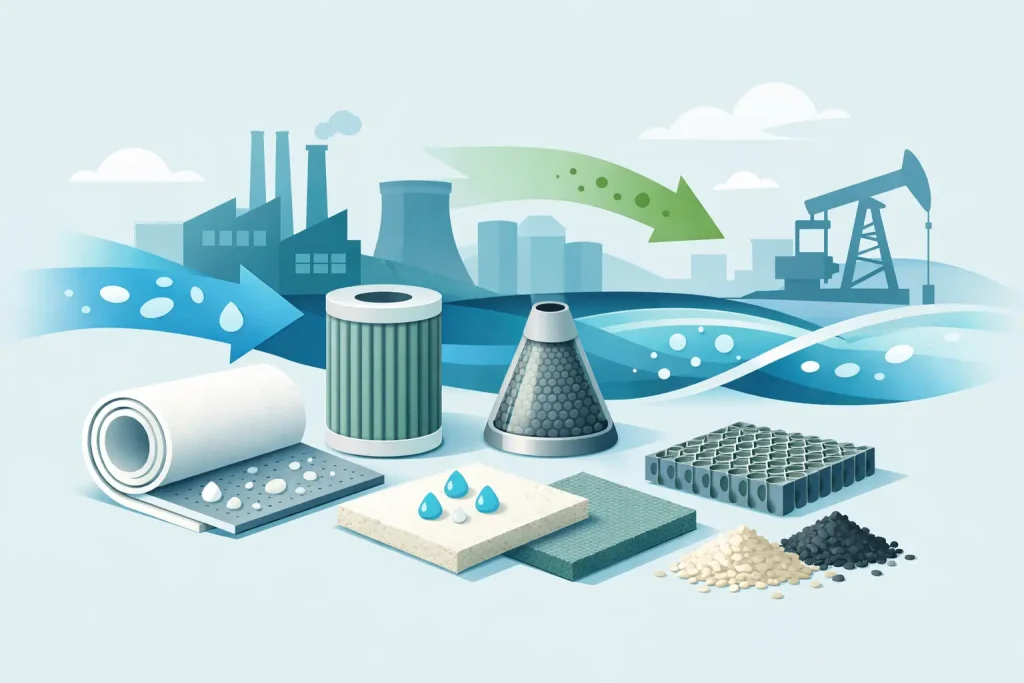
A dust collector can have the correct airflow, fan static pressure, and hopper design yet still underperform because the filter media is wrong for the process. This guide to filter media selection focuses on the operating conditions that determine filtration efficiency, cleaning stability, service life, and defensible emissions performance.
For plant managers, EHS leaders, and maintenance teams, media selection is not a catalog exercise. It is an engineering decision that affects stack test results, worker exposure, compressed-air consumption, unplanned shutdowns, and spare-parts cost. The correct filter bag, cartridge, or pleated element must manage the actual dust and gas stream, including the conditions that occur during startup, upset, cleaning, and production changes.
Start With the Process, Not the Filter Catalog
Filter media should be selected only after the emission source has been characterized. A metal grinding operation, a foundry shakeout line, a food powder transfer point, and a thermal oil-fired process may all use dust collection equipment, but their particulate behavior and gas conditions are fundamentally different.
Begin by confirming the contaminant type and how it is generated. Determine whether the stream contains dry dust, sticky particulate, fibers, smoke, oil mist, condensable vapor, corrosive gases, sparks, or combustible dust. Particle size distribution matters as much as total dust loading. Fine submicron fume behaves differently from coarse, free-flowing powder, while fibrous material can bridge across a media surface and restrict cleaning.
The gas stream must also be assessed at its worst credible condition, not only its normal operating average. Record temperature, moisture content, dew point, oxygen level, acid-gas content, solvent vapor, and pressure fluctuations. A baghouse operating safely at 180 F can fail rapidly if a process upset introduces moisture and the temperature falls below the acid dew point. The result may be blinding, chemical attack, corrosion, or a hardened dust cake that pulse cleaning cannot remove.
A field audit should verify duct velocity, points of air ingress, hood capture conditions, and whether the collector is receiving material it was not designed to handle. This upstream assessment often identifies the real cause of short media life.
Filter Media Selection: The Main Engineering Criteria
The best media is a balance of filtration performance, cleanability, temperature resistance, chemical compatibility, and cost over its usable service life. No single material is correct for every application.
Particle Capture and Surface Filtration
Conventional felt media captures particulate within its depth and gradually develops a dust cake that becomes part of the filtration layer. This can provide effective collection, but a deeply embedded dust load may increase pressure drop and make cleaning more difficult.
Surface-treated media, including membrane-laminated options, captures more particulate at or near the surface. In applications involving fine dust, pigment, pharmaceuticals, dry food ingredients, or high-value product recovery, surface filtration can provide more stable differential pressure and improved release during pulse cleaning. It may also reduce residual dust remaining after each cleaning cycle.
However, membrane media is not automatically the premium choice for every collector. Coarse abrasive dust, mechanical damage, poor cage condition, or excessive pulse pressure can shorten its useful life. The media must be matched to both the particulate and the physical condition of the collector.
Temperature Capability
Temperature is a basic design limit, but it should be considered with an adequate safety margin. Polyester media is commonly used for dry, moderate-temperature applications because it offers good value and broad industrial applicability. It is not suitable where sustained temperatures or chemical conditions exceed its limits.
For elevated-temperature duty, aramid, polyphenylene sulfide, polyimide, PTFE, fiberglass, and other specialty media may be considered. Each has a different tolerance for heat, hydrolysis, oxidation, abrasion, and acid or alkali exposure. A high-temperature rating alone is insufficient. For example, a media may tolerate heat but degrade in the presence of oxygen, moisture, or specific chemical compounds.
Where gas temperature varies, the system may require dilution air, insulation, spark control, a pre-separator, or process interlocks. These measures protect both the media and the dust collector structure.
Moisture, Dew Point, and Chemical Attack
Moisture is one of the most common causes of filter media failure. Hygroscopic dust can absorb water, swell, and form a dense layer on the media. Condensation can create mudding and bag blockage, while acidic condensate can attack fibers, cages, tubesheets, and collector housings.
Chemical compatibility must account for the complete stream. In thermal processes, sulfur compounds, chlorides, nitrogen oxides, or unburned hydrocarbons may influence media selection. In food and feed operations, washdown proximity and humid process air can be significant. In metalworking, coolant mist and oil aerosol may require mist collection or prefiltration rather than a conventional dry dust collector alone.
A proper design review should identify whether the process needs a packed tower scrubber, activated carbon stage, cyclone, oil mist collector, or other upstream or downstream equipment in addition to dry filtration. Filter media cannot compensate for an incorrect air pollution control technology selection.
Abrasion and Mechanical Stress
Abrasive dust wears media from the dirty-air side, especially near the inlet. Foundry sand, metal scale, mineral dust, and certain powders can quickly damage bags or cartridges if air distribution is poor. A cyclone or multi-cyclone can reduce coarse loading before the final collector, and inlet baffles can prevent direct particle impact on the media.
Mechanical failure can also come from poor bag installation, damaged cages, sharp cage wires, excessive pulse pressure, collapse during shutdown, or an improperly set cleaning sequence. When bags fail at the same height or in the same row, the root cause may be collector mechanics rather than media chemistry.
Match the Media to the Cleaning Method
Pulse-jet dust collectors require media that can release dust effectively under repeated compressed-air pulses. Cleaning pressure, pulse duration, diaphragm valve condition, blowpipe alignment, and compressed-air quality all affect filter performance. Water or oil in the compressed-air supply can damage media and make dust release inconsistent.
Differential pressure should be monitored as a trend, not only checked when an alarm occurs. A steadily rising pressure drop may indicate media blinding, insufficient cleaning energy, excess dust loading, or a process change. An unusually low pressure drop can be equally concerning if it indicates torn bags, poor sealing, or bypass leakage.
For cartridge collectors, pleat spacing and media stiffness influence how effectively dust releases. Fine powder can pack between tightly spaced pleats, reducing usable media area. In such cases, a different pleat geometry, surface treatment, or cleaning approach may be necessary.
Build Compliance Requirements Into the Selection
Media selection should support the facility’s applicable emission limits, operating permits, occupational exposure controls, and maintenance documentation. A collector cannot be considered compliant simply because the installed media has a high stated efficiency. Actual performance depends on airflow, leakage control, dust characteristics, cleaning condition, and the integrity of seals and elements.
Testing and commissioning should establish baseline airflow, differential pressure, fan performance, and visible-emission condition. Where required, stack sampling provides measured evidence of system performance. Ongoing inspection records should document media changes, cage condition, hopper evacuation, pulse-valve maintenance, and corrective actions.
For facilities operating under Malaysia’s Clean Air Regulations 2014 or DOSH local exhaust ventilation requirements, the selection process should be tied to the required control standard and verification method. Competent personnel, including CePSO and CePBFO role-holders where applicable, need clear operating data and maintenance evidence to support regulatory responsibilities.
Online performance monitoring can further strengthen control. Trends for differential pressure, airflow, temperature, fan status, and cleaning activity allow teams to detect deterioration before it becomes an emissions excursion or production interruption.
Specify for Lifecycle Value, Not Purchase Price
The lowest-cost media can become the most expensive option when it requires frequent replacement, creates high fan energy demand, or produces repeated shutdowns. Evaluate the total cost of ownership: expected service life, pressure-drop profile, compressed-air use, labor for changeout, spare-parts availability, and the production risk associated with a failure.
A practical specification should state the media fiber, finish or membrane type, weight, temperature range, chemical exposure limits, dimensions, construction details, grounding requirements where relevant, and acceptance criteria. It should also define the process data used as the basis of selection. This makes future troubleshooting more disciplined and avoids replacing failed media with an unverified equivalent.
Master Jaya Group approaches filter media as part of a complete air pollution control system, supported by field auditing, equipment design, testing and commissioning, stack sampling, servicing, and spare-parts readiness. That lifecycle perspective is especially valuable where collector reliability and compliance documentation must remain consistent over years of operation.
The right media should make the collector easier to operate, not more dependent on emergency maintenance. When the choice is based on real process conditions and verified in service, filter replacement becomes planned asset management rather than a recurring response to failure.