When a stack test comes back tight to the limit, the question is rarely “what can we buy?” It is “what can we operate, document, and defend for the next five years?” That is where the electrostatic precipitator vs baghouse decision gets practical. Both technologies can deliver compliant particulate control, but they behave very differently under real plant conditions: changing loads, sticky dust, temperature swings, maintenance realities, and the need for credible reporting.
This is a comparison written for plant managers, EHS leaders, maintenance managers, and project engineers who need reliable capture and defensible compliance – not just a nameplate efficiency claim.
Electrostatic precipitator vs baghouse: how they actually work
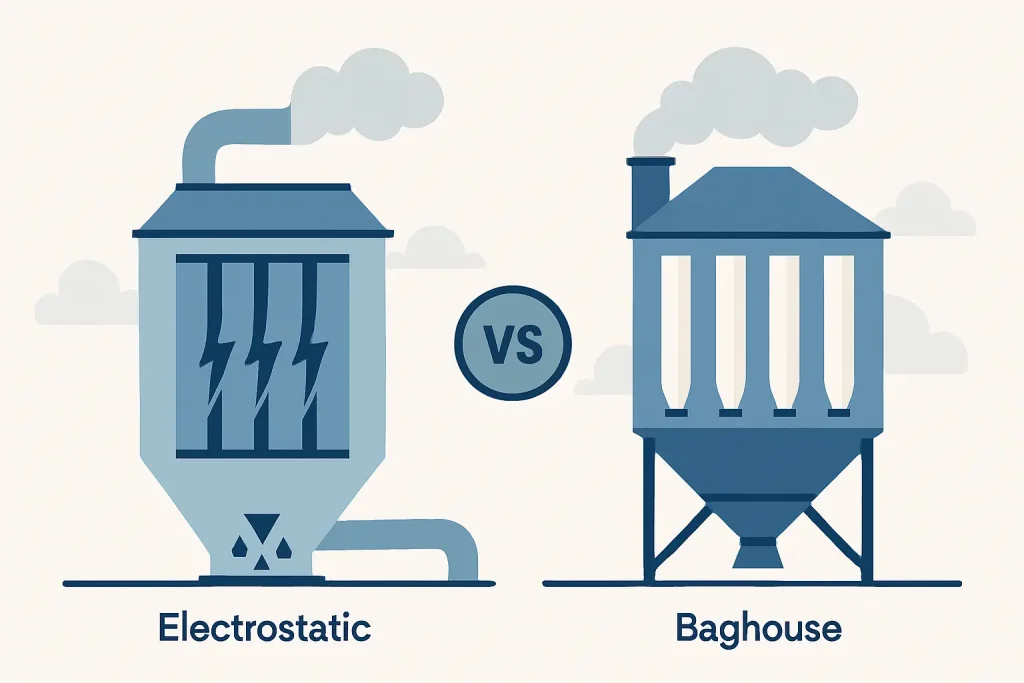
An electrostatic precipitator (ESP) uses high-voltage discharge electrodes to charge particles in the gas stream. Those charged particles migrate to collecting plates and are periodically removed by rapping or cleaning mechanisms. The filtration “media” is essentially an electric field, so pressure drop stays low.
A baghouse (fabric filter or pulse-jet dust collector) physically captures particles on filter bags. Over time, a dust cake forms on the fabric and becomes the primary filtering layer. The system periodically cleans the bags with pulses of compressed air or other cleaning methods to control differential pressure.
Both concepts sound straightforward. The differences show up in the details: what the dust is made of, how variable the process is, and what your site can realistically maintain.
Collection performance: average efficiency vs guaranteed emissions
If your goal is consistently low outlet concentrations across a wide range of operating conditions, baghouses are often selected because fabric filtration can achieve very high collection efficiency even for fine particles, provided the right media and air-to-cloth ratio are used and the bags are intact.
ESPs can also achieve excellent performance, especially on high-flow, high-temperature applications where low pressure drop is valuable. However, ESP performance is more sensitive to particle resistivity, gas composition, and operating stability. When the dust properties or moisture content shift, ESP efficiency can shift with them.
For compliance-focused operations, the key difference is predictability. A well-designed baghouse tends to be more forgiving when dust loading fluctuates, because the dust cake adapts. An ESP tends to be more “tunable” – it can perform very well when the electrical conditions are right, and noticeably worse when they are not.
Dust characteristics that push you one way or the other
Dust is not just “dust.” The particle size distribution, stickiness, abrasiveness, and chemical behavior will decide which technology is easier to run.
Fine, dry particulate with stable properties can suit either solution. Baghouses typically provide strong capture of fine PM when the filter media is selected correctly.
High-resistivity dust is a classic ESP challenge. When resistivity is too high, particles do not release easily from the collecting plates and re-entrainment can increase. When resistivity is too low, back corona and other effects can reduce collection. These are not theoretical issues. They show up as outlet opacity changes, unstable readings, and stack test variability.
Sticky, hygroscopic, or condensing particulate tends to be a baghouse risk if temperatures approach dew point. Moisture can blind bags, elevate differential pressure, and force frequent change-outs. The same moisture can also help an ESP in some cases by changing resistivity, but it can introduce corrosion risk and high-voltage stability issues.
Abrasive dust is manageable in both systems, but it changes the maintenance profile. In baghouses it can shorten bag life and wear elbows and ducting. In ESPs it can wear rappers, collecting surfaces, and discharge components over time.
Temperature and gas conditions: where the hardware limits matter
A frequent driver for ESP selection is high temperature and high flow, where a baghouse would require expensive high-temperature media and careful insulation to avoid condensation. In many process facilities, the “normal” temperature is not the problem – startup, shutdown, and upset conditions are.
Baghouse reliability depends heavily on keeping the gas stream above dew point with stable temperatures. If you have process swings, air in-leakage, or variable moisture, the design must include proper insulation, possibly heat tracing, and a control strategy that prevents cold spots.
ESPs handle high temperatures well in many configurations, but they require stable electrical conditions. If the gas composition changes rapidly (for example, varying hydrocarbons or moisture), it can affect spark rate and power input. The outcome can be reduced collection at the exact moment the process is unstable.
Pressure drop and energy: electricity in different places
If fan power is a constraint, ESPs have an advantage because pressure drop is typically low. A baghouse’s differential pressure is inherent to filtration and rises with dust cake formation, even with good cleaning.
That does not mean a baghouse is automatically “high energy.” Proper sizing, conservative air-to-cloth ratios, and well-tuned pulse cleaning can keep differential pressure in a manageable range. But you should assume the ID fan duty and operating cost are a meaningful part of baghouse OPEX.
ESPs shift energy consumption into the transformer-rectifier sets and high-voltage power supply. Total energy can still be favorable, especially on large systems, but the power quality and electrical maintenance discipline matter.
Maintenance reality: what fails, how it shows up, and who can fix it
A baghouse is mechanically straightforward but operationally demanding. The most common performance risks are torn bags, poor sealing, damaged cages, failed pulse valves, and improper cleaning cycles. The good news is that these issues are usually visible in differential pressure trends, broken bag detection (if installed), and inspection findings. A strong preventive maintenance plan plus a spare parts strategy (bags, cages, valves, diaphragms) is what keeps the system “boringly compliant.”
An ESP has fewer consumables but more specialized components. Insulators, rapper mechanisms, discharge electrodes, and high-voltage power supplies require specific diagnostic skills. When an ESP drifts out of peak performance, the symptoms can be subtle until an opacity event or a stack test reveals a problem.
From a maintenance manager’s standpoint, ask a simple question: do we have the in-house competency to troubleshoot high-voltage and internal electrical fields, or do we prefer a system where most issues are mechanical and consumable-based? There is no universal right answer, but the staffing reality should be part of the decision.
Footprint, installation, and shutdown planning
On new builds, either technology can be planned properly. On retrofits, footprint and outage windows often decide.
Baghouses can be modular and easier to fit into constrained spaces, but duct routing and access for bag change-out must be designed from day one. If you cannot safely and efficiently access the bags, the system will not be maintained well.
ESPs can be physically large for a given flow and may require structural considerations, crane access, and longer installation windows. Internal access for inspection and cleaning is also important. An ESP that is hard to access becomes an ESP that is not inspected.
Shutdown planning matters for both. Baghouses may need planned bag replacement intervals. ESPs may need longer internal work windows when major components require attention.
Compliance and documentation: designing for defensible performance
For regulated operations, compliance is not only the outlet concentration. It is also the ability to show control, traceability, and corrective action.
Baghouses support compliance documentation well because differential pressure, pulse cycles, and compartment status provide continuous operational signals. When paired with simple trend reporting, you can correlate process conditions to collector performance and show that the control device was operating within its intended range.
ESPs can also be instrumented effectively, but the data is different: kV, mA, spark rate, and power input per field. Interpreting that data requires more specialized understanding. If you do not translate the electrical metrics into an “operating envelope” that EHS and operations can follow, the data will exist without driving behavior.
In either case, stack sampling remains the compliance proof point. The better approach is to design the system so that stack test performance is not a once-a-year surprise. Monitoring, routine inspection, and disciplined maintenance are what prevent that.
Cost: CAPEX vs OPEX and the cost of an unplanned exceedance
A common misconception is that the decision is mainly about capital cost. In practice, lifecycle cost is where plants feel the difference.
Baghouses carry ongoing costs in filter bags and compressed air, plus fan power tied to differential pressure. Those costs are predictable, and many plants prefer predictable.
ESPs can have lower pressure-related fan costs and fewer consumables, but they can require specialized service and higher-cost components when major electrical or internal parts need replacement. The more important cost is the operational risk: if performance is sensitive to dust resistivity or process swings, the “cost” can show up as failed tests, production constraints, or forced unplanned upgrades.
The right way to evaluate cost is to tie it to your operating scenario: variability, dust properties, uptime requirements, and the internal capability to maintain the chosen technology.
So which one should you choose?
If your process is stable, your dust properties are favorable, and fan energy is a major concern at very large gas volumes, an ESP can be an excellent fit.
If you need consistently low particulate emissions across variable conditions, or you want a control device whose performance is easier to validate through routine operating indicators, a properly engineered baghouse is often the safer compliance choice.
If your process includes moisture swings, risk of condensation, or sticky particulate, neither solution should be selected without a hard look at temperature control, insulation, and dew point margin. Many “collector problems” are actually ducting, hooding, and process control problems that show up at the collector.
For facilities that want a single accountable partner from design through commissioning, stack sampling, and long-term servicing, Master Jaya Group supports both technology paths as part of an end-to-end clean-air program, including auditing and performance monitoring that helps keep operations aligned with regulatory expectations (https://www.masterjaya.com.my).
A practical closing thought
Before you decide between an electrostatic precipitator and a baghouse, write down what has to be true on your worst operating day – cold start, wet feed, unstable load, limited maintenance crew – and select the system you can keep within its operating envelope without heroics. Clean-air performance that is easy to operate is the performance you can defend.