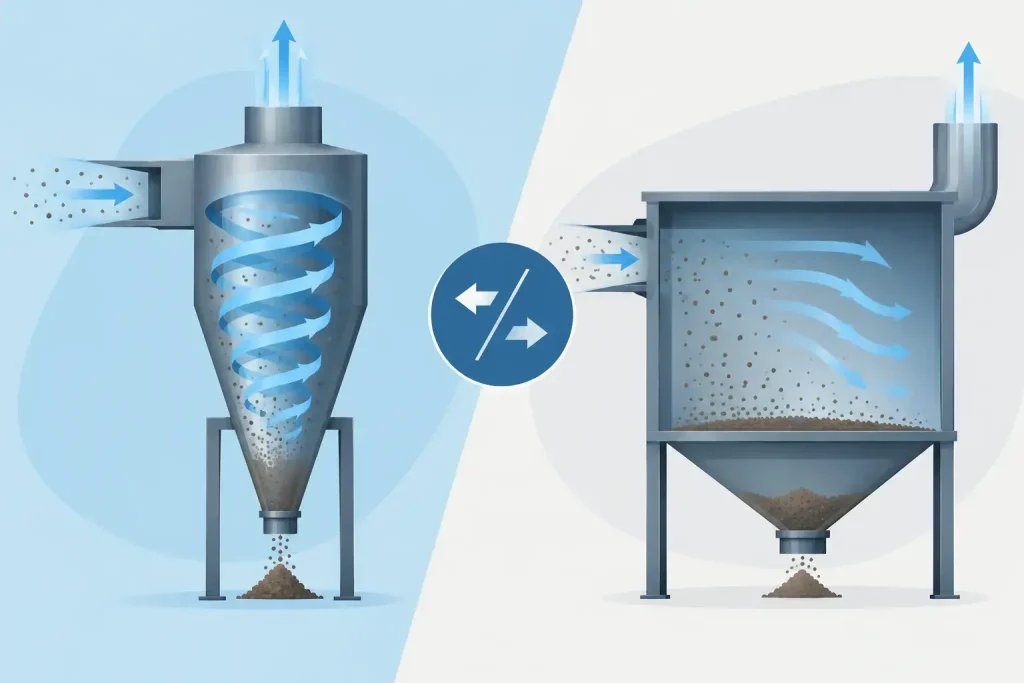
A cyclone separator versus settling chamber decision is rarely about choosing the more familiar piece of equipment. It is about matching a collector’s separation mechanism to the dust loading, particle-size distribution, airflow, space constraints, and compliance obligation of the actual process. A poor match can create chronic housekeeping issues, high fan energy consumption, excessive maintenance, or emission results that are difficult to defend during stack sampling.
For facilities handling coarse, dry particulate from processes such as metalworking, foundry operations, grain handling, animal feed production, or bulk material transfer, both systems can have a place. However, they perform very differently. Understanding those differences early in design helps plant teams specify practical air pollution control systems rather than adding equipment after an emissions or workplace exposure problem has developed.
How the Two Separators Work
A settling chamber is the simplest form of mechanical dust collector. It enlarges the gas passage to reduce air velocity. As velocity falls, heavier particles have time to settle by gravity into a hopper or collection area below the chamber. Internal baffles may improve distribution and prevent short-circuiting, but the fundamental principle remains gravitational settling.
A cyclone separator uses centrifugal force instead. Contaminated air enters tangentially and forms a rotating vortex inside a cylindrical and conical body. Particles with sufficient mass and inertia move outward toward the cyclone wall, lose momentum, and fall into the hopper. The cleaned air reverses direction and exits through the outlet tube.
The distinction matters because gravity is slow, while centrifugal separation is more forceful. A settling chamber needs large volume and low gas velocity to capture particles effectively. A cyclone can provide useful collection performance in a far smaller footprint, particularly for medium and coarse dust.
Cyclone Separator Versus Settling Chamber: Key Differences
The most meaningful comparison is not whether either device collects dust. Both do. The question is how reliably each one achieves the required capture efficiency without creating avoidable operating penalties.
Particle Size and Collection Efficiency
Settling chambers are generally appropriate only for very coarse particles. They are often used as pre-cleaners where dust is heavy, abrasive, or present at a high loading. Fine particles remain suspended in the airstream because they do not have enough settling velocity to reach the collection zone before leaving the chamber.
Cyclones typically collect a wider range of coarse and medium particles than settling chambers. Their performance is strongly influenced by cyclone geometry, inlet velocity, gas density, particle density, and particle size. A properly designed high-efficiency cyclone can be effective for certain applications, but it should not be assumed to replace a pulse-jet dust collector, electrostatic precipitator, or wet scrubber where fine particulate control is required.
For example, a cyclone may be suitable as a first-stage separator ahead of a baghouse in a metal casting or biomass-fired process. It reduces the particulate loading reaching the final filter, protects filter media from abrasive wear, and extends cleaning intervals. A settling chamber may fulfill the same pre-cleaning role where space is available and the collected material is exceptionally coarse.
Pressure Drop and Energy Demand
A settling chamber has low pressure drop because air moves slowly through a large enclosure. This can reduce fan energy demand, provided the chamber is properly designed and does not accumulate dust in a way that disrupts airflow.
Cyclones impose higher pressure drop because separation depends on rotational velocity. Higher-efficiency cyclone configurations usually create higher resistance. The induced-draft or exhaust fan must be selected to overcome this resistance while maintaining the design capture velocity at hoods and pickup points.
This is a common engineering trade-off. Selecting a cyclone solely for better separation without reviewing the complete ventilation system can reduce suction performance at the process source. Underperformance then appears at the hood, not necessarily at the cyclone. Field auditing should therefore review duct velocities, static pressure, fan curve, leakage, hopper condition, and discharge arrangement as one system.
Footprint and Installation Constraints
Settling chambers require considerable floor area or building volume because their performance depends on long residence time. They can be practical in large facilities or in locations where the duct route naturally permits a wide, horizontal chamber. They are less attractive for compact retrofit projects.
Cyclones have a smaller plan footprint but require vertical clearance for the cylindrical body, cone, hopper, rotary airlock, and access for maintenance. Multi-cyclones can process higher gas volumes within a compact arrangement by dividing flow among multiple small-diameter cyclones. This can improve collection of smaller particles compared with one large cyclone, although pressure drop and maintenance requirements must be considered.
Dust Characteristics and Material Handling
Both systems are best suited to dry, free-flowing particulate. Dust that is sticky, hygroscopic, fibrous, oily, or prone to bridging can cause hopper buildup and poor discharge. In a settling chamber, deposited dust may be re-entrained if the airflow is turbulent or if cleaning practices disturb the material. In a cyclone, buildup around the hopper or discharge valve can interfere with the vortex and allow collected dust to re-enter the gas stream.
An effective hopper and discharge system is not an accessory. It is part of the separator’s operating principle. Rotary valves, screw conveyors, slide gates, sealed drums, and level monitoring should be selected according to dust properties, collection rate, fire risk, and the need to prevent false air entering the system.
When a Settling Chamber Is the Better Fit
A settling chamber can be a sound engineering choice where particulate is predominantly large and dense, gas volume is high, pressure-drop allowance is limited, and plant space is readily available. It may also be used upstream of a more efficient collector to remove chips, scale, sand, or other heavy material before it reaches downstream equipment.
Its advantages are mechanical simplicity, low energy resistance, and limited moving parts. However, simplicity should not be confused with broad emissions-control capability. Settling chambers are not generally suitable as the sole control device where discharge limits require reliable fine-particle removal.
They also need disciplined housekeeping. Internal deposits must be removed safely, access doors must remain sealed, and dust discharge must not create secondary exposure for maintenance personnel. For facilities subject to local exhaust ventilation requirements, the collector must support source capture performance rather than merely provide a place for dust to settle.
When a Cyclone Separator Is the Better Fit
A cyclone is usually the stronger option when available space is limited, dust is dry and abrasive, and the facility needs more effective coarse-particle separation than a settling chamber can deliver. It is often selected for woodworking, grinding, metal chips, boiler ash, product recovery, pneumatic conveying, and pre-separation ahead of final filtration.
Cyclones are particularly valuable when they protect more sensitive downstream equipment. By removing heavy particulate before a pulse-jet dust collector, they can reduce abrasion, lower hopper loading, and improve overall system reliability. In processes with combustible dust, the system design must also address hazard assessment, grounding and bonding, explosion venting or isolation where applicable, and safe dust discharge practices.
A cyclone alone may not meet stringent outlet emission requirements. Stack sampling results, process variability, and the applicable regulatory limit should determine whether a secondary collector is required. Where dust loading, particle size, or emissions targets fluctuate, a combined system often offers more defensible long-term performance than relying on a single mechanical separator.
Design Decisions That Should Be Verified Before Procurement
The separator should be selected from measured process information, not a nominal airflow figure alone. Dust samples and field observations can reveal whether material is coarse, fine, abrasive, damp, explosive, or likely to bridge. Airflow testing identifies whether the process needs higher capture velocity, better hood placement, or duct modifications before a new collector is installed.
Engineering review should also confirm the required gas volume, operating temperature, moisture content, inlet dust concentration, particle-size distribution, target outlet concentration, available static pressure, and discharge method. The layout must allow maintenance access, safe hopper cleaning, and proper weather protection where equipment is installed outdoors.
Testing and commissioning should verify actual fan performance, duct transport velocity, pressure drop, leakage, hopper discharge, and visible emissions. For regulated facilities, documented inspection, performance monitoring, stack sampling, and records for environmental submissions turn collector performance into evidence of ongoing compliance.
Build for the Required Outcome
The right choice is not automatically the cyclone with the highest advertised efficiency or the settling chamber with the lowest pressure drop. It is the separator that supports stable process ventilation, manageable maintenance, safe dust handling, and verifiable emissions performance over its service life.
Master Jaya Group evaluates these systems as part of the complete air pollution control train, including ducting, fans, final filtration, monitoring, field auditing, testing and commissioning, and after-sales servicing. When the dust is characterized and the operating duty is clear, the equipment selection becomes a practical compliance decision rather than a costly assumption.