A solvent-like smell at a property boundary, a persistent resin odor in a work area, or complaints near an exhaust stack all raise the same operational question: can carbon filters remove odors reliably enough to protect people, production, and compliance standing? In many industrial applications, the answer is yes – but only when activated carbon is selected and engineered for the actual odor-causing compounds, airflow, humidity, and duty cycle.
Activated carbon is not a universal odor eraser. It is an adsorption medium with finite capacity. A system that performs well for low-concentration volatile organic compounds (VOCs) may fail quickly when exposed to high moisture, oil aerosols, hot gas, or contaminants that do not adsorb effectively. For plant managers and EHS teams, the practical issue is not whether carbon can reduce odor. It is whether the complete system can sustain required performance between service intervals and provide defensible operating records.
Can Carbon Filters Remove Odors From Industrial Exhaust?
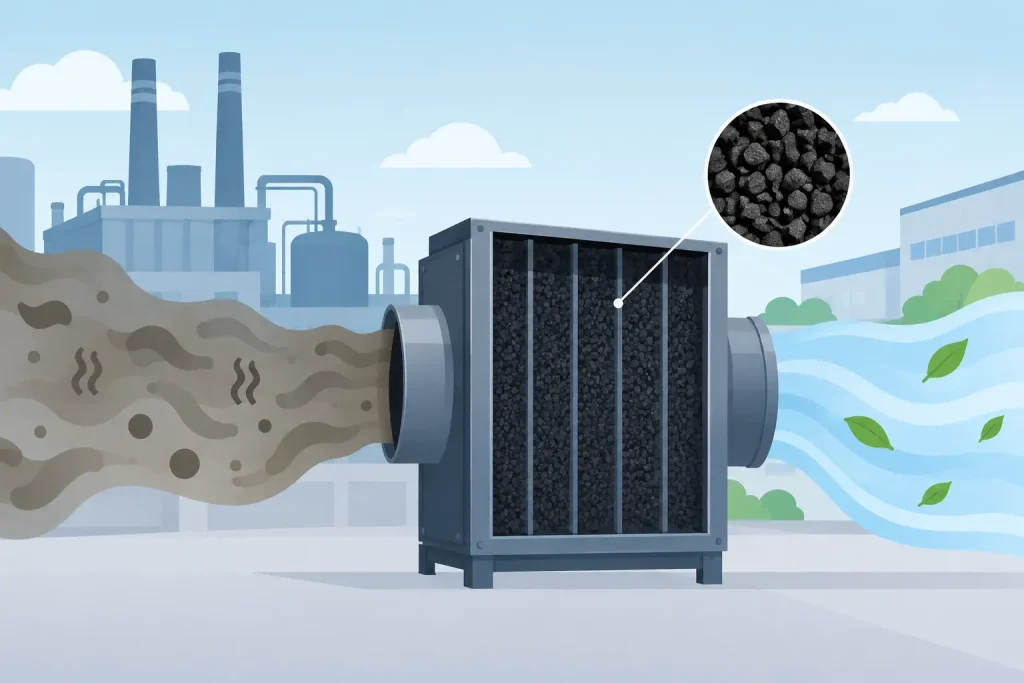
Activated carbon filters remove many odors by adsorption. The carbon contains an extensive network of microscopic pores that attract and retain vapor-phase molecules as contaminated air passes through the media bed. Compounds commonly associated with solvent, paint, chemical, petroleum, adhesive, and some organic processing odors can be captured effectively when the adsorption conditions are correct.
Odor control is more complex than particle filtration. A dust collector can capture solid particulate matter, but vapor-phase odors may pass through conventional fabric bags or cartridges. Likewise, a wet scrubber may remove soluble gases and particulate matter but may not adequately control non-soluble VOCs. Carbon adsorption is often installed as a polishing stage after primary particulate, mist, or gas treatment.
The term “odor” also covers a wide range of chemical conditions. One facility may be dealing with toluene and xylene from coating operations. Another may have hydrogen sulfide, ammonia, amines, aldehydes, or compounds generated during food, feed, rubber, plastic, or thermal processing. Each has different adsorption behavior. Proper design begins with identifying the emission, not selecting a carbon vessel by odor intensity alone.
Where Activated Carbon Performs Well
Carbon filtration is generally effective where the exhaust stream has relatively stable flow and concentration, manageable temperature and moisture, and contaminants that are adsorbable. It is commonly considered for VOC-bearing exhaust from printing, coating, painting, chemical handling, solvent cleaning, odor-generating storage areas, and selected process ventilation systems.
Residence time matters. Air must remain in contact with the carbon long enough for mass transfer to occur. If an exhaust fan pulls air through an undersized bed too quickly, odor breakthrough can occur even when the media is new. The design must balance airflow, bed depth, pressure drop, empty-bed contact time, and the expected contaminant loading.
Carbon type also matters. Standard activated carbon is frequently suitable for many organic vapors. However, impregnated or chemically treated carbon may be required for specific acidic, alkaline, sulfur-bearing, or reactive gases. For example, a stream containing hydrogen sulfide or ammonia cannot be approached as if it were simply a paint-booth VOC exhaust. The media chemistry, disposal route, fire risk, and replacement schedule must all be evaluated.
The Conditions That Cause Odor Breakthrough
The most common carbon-filter failures are not caused by the carbon itself. They result from incomplete characterization, weak pretreatment, undersized equipment, or a maintenance plan based on calendar dates rather than actual loading.
High relative humidity can compete for adsorption sites and reduce capacity for certain compounds. Hot exhaust can also lower adsorption performance, particularly where temperatures exceed the preferred operating range of the media. If the process exhaust carries oil mist, condensable vapor, or fine dust, those contaminants can coat carbon surfaces and restrict access to the pores.
A carbon bed also has a predictable endpoint. Once available adsorption sites are occupied, contaminants pass through the vessel. This is called breakthrough. Because some odor compounds are detectable by people at very low concentrations, nuisance odor can return before a plant recognizes a broader process issue. Relying only on smell is not an acceptable maintenance strategy for regulated operations.
Certain compounds may require a different technology altogether. Very high VOC concentrations can make carbon adsorption uneconomical because media replacement becomes too frequent. Depending on the concentration, flow rate, process temperature, and compound properties, regenerative thermal oxidation, thermal oxidation, condensation, scrubbing, or source-process changes may be more appropriate. An engineered assessment should compare lifecycle cost, energy demand, safety controls, destruction efficiency, and compliance requirements before selecting a solution.
Carbon Filtration Needs Proper Pretreatment
An activated carbon filter should rarely be treated as a stand-alone answer to a dirty industrial airstream. Upstream control equipment protects the adsorption bed and extends media life.
For dust-producing processes, a pulse-jet dust collector, cyclone, or multi-cyclone may be required before carbon. For oil mist or aerosol-laden streams, suitable mist elimination and coalescing stages should be considered. Where corrosive or highly soluble gases are present, a packed tower scrubber may be used before the carbon polishing stage. The correct arrangement depends on the chemistry and the order in which contaminants should be removed.
Pretreatment is not merely an equipment add-on. It protects pressure-drop performance, reduces fire and hot-spot risks, prevents premature media fouling, and makes replacement intervals more predictable. It can also reduce operating cost by preventing expensive activated carbon from being consumed by contaminants that another technology can remove more efficiently.
Design Inputs That Determine Performance
A reliable odor-control system starts with field data. A site audit should establish the exhaust flow rate, temperature, relative humidity, pressure, contaminant identity, inlet concentration, operating hours, variation by production shift, and any upset conditions. Stack sampling and laboratory analysis may be necessary where the source chemistry is uncertain or where permit documentation requires measured evidence.
Engineering calculations then determine carbon quantity, vessel configuration, superficial velocity, expected pressure drop, fan duty, ducting requirements, and estimated breakthrough interval. A single large vessel may suit one operation, while duplex vessels can provide operational continuity where uninterrupted extraction is critical. Access for media replacement, isolation dampers, sampling ports, and safe handling arrangements should be included at the design stage.
Fire safety requires special attention. Some VOCs are flammable, and activated carbon can generate heat during adsorption under particular loading conditions. Systems may require temperature monitoring, flame protection, suitable electrical classification, bypass arrangements, or other safeguards based on the hazard assessment. The design must never assume that odor control and process safety are separate subjects.
Monitoring and Maintenance Are Part of the System
A carbon system is compliant only if it continues to perform after commissioning. Testing and commissioning should confirm airflow, pressure drop, fan performance, duct capture, leakage control, and outlet conditions. Baseline readings are valuable because they make later changes visible.
Routine servicing should include inspection of prefilters, seals, ductwork, fan condition, differential pressure, carbon-bed condition, and any monitoring instruments. Media replacement frequency should be based on predicted loading and verified through outlet sampling, odor observations, process records, or appropriate sensor data. In high-consequence applications, online monitoring and documented maintenance records provide stronger evidence of control than reactive callouts after complaints occur.
Spent carbon must also be managed correctly. Depending on the adsorbed contaminant, used media may require classification, controlled handling, regeneration, or disposal through an approved route. This should be considered before installation, particularly for facilities with hazardous chemical inventories or strict waste-management obligations.
Compliance Requires Evidence, Not Assumptions
Odor complaints can indicate a community-impact issue, a worker-exposure concern, or an emission-control failure. The applicable limits and reporting requirements depend on the facility location, permit conditions, and regulated contaminants. For plants operating under Malaysia’s Clean Air Regulations 2014, carbon filtration design and operating records should support the wider air-emission control strategy, including inspections, monitoring, and required submissions.
Master Jaya Group approaches activated carbon filtration as part of an end-to-end air-pollution-control system: field auditing, process assessment, engineered fabrication, installation, testing and commissioning, stack sampling, servicing, and performance monitoring. This is particularly valuable where a facility needs one accountable party to address both control equipment and the evidence behind its performance.
The right question is not simply whether a carbon filter can make an odor less noticeable. Ask what compounds are present, what reaches the bed after pretreatment, when breakthrough is expected, and how performance will be verified. Those answers turn carbon adsorption from a short-term odor fix into a controlled, maintainable part of plant air-quality management.