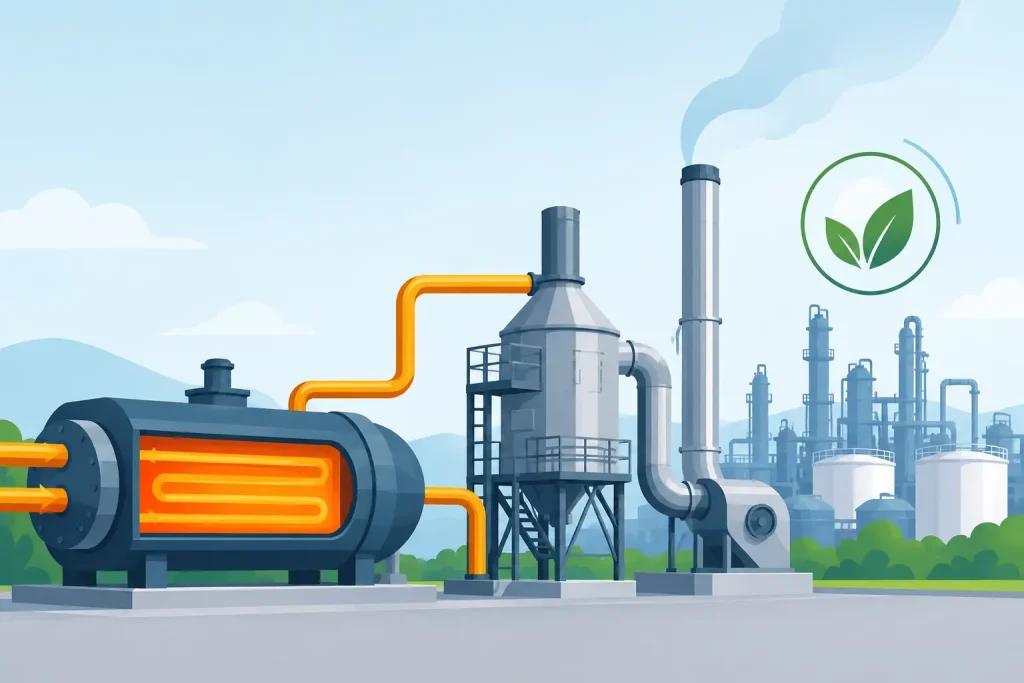
A thermal oil heater can appear to be a minor utility system until its stack test, fuel usage, or visible plume raises a compliance concern. Selecting the best thermal oil emission controls requires more than adding a single device at the stack. The correct solution must account for burner combustion, fuel quality, heater capacity, thermal oil condition, process vents, and the applicable air-emission limits.
For plant managers and EHS leaders, the priority is straightforward: achieve defensible compliance without introducing unnecessary pressure drop, fuel consumption, maintenance burden, or downtime. A control system should be engineered as part of the complete thermal oil operation, with testing, commissioning, stack sampling, and ongoing performance verification built into the project scope.
Start With the Emission Source, Not the Equipment
Thermal oil systems can generate several different emission profiles. The heater stack is normally the primary point source, with nitrogen oxides (NOx), carbon monoxide (CO), carbon dioxide (CO2), sulfur dioxide (SO2), particulate matter, and unburned hydrocarbons influenced by burner design and fuel type. A natural gas-fired heater generally presents a different control challenge from a diesel, fuel oil, biomass, or solid-fuel-fired unit.
The thermal fluid circuit can create a separate concern. Overheated or degraded thermal oil may release hydrocarbon vapors from expansion tanks, vents, seals, pumps, and transfer points. Where these vapors contain volatile organic compounds (VOCs), odor-causing compounds, or oil mist, stack controls alone will not resolve the full emissions risk.
An effective engineering review should establish actual operating load, stack temperature, oxygen level, excess air, fuel analysis, oil flash point, and available stack sampling data. This baseline prevents a common mistake: specifying an emission-control device before confirming what pollutant is present and at what concentration.
Best Thermal Oil Emission Controls by Pollutant
There is no universal best system for every thermal oil heater. The most suitable arrangement depends on the pollutant, exhaust flow, temperature, fuel, site layout, and emission limit. In many facilities, the best result comes from combustion optimization first, followed by targeted end-of-pipe treatment where required.
Low-NOx Burners and Combustion Controls
For gas- and liquid-fuel-fired thermal oil heaters, a low-NOx burner is often the first and most cost-effective control measure. These burners reduce peak flame temperatures and manage the oxygen-fuel mixing pattern to limit thermal NOx formation. Depending on the heater design and local requirements, options may include staged combustion, flue gas recirculation, or ultra-low-NOx burner packages.
Burner upgrades should be paired with reliable combustion controls. Oxygen trim systems, variable-speed combustion air fans, properly sized fuel trains, and calibrated flame management controls can reduce excess air while maintaining stable combustion. Too little air increases CO and unburned hydrocarbons; too much air can reduce thermal efficiency and may increase NOx under certain operating conditions.
A low-NOx burner is not a substitute for maintenance. Fouled burner tips, incorrect damper positions, leaking fuel valves, poor draft, and unstable fuel pressure can quickly undermine expected performance. Routine combustion tuning should be documented as part of the facility’s preventive maintenance and compliance record.
Selective Catalytic Reduction for High NOx Duty
Selective catalytic reduction (SCR) is considered when burner-level reduction is insufficient to meet a strict NOx limit. The process injects a reagent, commonly ammonia or urea, into the flue gas before it passes through a catalyst bed. The reaction converts NOx into nitrogen and water vapor.
SCR can achieve high NOx removal efficiency, but it requires disciplined operation. Flue gas temperature must remain within the catalyst’s operating range, reagent dosing must be accurately controlled, and ammonia slip must be monitored. Catalyst fouling is also a concern where the gas stream contains particulate matter, sulfur compounds, or oil aerosols.
For a smaller thermal oil heater with moderate emissions, SCR may be technically capable but commercially disproportionate. A detailed lifecycle assessment should compare capital cost, reagent handling, catalyst replacement, fan power, maintenance access, and expected compliance margin before selection.
Scrubbers for Acid Gases and Soluble Pollutants
Packed tower scrubbers are appropriate where the exhaust contains acid gases or soluble contaminants, particularly from sulfur-bearing fuels or specific process vent streams associated with thermal oil operations. In a wet scrubber, contaminated gas contacts a recirculating liquid, often with chemical dosing to neutralize targeted pollutants.
Scrubber performance depends on gas velocity, packing selection, liquid-to-gas ratio, pH control, circulation pump reliability, and mist eliminator condition. A poorly maintained scrubber may create a false sense of security while allowing breakthrough, liquid carryover, corrosion, or excessive pressure drop.
Wet scrubbing also produces wastewater or spent scrubber liquor that must be managed correctly. This makes scrubbers a strong solution for the right contaminant, but not an automatic choice for a clean natural gas-fired heater whose principal concern is NOx.
Particulate Controls for Solid and Heavy Liquid Fuels
When thermal oil heaters burn biomass, coal, heavy fuel oil, or other fuels that generate ash and soot, particulate control becomes central to the system design. Cyclones and multi-cyclones can serve as pre-separators for larger particles, reducing dust loading to downstream equipment.
For higher collection efficiency, a pulse-jet dust collector or electrostatic precipitator may be required. Pulse-jet collectors are widely used for dry particulate streams, while electrostatic precipitators can perform effectively for fine particulate at larger gas volumes when electrical conditions and maintenance are properly controlled.
The control device must be selected with the dust characteristics in mind. Sticky, oily, moist, or high-temperature particulate can blind filter media, bridge inside hoppers, or create fire risk. In these cases, gas cooling, spark control, hopper heating, insulation, or alternative filtration media may be necessary.
Thermal Oxidizers and Activated Carbon for VOCs
Thermal oil vapor emissions from expansion tank vents, contaminated air streams, or solvent-related process areas may require VOC control rather than combustion stack treatment. Regenerative thermal oxidizers (RTOs) destroy VOCs through high-temperature oxidation and are generally suited to larger, continuous streams with sufficient hydrocarbon loading.
Activated carbon filters can be more practical for lower-flow, lower-concentration vapor streams where recovery or adsorption is appropriate. Carbon systems require careful media selection, breakthrough monitoring, fire-risk assessment, and scheduled carbon replacement. They are not suitable for every hot or high-moisture stream.
Where VOC concentration is variable, a field audit and representative sampling program are essential. Designing from assumptions can lead to undersized carbon beds, excessive operating cost, or an oxidizer that does not sustain the required destruction efficiency.
Monitoring Makes Compliance Defensible
Emission controls only protect the facility when their performance is verified. Periodic stack sampling establishes whether the heater and control equipment are operating within applicable limits. Testing should be conducted under representative production conditions, not only during low-load or favorable operating periods.
For critical systems, online performance monitoring can provide earlier warning of operating drift. Useful parameters may include stack oxygen, temperature, differential pressure, burner fuel flow, draft, scrubber pH, recirculation flow, and bag filter cleaning pressure. Trend data helps maintenance teams identify a developing issue before it becomes a failed test or unplanned shutdown.
Documentation matters as much as hardware. Facilities should retain commissioning records, operating parameters, maintenance logs, calibration certificates, stack sampling reports, corrective-action records, and training evidence. Where regulations require competent personnel, organizations should ensure that responsible staff have the appropriate competency and practical understanding of the installed system.
Specify a Complete Control Project
A thermal oil emission-control project should begin with a site assessment and end with demonstrated performance. The scope should cover engineering design, equipment fabrication, installation, ductwork, structural supports, electrical and control integration, testing and commissioning, and post-installation stack sampling where required.
It is also prudent to confirm spare-parts availability before equipment is purchased. Filter bags, solenoid valves, burner components, scrubber pumps, mist eliminators, sensors, and control panels are operational necessities, not afterthoughts. A system with excellent design performance but no service plan can become a compliance liability.
Master Jaya Group approaches these projects as full-lifecycle clean-air systems, combining engineered control equipment with field auditing, stack sampling, commissioning, after-sales service, and performance monitoring. That level of accountability is particularly valuable when a plant must demonstrate not only that equipment was installed, but that it continues to operate as intended.
The practical next step is to assess the heater, fuel, emission points, and current operating data together. The right control decision is rarely the most complex equipment package. It is the one that reliably meets the required emission outcome, fits the plant’s operating realities, and can be maintained with confidence for years to come.