An odor complaint rarely begins as a simple nuisance issue. At a process facility, it can indicate uncontained VOCs, hydrogen sulfide, ammonia, mercaptans, oil vapor, spoiled organic material, or incomplete combustion. Selecting the best industrial odor control technologies requires more than identifying a smell. The system must match the contaminant chemistry, airflow, concentration range, temperature, moisture content, production schedule, and permit obligations.
For plant managers and EHS leaders, the right decision protects community relationships, supports worker exposure control, and creates defensible operating records. The wrong decision may reduce odor temporarily while increasing pressure drop, creating corrosion, raising operating cost, or shifting the problem to a spent media disposal stream. Odor control should therefore be engineered as part of the facility’s overall air pollution control strategy, from source capture through testing, commissioning, and ongoing performance monitoring.
Best Industrial Odor Control Technologies by Application
There is no universal odor control unit. A technology that performs well for low-concentration sulfur compounds from wastewater handling may be unsuitable for high-loading solvent exhaust from a coating line. The most reliable selection starts with representative field data: airflow, temperature, relative humidity, oxygen level, contaminant concentration, odor intensity, gas velocity, particulate loading, and process variability.
Activated Carbon Adsorption
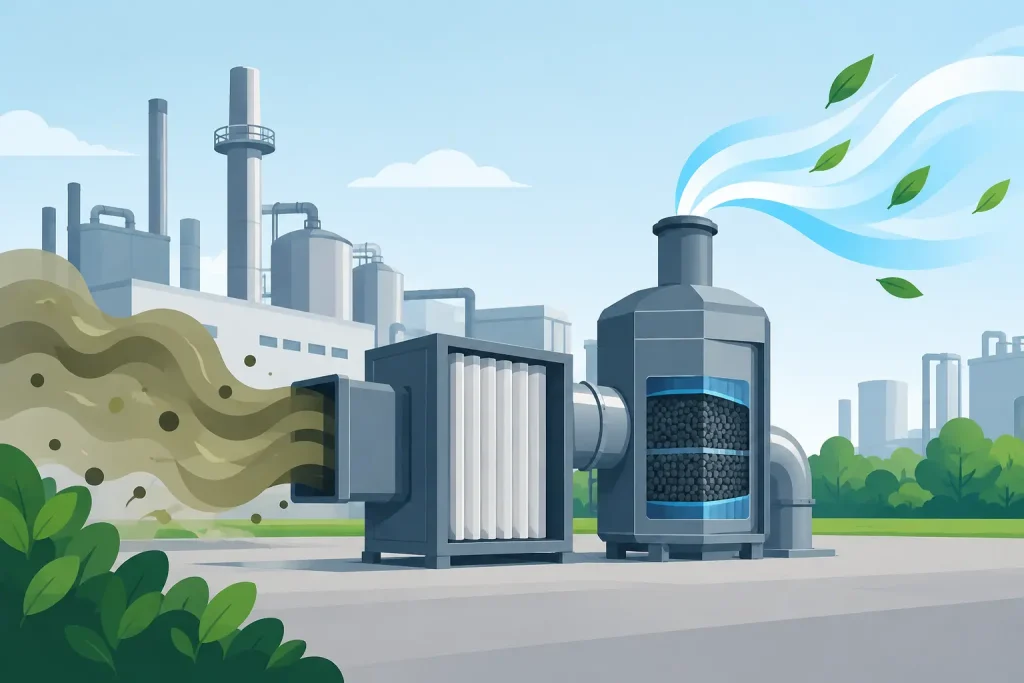
Activated carbon filters are widely applied where airflow is moderate and odor-causing compounds are present at low to medium concentrations. Carbon captures VOCs and many odor compounds within its pore structure. It is often effective for solvent odors, paint-related emissions, printing operations, chemical storage vents, food-processing odors, and final polishing after another treatment stage.
Carbon adsorption is compact and can be installed as a standalone unit or downstream of particulate filtration. However, media selection matters. Standard activated carbon may be appropriate for many organic vapors, while impregnated media can improve removal of sulfur compounds, ammonia, aldehydes, and other reactive gases. A poorly selected media bed can reach breakthrough quickly, allowing odors to return with little visible warning.
The main trade-off is lifecycle management. Carbon systems require routine monitoring of pressure drop, breakthrough risk, bed condition, and fire potential. High humidity, high VOC loading, oil mist, and dust can reduce adsorption capacity. For this reason, a pre-filter, mist eliminator, or dust collector is frequently required ahead of the carbon vessel.
Packed Tower Wet Scrubbers
Packed tower scrubbers transfer contaminants from exhaust gas into a recirculating liquid. They are particularly effective for water-soluble gases and chemically reactive odor compounds, including ammonia, hydrogen sulfide, amines, chlorine-related gases, and certain acid or alkaline vapors. The scrubbing liquid can be water, caustic, acid, or an oxidizing solution depending on the gas chemistry.
For example, alkaline scrubbing may be selected for acidic gases, while acidic scrubbing is commonly applied to ammonia-bearing exhaust. Oxidizing scrubber chemistry can treat reduced sulfur compounds that produce strong odors at very low concentrations. Proper design must account for gas-liquid contact time, packing type, recirculation rate, pH control, oxidation-reduction potential, chemical dosing, and mist elimination.
A scrubber is not simply a tower with water flowing through it. Inadequate chemical control, poor liquid distribution, scaling, packing fouling, or damaged mist eliminators can rapidly reduce performance. Wastewater generation and chemical handling also need to be considered during project planning. For facilities with corrosive exhaust, the scrubber material of construction must be selected for the actual process conditions, not only the design concentration stated on paper.
Thermal Oxidizers and Regenerative Thermal Oxidizers
Thermal oxidation destroys VOCs and combustible odor compounds by exposing exhaust gas to elevated temperatures for a defined residence time. Regenerative thermal oxidizers, or RTOs, recover heat through ceramic media and are commonly used for high-volume process exhaust with VOC emissions from coating, printing, resin, chemical, and manufacturing operations.
An RTO can provide high destruction efficiency when the exhaust stream is suitable and the system is correctly operated. It is generally more appropriate for continuous VOC-bearing streams than for dilute, highly variable, or moisture-heavy exhaust with little fuel value. The facility must evaluate fuel consumption, startup requirements, process interlocks, bypass arrangements, combustion safety, and any contaminants that could damage ceramic media or create secondary emissions.
Thermal systems are powerful but are not automatically the best choice for every odor source. High sulfur, halogenated compounds, silicon-containing vapors, or particulate-rich air may require pretreatment and additional downstream control. A detailed waste-gas analysis is essential before committing to a thermal oxidizer.
Biological Odor Control Systems
Biofilters, biotrickling filters, and bioscrubbers use microorganisms to break down biodegradable odor compounds. They are often considered for wastewater treatment plants, composting areas, food and feed processing, rendering operations, and other sources with high moisture content and biodegradable compounds.
Biological treatment can offer lower energy demand than thermal oxidation, but it requires stable operating conditions. The microbial population needs suitable moisture, nutrients, pH, temperature, and contact time. Sudden chemical shocks, disinfectants, excessive heat, or long periods without airflow can reduce biological activity. Biofiltration is therefore best suited to facilities willing to manage it as a living process rather than a passive filter.
Condensation, Recovery, and Source Reduction
Some odor problems are better addressed by recovering vapors before they enter the control device. Condensers can reduce vapor loading from heated tanks, solvent processes, and certain chemical operations. Enclosing transfer points, improving tank vent management, repairing leaking ductwork, and reducing open handling time may also deliver a greater result than adding a larger end-of-pipe treatment unit.
Source reduction is especially valuable when odor originates from fugitive emissions. A carbon vessel cannot correct a poorly designed hood, an undersized fan, or a process room that is under positive pressure. Local exhaust ventilation should capture contaminants close to the source and maintain sufficient transport velocity through the duct system. Under DOSH-LEV principles and comparable industrial hygiene expectations, capture performance must be verified rather than assumed.
How to Select an Odor Control System
The technology decision should begin with a site assessment, not a catalog review. Field auditing identifies where odors escape, whether emissions are stack-related or fugitive, and how process changes affect the exhaust stream. Sampling should be carried out during representative production conditions, including high-load periods, cleaning cycles, raw-material changeovers, and startup or shutdown where relevant.
A competent engineering review should establish four practical questions. First, what compounds are creating the odor and at what loading? Second, can the emissions be captured effectively at the source? Third, what removal performance is required by permit limits, workplace exposure objectives, and community expectations? Fourth, can the plant operate and maintain the selected system reliably for its full service life?
Design calculations must include actual airflow, not only the fan nameplate rating. Excess air dilution can make a thermal unit unnecessarily large and costly, while insufficient airflow can allow odor to escape from hoods and process enclosures. Duct routing, fan static pressure, corrosion allowance, access doors, drainage, fire protection, and maintenance clearance deserve the same attention as the main control equipment.
For many facilities, the best result comes from a treatment train. A process may require a dust collector or oil mist filter to protect downstream equipment, followed by a packed tower scrubber for reactive gases and activated carbon as a final polishing stage. VOC-rich exhaust may need particulate prefiltration before an RTO. Combining technologies is often more dependable than asking one device to handle incompatible contaminants.
Compliance, Monitoring, and Long-Term Performance
An odor control project is only as strong as its commissioning and after-sales support. Testing and commissioning should confirm airflow balance, fan performance, pressure drop, liquid circulation, chemical dosing, pH or oxidation-reduction control, capture effectiveness, and outlet emissions. Stack sampling or other appropriate verification methods should be planned early, particularly where permit conditions require documented results.
Continuous or connected monitoring can improve operational visibility. Differential pressure trends may indicate filter loading or carbon bed restriction. pH and oxidation-reduction potential reveal scrubber chemistry stability. Temperature alarms, fan status, damper position, and operating-hour records help demonstrate that control equipment was available and functioning when the process was running.
Maintenance teams should have clear operating limits and response procedures. This includes media replacement intervals, chemical replenishment, pump inspection, mist eliminator cleaning, duct inspection, fan vibration checks, and alarm escalation. Training is part of compliance assurance because a well-designed system can still fail when operators do not recognize early warning signs.
Master Jaya Group approaches odor control as a lifecycle responsibility: engineering assessment, in-house fabrication, installation, testing and commissioning, field auditing, stack sampling, monitoring, spare parts readiness, and service support. This model is particularly valuable where odor control must operate alongside dust collection, VOC control, or local exhaust ventilation requirements.
The most effective next step is to characterize the actual exhaust stream while the plant is operating normally. Once the chemistry, airflow, capture conditions, and compliance target are confirmed, the technology choice becomes an engineering decision rather than a guess based on what has worked somewhere else.