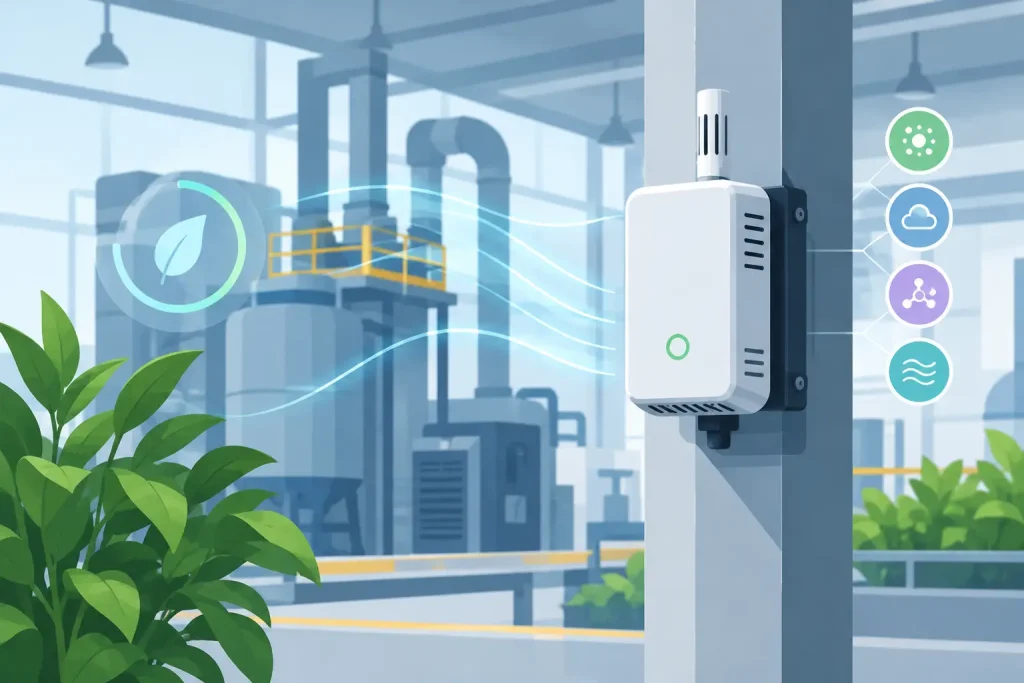
A dust collector can be operating, a scrubber can be circulating, and an exhaust fan can be running at full speed while a facility still has an air-quality problem. The best industrial air quality sensors give plant teams evidence of what is occurring at the emission point, within the work area, and at the outlet of the control system. For EHS leaders, plant managers, and maintenance teams, that evidence supports faster corrective action and more defensible compliance records.
A suitable sensor is not simply the device with the lowest detection limit or the largest screen. It must match the contaminant, process temperature, humidity, airflow conditions, compliance objective, and maintenance capability of the facility. Selecting the wrong technology can create misleading trends, excessive service requirements, or a false sense of control.
What Industrial Air Quality Monitoring Must Measure
Industrial air monitoring generally serves two separate but related purposes: controlling worker exposure and verifying environmental emissions. These applications require different measurement points, measurement methods, and reporting practices.
Worker-exposure monitoring focuses on contaminants within breathing zones and process areas. A metalworking plant may need to monitor respirable particulate matter, welding fumes, oil mist, and carbon monoxide near production lines. A food or animal-feed facility may require visibility into airborne dust around transfer points, mixers, bagging stations, and local exhaust ventilation hoods. Fixed-area monitors provide continuous trend data, while personal sampling remains necessary where occupational exposure assessments require individual worker results.
Emission monitoring focuses on pollutants discharged through stacks, vents, and process exhaust systems. Here, the relevant parameters may include particulate concentration, sulfur dioxide, nitrogen oxides, carbon monoxide, total volatile organic compounds, oxygen, temperature, pressure, and flow. The monitoring arrangement must be coordinated with the applicable permit conditions, test methods, and regulatory reporting requirements. A low-cost indoor monitor is not a substitute for a properly specified stack-monitoring system or periodic stack sampling.
Best Industrial Air Quality Sensors by Application
The best choice depends on the pollutant and the decision the plant needs to make. A sensor used to alert maintenance to a torn filter bag has different requirements from one used to document VOC breakthrough across an activated carbon filter.
Particulate and Dust Sensors
For dust collectors, cyclones, multi-cyclones, and electrostatic precipitators, particulate monitoring is often the first priority. Industrial particulate monitors commonly use triboelectric, electrodynamic, optical, or opacity-based measurement principles.
Triboelectric and electrodynamic probes are well suited for trend monitoring in ducts and stacks. They detect particle impacts or electrical charge associated with moving particulate. Their principal value is early warning: an unusual upward trend may indicate filter damage, poor pulse-cleaning performance, hopper blockage, or a process change that has increased loading. These instruments are particularly useful where the goal is to protect a pulse-jet dust collector before emissions become a significant compliance issue.
Optical particulate sensors measure light scattered by airborne particles. They can provide useful real-time information on particle concentration and size fractions such as PM1, PM2.5, PM10, or total suspended particles. However, performance can be affected by particle color, shape, refractive properties, humidity, and high dust loading. They are valuable for indoor work-area trending and perimeter monitoring, but should be selected carefully for severe process conditions.
Opacity monitors are commonly applied to visible stack emissions. They are effective where plume visibility is a relevant indicator, although they do not directly replace gravimetric particulate testing. Plants should confirm whether opacity, mass concentration, or both are required for their compliance program.
VOC and Solvent Vapor Sensors
Facilities using paints, coatings, inks, solvents, degreasers, resins, or thermal treatment processes should evaluate VOC monitoring. Photoionization detector, or PID, sensors are widely used for detecting many volatile organic compounds at relatively low concentrations. They are responsive and useful for identifying leaks, poor capture performance, or elevated vapor levels near process equipment.
The limitation is selectivity. A PID does not identify every compound equally, and readings depend on the response factor of the chemical being measured. Humidity and lamp contamination can also affect results. For this reason, PID data should be interpreted against the facility’s actual chemical inventory rather than treated as a universal total-VOC value.
Metal-oxide semiconductor sensors offer lower-cost VOC trend monitoring and can be useful for broad alarm indications. They are generally less precise and may drift or respond to interfering gases. For compliance-critical applications, plants should specify equipment that can be calibrated, documented, and maintained according to the required method.
Where thermal oxidizers, activated carbon adsorbers, or air strippers are installed, VOC sensors should be placed with a defined purpose. Inlet monitoring can show process loading. Outlet monitoring can help identify deteriorating destruction efficiency or adsorbent breakthrough. Differential monitoring across the control equipment can be more actionable than a single reading at an arbitrary location.
Toxic Gas and Combustion Gas Sensors
Electrochemical sensors are frequently used for carbon monoxide, hydrogen sulfide, sulfur dioxide, nitrogen dioxide, chlorine, and ammonia. They are common in combustion areas, wastewater treatment facilities, chemical handling zones, and enclosed process areas. Their strengths are sensitivity and relatively direct measurement of specific gases.
Their service life is finite, and cross-sensitivity is a practical concern. A sensor installed near a boiler or thermal oil-fired system must be selected for expected temperature, humidity, and interfering gases. Calibration gas, bump-test procedures, replacement intervals, and alarm verification need to be part of the operating plan from the beginning.
For combustion exhaust and thermal oxidizer applications, oxygen, carbon monoxide, nitrogen oxides, and temperature measurements may be combined to evaluate combustion conditions. These values are not only environmental indicators. They can also reveal excess-air issues, burner instability, and energy losses that affect production costs.
Sensor Selection Starts With the Sampling Location
Many monitoring failures are caused by poor installation rather than poor sensor technology. A sensor located downstream of dilution air, next to a turbulent bend, or in a dead-air zone may produce data that do not represent actual emissions or employee exposure.
For ducts and stacks, the sampling location should provide representative flow conditions and safe access for inspection, calibration, and servicing. Temperature, pressure, moisture, corrosive gases, and particulate loading must be considered when selecting probes, heated sample lines, filters, and enclosures. Packed tower scrubber outlets, for example, may have high moisture content that requires appropriate conditioning to prevent condensation from distorting readings.
For indoor monitoring, placement should follow the contaminant source and airflow pattern. A monitor near a loading dock may mostly measure outdoor air. A monitor at a welding bay should be positioned to assess the work area without being exposed to direct sparks, heat, or physical damage. Before purchasing equipment, perform a field audit of source locations, hood capture performance, airflow direction, and work practices.
Specify the Complete Monitoring System, Not Only the Sensor
A reliable monitoring project includes the instrument, sample conditioning where required, mounting arrangement, electrical and communication infrastructure, alarms, data storage, calibration procedures, and service access. Each element affects whether the plant can rely on the data during an inspection, incident investigation, or maintenance review.
The following requirements should be defined in the project specification:
- Target contaminants, expected concentration range, and required detection limits.
- Process conditions including temperature, moisture, pressure, dust loading, and corrosivity.
- Alarm thresholds, escalation responsibilities, and required shutdown or interlock actions.
- Data logging interval, retention period, remote access, and report format.
- Calibration method, service frequency, spare parts availability, and sensor replacement plan.
Plants should also separate operational trend monitoring from compliance measurement. Trend monitoring is highly valuable for identifying deterioration before a failure occurs. Compliance measurement must meet the applicable regulatory method, permit requirement, and documentation standard. Both may be necessary, but they should not be confused.
Connecting Sensor Data to Air Pollution Control Performance
Monitoring becomes useful when it leads to a defined response. A rising particulate trend downstream of a dust collector should trigger inspection of filter bags, pulse valves, compressed-air quality, hopper discharge, and duct leakage. A VOC increase downstream of an activated carbon unit should prompt review of bed life, airflow, inlet loading, and replacement scheduling. A decline in local exhaust capture performance may require hood adjustment, duct cleaning, fan inspection, or airflow balancing.
This is where an IoT monitoring layer can strengthen plant control. Remote dashboards, alarm notifications, and historical trends allow operations and EHS teams to identify gradual performance changes that are easily missed during manual inspections. The system should not replace competent personnel. It should make field auditing, preventive maintenance, and corrective action more timely and better documented.
Master Jaya Group approaches monitoring as part of the complete clean-air system: engineering design, fabrication, installation, testing and commissioning, field auditing, stack sampling, and after-sales servicing. That lifecycle view matters because the sensor reading is only the starting point. The meaningful outcome is sustained capture, filtration, treatment, and documented compliance performance.
Before selecting equipment, define the contaminant, the decision the data must support, and the action the team will take when the reading changes. A well-specified sensor system turns air-quality data into earlier maintenance decisions, stronger exposure control, and cleaner operating discipline across the plant.