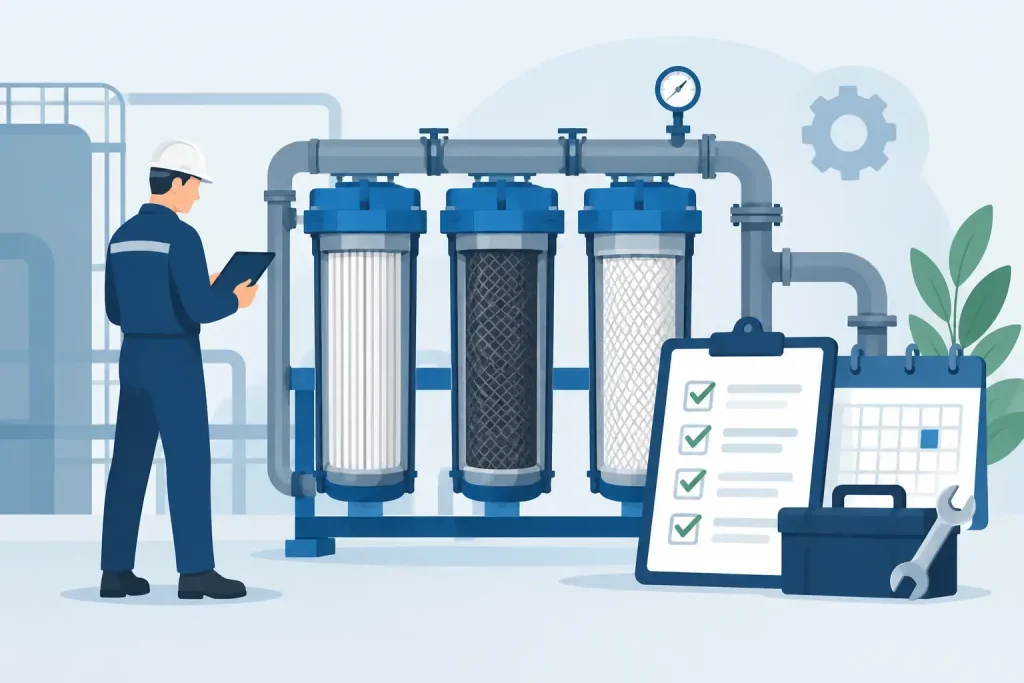
A dust collector can appear to be operating normally while a damaged filter, failed pulse valve, or overloaded hopper is quietly increasing stack emissions and worker exposure. Industrial filtration maintenance planning turns those hidden failure modes into scheduled, documented actions before they become production interruptions, permit exceedances, or costly emergency repairs.
For plant managers, EHS leaders, and maintenance teams, the objective is not simply to keep a fan turning. The objective is to maintain capture efficiency, airflow, pressure stability, discharge performance, and compliance evidence throughout the system lifecycle. That requires a plan built around the actual contaminant, equipment design, operating load, and applicable permit conditions.
Start With the Filtration System’s Critical Duties
Maintenance intervals should not be copied from a generic checklist. A pulse-jet dust collector serving a metal grinding line faces different loading, particle characteristics, and ignition concerns than an activated carbon unit controlling solvent vapors or a packed tower scrubber handling acid mist. The first planning task is to identify what each system must reliably achieve.
Define the controlled pollutant, expected inlet concentration, required outlet limit, design airflow, static pressure range, and operating hours. Record the source processes served by the system and identify whether they run continuously, in batches, or only during particular shifts. This operating context determines how quickly filters load, how often hoppers require discharge, and when inspections can be performed without disrupting production.
The maintenance plan should also recognize the components that support collection performance. Ductwork, hoods, dampers, fans, rotary valves, compressed-air lines, pumps, instrumentation, and discharge equipment are part of the control system. A dust collector with clean filter bags cannot compensate for a blocked pickup hood or a worn fan impeller. Likewise, a scrubber cannot meet its duty if recirculation flow, pH control, or mist elimination has deteriorated.
Build a Baseline Before Setting Maintenance Intervals
A defensible plan begins with baseline data collected after proper testing and commissioning. This is the reference point for identifying gradual decline rather than waiting for visible dust, odor complaints, or a failed inspection.
For fabric filters, record differential pressure, airflow, fan amperage, compressed-air pressure, pulse frequency, hopper discharge condition, and visible stack appearance. For wet scrubbers, establish liquid flow, pressure drop, pH, conductivity where relevant, pump condition, nozzle performance, and mist eliminator condition. Activated carbon systems require documented bed depth, pressure drop, process vapor loading, breakthrough indicators, and changeout criteria.
Where regulatory limits apply, stack sampling provides essential performance evidence. Continuous or online monitoring can add operating visibility between formal sampling events by identifying abnormal pressure, temperature, airflow, or emissions trends early. The best baseline is not a single reading. It is a set of readings collected across normal production conditions, including high-load periods.
Use condition triggers, not calendar dates alone
Calendar-based tasks remain necessary, especially for safety inspections and lubrication. However, replacement decisions should be driven by condition wherever practical. Differential pressure trending, airflow measurements, fan vibration, motor current, compressed-air consumption, and scrubber liquid quality can reveal deterioration long before a component fails.
For example, rising differential pressure may indicate normal filter cake development, but a sudden increase can point to blinded media, moisture carryover, failed cleaning pulses, or an overloaded system. Very low differential pressure may be equally concerning if it indicates torn bags, leaking cartridges, bypass paths, or inadequate airflow. The interpretation depends on the collector’s established operating range.
Create Task Frequencies Around Failure Consequences
Not every task deserves the same frequency or level of documentation. Prioritize equipment whose failure could cause an emissions exceedance, a worker-exposure event, a combustible-dust hazard, or an unplanned production shutdown.
Operator checks may be required each shift for hopper levels, alarm status, abnormal noise, visible leakage, and pressure readings. Weekly checks can cover compressed-air pressure, drain function, fan belt condition, and scrubber liquid levels. Monthly or quarterly inspections may include internal collector condition, pulse valve operation, duct integrity, fan alignment, instrumentation verification, and detailed inspection of filters or cartridges.
Major shutdown work should be planned annually or according to operating condition. This is the appropriate time for internal cleaning, bag or cartridge replacement, fan balancing, duct repairs, scrubber packing inspection, mist eliminator cleaning, and calibration of critical instruments. Facilities operating abrasive, sticky, corrosive, or high-temperature processes may need shorter intervals.
A practical schedule should clearly state the task, frequency, acceptance criteria, responsible role, safety requirements, and required record. “Inspect dust collector” is not a useful instruction. “Verify differential pressure remains within the established operating band; investigate any shift greater than the defined trend limit” gives the technician an actionable standard.
Plan Filter Changes as Controlled Work
Filter replacement is one of the highest-risk maintenance activities in an industrial filtration system. It affects exposure control, equipment integrity, housekeeping, waste handling, and restart performance. Treating it as a rushed breakdown task often creates more problems than it solves.
Before a planned changeout, confirm the correct media specification, quantity, dimensions, temperature rating, chemical compatibility, and grounding or antistatic requirement. A lower-cost substitute may create premature failure or compromise the collector’s emission performance. For carbon adsorption, confirm the correct carbon type and capacity for the compounds being controlled rather than selecting media on price alone.
The work package should include isolation procedures, lockout/tagout, confined-space assessment where applicable, dust-handling methods, personal protective equipment, and waste classification requirements. Inspect cages, tube sheets, gaskets, seals, venturis, and pulse pipes during the changeout. Installing new bags over damaged cages or leaving failed seals in place wastes the value of the replacement project.
After restart, verify differential pressure, pulse cleaning response, fan load, airflow, and leakage condition. Document the date, media type, quantity installed, reason for replacement, findings, and disposal route. These records make it possible to compare service life across production campaigns and identify recurring root causes.
Protect the Supporting Equipment
Many filtration failures begin outside the filter housing. Compressed-air quality is a common example in pulse-jet collectors. Moisture, oil, low pressure, or undersized air supply reduces cleaning effectiveness and can blind filter media. Include air receiver draining, filter-regulator maintenance, leak inspection, and pulse valve testing in the maintenance plan.
On the air-moving side, monitor fan vibration, bearing temperature, belt tension, coupling alignment, damper position, and motor current. A fan operating away from its intended duty point can reduce capture velocity at process hoods, even when the collector itself appears healthy. Hood and duct inspections should focus on accumulation, corrosion, abrasion, unauthorized modifications, and leaks that upset system balance.
For wet systems, maintain pumps, nozzles, strainers, chemical dosing equipment, recirculation tanks, and blowdown controls with equal discipline. Scale or solids accumulation can reduce liquid distribution and raise pressure drop. In packed towers, channeling or damaged packing can sharply reduce gas-liquid contact efficiency without creating an obvious external alarm.
Connect Maintenance Records to Compliance Decisions
Maintenance documentation should answer a simple question: can the facility demonstrate that its air pollution control equipment was operated and maintained as designed? Work orders alone are rarely enough. The record should connect inspections and repairs to operating readings, alarms, deviations, corrective actions, and verification results.
A useful compliance file includes equipment identification, approved operating parameters, preventive maintenance history, calibration records, spare-parts usage, filter and carbon changeouts, training records, stack sampling reports, and evidence of corrective action after abnormal events. If a deviation occurs, document the time, likely cause, production status, interim controls, repair completed, and return-to-service checks.
This approach also improves management decisions. Repeated pulse valve failures may justify an air-system upgrade. Short filter life may indicate moisture ingress, incompatible media, or excessive air-to-cloth ratio. Recurring high emissions readings may require a broader engineering review of capture hoods, duct velocity, collector sizing, or process changes rather than another routine service visit.
Keep Spares and Competency Aligned With Risk
A maintenance plan is only useful if critical work can be completed when needed. Stock items with long lead times or direct compliance impact, such as filter bags, cartridges, pulse valves, diaphragms, gaskets, fan belts, bearings, sensors, and scrubber pump seals. The right inventory level depends on equipment criticality, supplier lead time, and the cost of downtime.
Competency matters just as much. Operators should understand normal readings and alarm response. Maintenance personnel need clear procedures for isolation, inspection, media handling, and reassembly. EHS personnel should be able to interpret records against permit obligations and determine when stack sampling, field auditing, or engineering intervention is required.
Master Jaya Group supports this lifecycle approach through engineered filtration systems, testing and commissioning, field auditing, spare-parts readiness, servicing, stack sampling, and performance monitoring. The value is not a maintenance checklist in isolation, but an accountable process that protects clean-air performance over the life of the equipment.
The strongest maintenance plan is reviewed after every significant failure, process change, or emissions test. Each finding is an opportunity to refine task intervals, acceptance limits, spare-parts strategy, and operator response before the next issue reaches the stack or the shop floor.