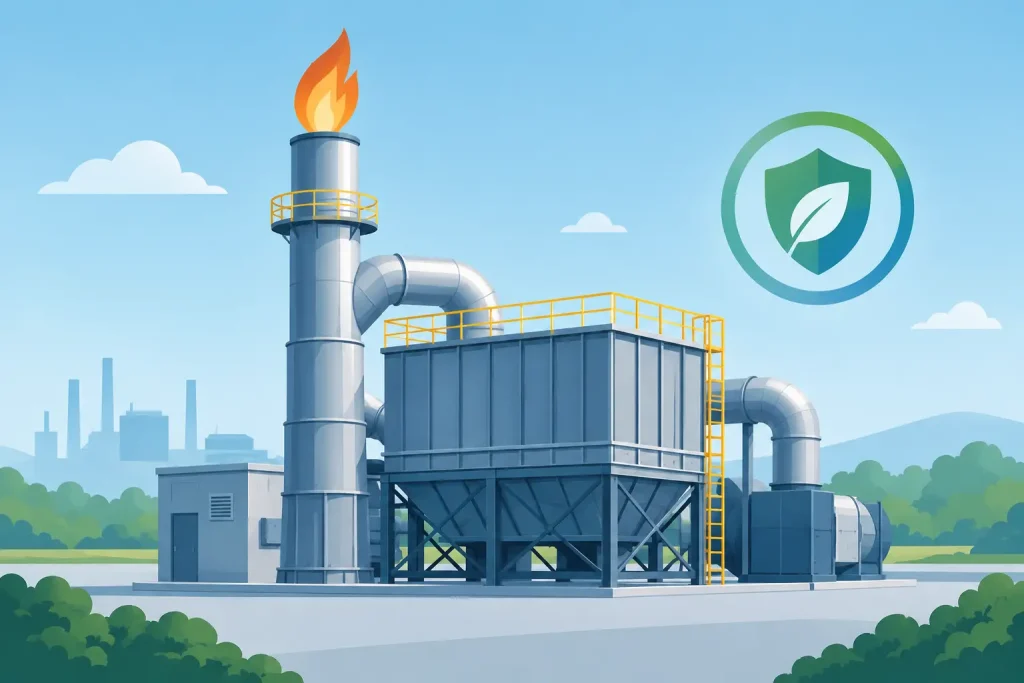
A thermal oxidizer can appear to be operating normally while its destruction efficiency is already declining. A burner may be firing, chamber temperature may look acceptable, and the exhaust stack may show no visible issue. Yet an unstable process load, poor airflow balance, oxygen deficiency, or a failed damper can compromise thermal oxidizer operation long before a compliance test identifies the problem.
For facilities managing volatile organic compounds (VOCs), hazardous air pollutants, odorous process gases, or solvent-laden exhaust, the oxidizer is not simply a combustion device. It is a controlled emissions system. Its performance must be verified through sound operating practices, calibrated instruments, documented inspections, preventive maintenance, and records that can support permit conditions and regulatory review.
What Controls Thermal Oxidizer Performance?
Thermal oxidation destroys combustible contaminants by exposing them to sufficient heat, oxygen, and time. This is commonly described as the three Ts: temperature, time, and turbulence. In practice, a fourth factor is equally significant: stable process control.
The required combustion chamber temperature depends on the contaminant stream and the applicable permit requirements. Many VOC applications operate at temperatures in the range of 1,400°F to 1,600°F, but the correct setpoint must be established from the waste gas composition, required destruction removal efficiency, system design, and permit limits. Raising the temperature without understanding the process is not always the right response. It can increase fuel consumption, damage refractory, and create unfavorable combustion conditions.
Residence time determines how long the contaminated gas remains in the combustion chamber at the required temperature. A higher-than-designed exhaust flow can reduce residence time even if the temperature controller remains on setpoint. This is why fan speed, damper position, duct leakage, and production exhaust demand must be evaluated together.
Turbulence promotes mixing between the contaminated gas, combustion air, and fuel. Poor mixing can create localized cool zones and allow contaminants to pass through the chamber without complete oxidation. Burner condition, chamber geometry, inlet arrangement, and airflow balance all affect this result.
Oxygen must also be available at the point of combustion. Excess oxygen is often monitored as an operating indicator, but it must be interpreted correctly. A high oxygen reading may reflect excess dilution air rather than good combustion. Dilution can lower VOC concentration, increase total flow, reduce residence time, and raise fan energy demand.
Establish Operating Limits Before Production Changes
A well-managed system has defined operating limits, not only a temperature setpoint. Plant teams should establish normal operating ranges and alarm responses for combustion chamber temperature, burner firing rate, combustion air pressure, exhaust flow, oxygen concentration where applicable, draft pressure, fan amperage, and bypass damper status.
These ranges should be based on testing and commissioning data, equipment design documents, source-test results, and actual production conditions. They should not be copied from another facility or assumed from a generic operating manual. A coating line, resin process, printing operation, and chemical blending system can present very different VOC loads even when they use similar oxidizer equipment.
Production changes should trigger a technical review. A new solvent, higher line speed, additional process hoods, altered batch cycle, or change in moisture content can all affect the inlet stream. The key questions are whether the oxidizer can still maintain design residence time, whether the lower explosive limit remains within safe operating parameters, and whether the control system will respond correctly to changing heat release.
For regenerative thermal oxidizers (RTOs), process variation also affects heat recovery and valve sequencing. High moisture, particulates, silicone compounds, sulfur-bearing gases, or condensable organics may foul ceramic media and reduce heat-transfer performance. The system may then consume more supplemental fuel while delivering less predictable destruction efficiency.
Startup, Shutdown, and Upset Conditions Need Written Procedures
The highest-risk periods in thermal oxidizer operation are often startup, shutdown, and process upset events. During normal production, the system may run within a narrow and familiar range. During transitions, interlocks, purge sequences, burner management logic, and damper positions become critical.
Startup procedures should confirm that the combustion chamber reaches the approved minimum operating temperature before contaminated process gas is introduced. The correct sequence generally includes combustion air verification, purge completion, burner light-off confirmation, temperature stabilization, induced-draft fan operation, and confirmation that bypass pathways are closed or controlled according to design.
Shutdown requires the same discipline. Process exhaust should be isolated or redirected only according to the approved procedure, and the oxidizer should complete its required post-purge cycle. Turning off the burner too early or stopping exhaust movement without considering residual vapors can create a safety and emissions risk.
Written upset procedures should address conditions such as low combustion temperature, flame failure, high chamber pressure, induced-draft fan trip, high VOC concentration, valve malfunction, and loss of electrical power. Operators need clear authority to stop the process when an emissions control device cannot maintain its required operating conditions. That decision should never depend on guesswork during a production emergency.
Daily Checks Prevent Expensive Compliance Failures
Daily operator rounds provide the earliest opportunity to identify a developing problem. A practical inspection should confirm actual chamber temperature against the required setpoint, burner flame stability, fuel pressure, combustion air pressure, fan vibration, motor amperage, duct and damper condition, control panel alarms, and any unusual odors or noise.
For RTO systems, operators should also observe switching-valve timing, valve actuation, pressure fluctuations, and temperature trends across the heat-recovery beds. A valve that does not seal correctly can cause untreated gas slip between beds. This may not be obvious from a single temperature reading, which is why trend data and periodic testing are valuable.
Instrumentation deserves the same attention as mechanical equipment. A failed thermocouple, plugged pressure tap, drifting oxygen analyzer, or incorrectly scaled flow signal can give personnel false confidence that the oxidizer is compliant. Calibration schedules should be documented, traceable, and aligned with permit requirements and the facility’s environmental management procedures.
Preventive Maintenance Should Target Failure Modes
Thermal oxidizer maintenance is most effective when it is built around likely failure modes rather than a generic calendar. Burner assemblies require inspection for ignition reliability, flame detection, fuel train integrity, combustion air supply, and burner tile condition. Refractory should be checked for cracking, spalling, hot spots, and areas of degraded insulation.
The exhaust system requires attention to induced-draft fans, bearings, belts or couplings, vibration levels, expansion joints, dampers, duct supports, and corrosion. Air leakage upstream of the oxidizer can be especially costly because it increases the volume of gas that must be heated and moved through the system.
RTO maintenance must include media-bed inspection and valve service. Ceramic media can foul, fracture, or become coated with deposits that reduce heat transfer and increase pressure drop. Poppet valves, rotary valves, and diverter dampers must seat properly and sequence accurately. Their condition directly affects destruction performance, pressure stability, and energy use.
A maintenance plan should distinguish between work that can be completed during routine operation and work that requires a planned outage. Waiting for a major fan failure, refractory collapse, or valve seizure often converts a manageable service task into an unplanned production interruption.
Use Data to Demonstrate Control, Not Just Collect It
Environmental compliance records are stronger when they show how the facility responded to operating deviations. Temperature charts alone are useful, but they do not explain whether process flow changed, whether an alarm was investigated, or whether a corrective action restored stable conditions.
A useful record set connects continuous operating data with operator logs, maintenance work orders, calibration certificates, fuel usage, alarm history, and periodic stack sampling results. This creates an auditable picture of system performance. It also helps maintenance and EHS teams identify trends, such as rising pressure drop, increasing burner demand, repeated low-temperature alarms, or declining heat recovery.
Online monitoring and plant IoT systems can improve visibility when they are configured around meaningful operating parameters. The objective is not to generate more dashboards. It is to identify deviations early enough for plant personnel to prevent exceedances, equipment damage, and avoidable fuel cost.
Master Jaya Group applies this lifecycle approach through engineered system design, testing and commissioning, field auditing, stack sampling, monitoring, servicing, and spare-parts support. For plant operators, the value is a clearer connection between equipment condition, operating data, and defensible emissions-control performance.
When Performance Drops, Diagnose the Whole System
A thermal oxidizer should not be evaluated only at the combustion chamber. If fuel use rises, temperature becomes unstable, or source-test performance declines, the cause may originate in the process exhaust system rather than the oxidizer itself. Changes in capture hood performance, duct leakage, fan capacity, makeup air balance, solvent usage, or particulate loading can all alter the inlet condition.
The most effective response is a structured assessment of the process source, capture system, ductwork, fan performance, combustion controls, heat-recovery section, and stack discharge. This avoids expensive modifications that treat a symptom while leaving the original cause in place.
Reliable thermal oxidizer operation is built during ordinary shifts, not only during an annual stack test. When operators understand the limits of the system and act on small deviations early, the oxidizer remains what it was designed to be: a dependable control point between the production process and the atmosphere.